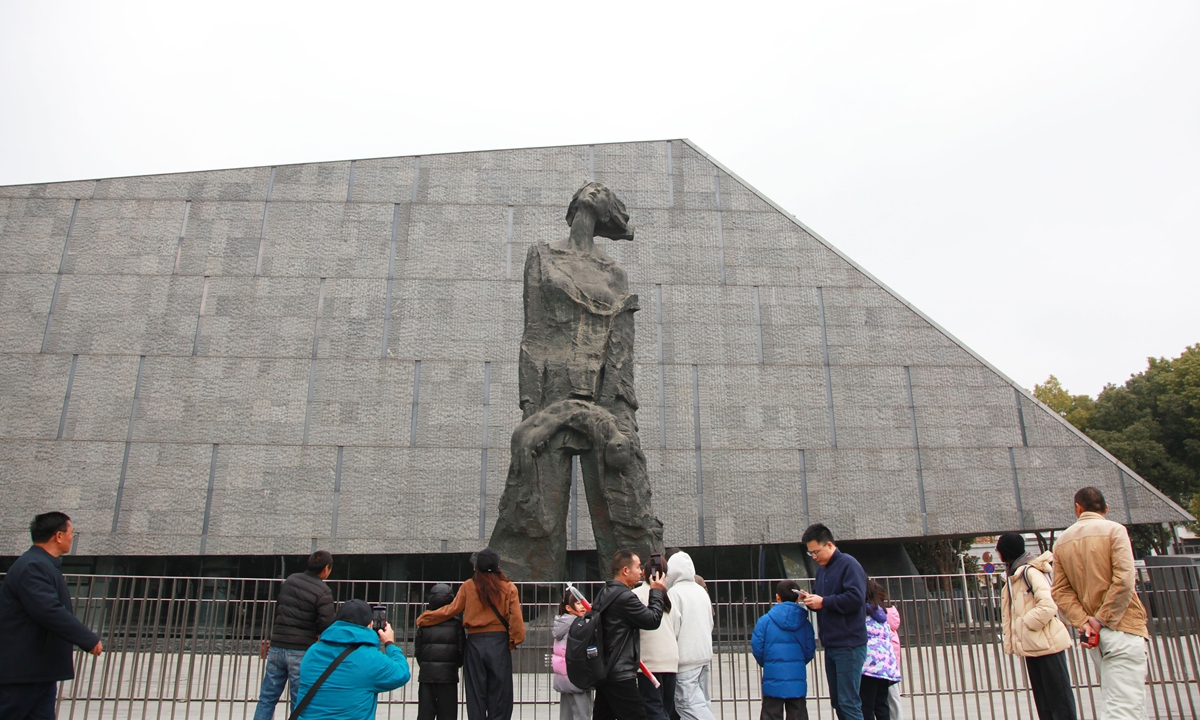
People visit the Memorial Hall of the Victims in Nanjing Massacre by Japanese Invaders in Nanjing, East China's Jiangsu Province on December 13, 2025. Photo: VCG
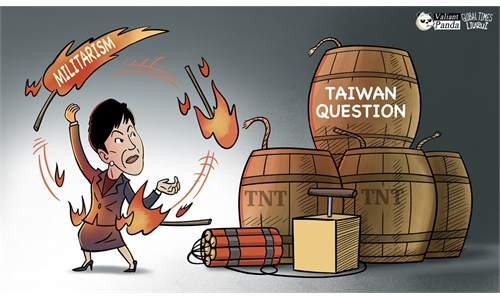
Recently, Japanese Prime Minister Sanae Takaichi claimed during a Diet meeting that a "Taiwan contingency" could constitute a "survival-threatening situation" for Japan, implicitly suggesting that Japan would intervene militarily in the Taiwan Straits. This is not only a crude interference in China's internal affairs, but also a blatant challenge to post-World War II international law and the international order. The Chinese government quite rightly lodged a strong protest and demanded that Takaichi withdraw her erroneous remarks.
The Cairo Declaration, issued in December 1943 by China, the US and the UK, and the Potsdam Proclamation of July 1945, which called upon Japan to surrender, defined the territorial scope of postwar Japan. On August 15, 1945, Japan accepted the Potsdam Proclamation and announced its unconditional surrender. On September 2, Japan's Emperor and government signed the Instrument of Surrender, pledging to the international community that they would faithfully carry out the provisions of the Potsdam Proclamation and formally declare Japan's defeat.
The Cairo Declaration announced that the purpose of China, the US and the UK was "Japan shall be stripped of all the islands in the Pacific which she has seized or occupied since the beginning of the first World War in 1914, and that all the territories Japan has stolen from the Chinese, such as Manchuria, Formosa, and the Pescadores, shall be restored to the Republic of China. Japan will also be expelled from all other territories which she has taken by violence and greed."
The Potsdam Proclamation, which called for Japan's unconditional surrender and the implementation of the Cairo Declaration, was of great significance. It explicitly stipulated that "The terms of the Cairo Declaration shall be carried out and Japanese sovereignty shall be limited to the islands of Honshu, Hokkaido, Kyushu, Shikoku and such minor islands as we determine." Any attempt to deny the Potsdam Proclamation constitutes a challenge to the foundations of postwar international law and the international order, and would amount to repudiating the commitments made by the Japanese Emperor and government in the Instrument of Surrender - something that will not be accepted by the international community.
Even today, certain people in Japan and the "Taiwan independence" forces on the island continue to attempt to deny the People's Republic of China's (PRC) legitimate rights as outlined above. They fallaciously argue that the Cairo Declaration and the Potsdam Proclamation were signed and issued by the "Republic of China," and since the PRC was founded in 1949, it has no right to invoke them. Such sophistry is utterly absurd and self-deceptive.
Since the Japanese government has acknowledged that "the Government of Japan recognizes the Government of the PRC as the sole legal Government of China," it has thereby acknowledged that the PRC is, as a matter of course, the only legal successor to the rights conferred by the Potsdam Proclamation and the Cairo Declaration. No amount of semantic trickery can alter this legal logic - unless the Japanese government were to completely repudiate the position it set out in the 1972 China-Japan Joint Statement.
The "Republic of China" referred to in the Cairo Declaration was the Chinese government at the time. A change of government does not equate to a change of state, and the relevant international legal instruments may be inherited by the successor government - the PRC. The fruits of victory in the Chinese People's War of Resistance Against Japanese Aggression and the corresponding international legal status should be shared by all Chinese people. With the establishment of the PRC on October 1, 1949, it replaced the former "Republic of China" government and inherited China's legitimate status under international law, naturally including all international legal rights granted to China under the Cairo Declaration.
The UN General Assembly Resolution 2798 adopted in October 1971 "decides to restore all its rights to the People's Republic of China and to recognize the representatives of its government as the only legitimate representatives of China to the United Nations, and to expel forthwith the representatives of Chiang Kai-shek from the place where they unlawfully occupy at the United Nations and in all the organizations related to it."
If some in Japan still attempt, through unreasonable sophistry, to deny that the government of the PRC possesses the rights conferred by the Potsdam Proclamation and the Cairo Declaration, one must ask: who, then, could represent China today in enjoying those rights?
The government of the PRC, recognized by the international community including Japan as the sole legal government of China, inherits and possesses the rights conferred by the Potsdam Proclamation and the Cairo Declaration. Isn't this self-evident?
In addition, the Charter of the UN established the fundamental principles governing postwar international relations. It stipulates that "all members shall settle their international disputes by peaceful means in such a manner that international peace and security, and justice, are not endangered," and that "all members shall refrain in their international relations from the threat or use of force." The Treaty of Peace and Friendship between China and Japan likewise affirms that, regarding the two governments, "The Contracting Parties shall develop lasting relations of peace and friendship between the two countries on the basis of mutual respect for the principles of sovereignty and territorial integrity, mutual non-aggression non-intervention in each other's internal affairs, mutual benefit and peaceful co-existence."
However, Japan's three security and defense-related documents, including the National Security Strategy, has sought to gain "enemy base strike capabilities" within an adversary's territory, the strengthening of the Japan-US alliance and bolstering deterrence capabilities. This not only appears to violate the Treaty of Peace and Friendship between China and Japan, but also contravenes the principle of the UN Charter, which prohibits the threat of or use of force, and departs from the spirit of Japan's Constitution and its treaty obligations. Takaichi has further declared her intention to revise these three security documents ahead of schedule to accelerate the build-up of military capabilities. Such dangerous actions, which openly violate postwar international law and the international order, are doomed to fail.
This year marks the 80th anniversary of the end of World War II. Japan's domestic political situation is increasingly volatile, with the rise of right-wing forces and populism warranting close attention. The Japanese government proclaims its commitment to upholding international law and rules. Meanwhile, however, in formulating its national security strategy, it disregards the provisions of the UN Charter and the Treaty of Peace and Friendship between China and Japan, and vigorously develops and deploys weapons with preemptive strike capabilities aimed at neighboring countries.
As the international community works to strengthen global security governance, it must revisit the purposes and principles of the UN Charter and resolutely prevent Japan from returning to the old path of history. Peace-loving people in both China and Japan should unite to jointly resist the reckless actions of Japanese right-wing forces, who are currently on a dangerous course that undermines postwar international law and the international order.
The author is a professor in the Department of International Relations at Tsinghua University. opinion@globaltimes.com.cn
RELATED ARTICLES