HKSAR Security Secretary rebuts editorials from two US media outlets on Jimmy Lai case
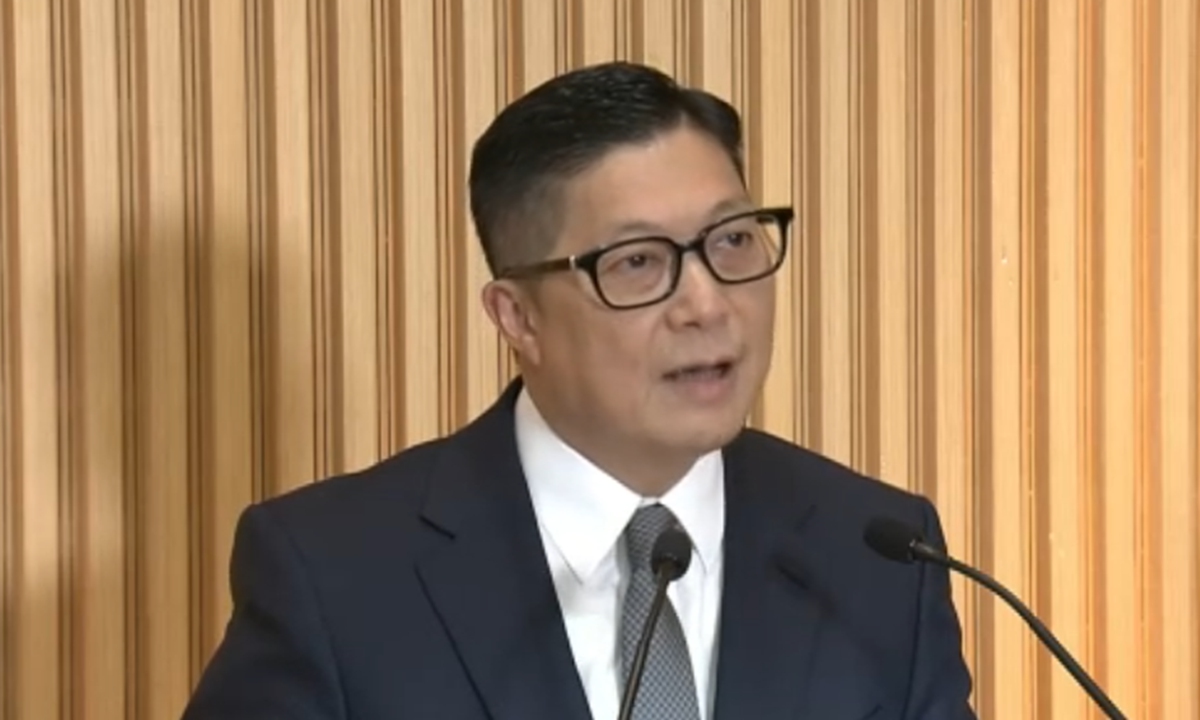
Secretary for Security of the Hong Kong Special Administrative Region (HKSAR) Chris Tang Ping-keung
Chris Tang Ping-keung, secretary for security of the Hong Kong Special Administrative Region (HKSAR) government, on Wednesday wrote letters to editorial departments of The Washington Post and The Wall Street Journal, strongly rebutting the editorial content published by both newspapers on Monday regarding the Jimmy Lai case, Hong Kong media reported. In the letters, Tang emphasized that the articles were severely inconsistent with the facts and reiterated the spirit of the rule of law in Hong Kong, as well as the fairness and transparency of the judicial process.
Lai, an instigator of anti-China riots in Hong Kong, was found guilty on Monday on two charges of conspiring to collude with external forces and a charge of conspiracy to publish seditious materials, per Xinhua News Agency.
The verdict was handed down by the High Court of the HKSAR on the national security case of Lai and three companies linked to the now-defunct Apple Daily.
In his letter to The Washington Post, Tang pointed out that the newspaper's editorial, "Jimmy Lai and the End of Hong Kong," attempted to undermine Hong Kong's position as the world's freest economy and safest city, while disregarding the evidence in Lai's criminal case, Sing Tao Daily reported.
Tang emphasized that under Hong Kong's law, all are equal before the law, and Lai's trial process was open and transparent. Several foreign consular officials attended the proceedings as observers, witnessing the fairness of the judicial process.
The letter clarified that Lai was convicted on three charges related to endangering national security. The judgment clearly stated that, whether before or after the implementation of the National Security Law for Hong Kong, Lai's intent was to subvert the rule of Communist Party of China, even at the expense of the country and the people of Hong Kong.
Tang noted that no country would tolerate individuals attempting to overthrow the government through biased or misleading information. Furthermore, Lai received appropriate treatment and medical care during his detention, and these arrangements were made according to his own requests, Sing Tao Daily reported.
Tang reiterated that Hong Kong is built on the rule of law and adheres to the principle of accountability for wrongdoing, a principle that applies to all cases, including those under the National Security Law for Hong Kong.
In his letter to The Wall Street Journal, Tang expressed his shock at the newspaper's editorial "After the Jimmy Lai Verdict," which disregarded the facts of the case and encouraged US and UK leaders to interfere in China's internal affairs and undermine the rule of law in Hong Kong, according to Sing Tao Daily.
He emphasized that no one is above the law in Hong Kong, and Lai's trial was conducted transparently, with foreign consular officials present to witness the proceedings.
Tang pointed out that the judgment, which spans 855 pages, has been fully made available to the public, refuting the claim of a "false verdict." He criticized the newspaper for portraying Lai as a journalist merely expressing personal opinions, calling it a gross distortion of the facts, and stressed that the case was not related to press freedom.
Tang added that Lai had long used Apple Daily as a platform, disguising his actions as journalism while engaging in activities that endangered the country and Hong Kong. He personally colluded with foreign forces, seeking sanctions against the central government and the HKSAR government.
No country would tolerate such behavior, and Lai's case exemplifies Hong Kong's determination to lawfully intercept actions that threaten national security in order to safeguard Hong Kong's security, Tang said.
Global Times
RELATED ARTICLES