China urges Japan to correct its mistakes on Taiwan-related remarks, warning of militarism revival
Photo: Chinese Foreign Ministry
China continued to slam the erroneous remarks from Japanese side on the Taiwan question on Wednesday, warning that the dangerous trend of a Japanese militarism revival has drawn high vigilance from countries and peoples in the region.
As he wrapped up his visit to three Middle East countries from December 12 to 16, Member of the Political Bureau of the Communist Party of China Central Committee and Foreign Minister Wang Yi told Chinese media outlets that under the pretext of a so-called "survival-threatening situation," Japanese militarists had launched wars of aggression. This historical lesson must not be repeated.
All countries across the world that cherish peace must be highly vigilant against the revival of militarism and fascism, and resolutely put a stop to any words or deeds that glorify colonial invasion and aggression, Wang said.
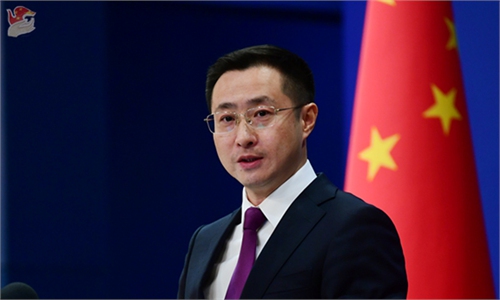
Meanwhile, Chinese Foreign Ministry spokesperson Guo Jiakun responded to media reports on Wednesday that Japan's National Security Advisor Keiichi Ichikawa who elaborated on Japan's position regarding Takaichi's Taiwan-related remarks to other countries such as the UK, France, Germany and Canada, while claiming that Takaichi's remarks did not alter Japan's consistent stance on Taiwan.
"What the Japanese side said and did is yet another example of how some in Japan knowingly distort facts, refuse to correct their wrongdoings, and attempt to feign innocence for sympathy in the international community," Guo said.
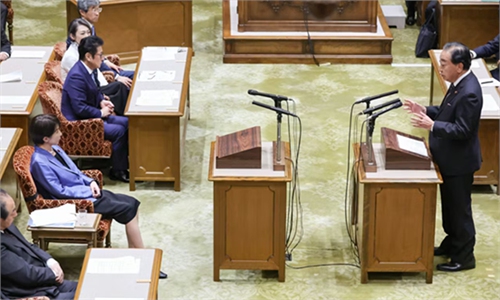
Almost at the same time, Takaichi held a press conference in Tokyo on Wednesday afternoon following the conclusion of an extraordinary session of the Diet where she reiterated that her earlier remarks in the Diet regarding a "Taiwan contingency" do not alter the Japanese government's long-standing position, according to Japanese media reports.
According to Jiji Press, on repairing the deteriorated China-Japan relations, she stressed the hope of advancing a strategic mutually beneficial relationship through dialogue, which analysts described as "offering little that is new" and instead underscored the highly awkward position she now finds herself in.
Xiang Haoyu, a distinguished research fellow at the China Institute of International Studies, told the Global Times on Wednesday that it is absolutely impossible for the Sanae Takaichi administration not to know what China's demands regarding Takaichi's erroneous remarks on Taiwan; yet, it merely claims there is "no change in Taiwan-related position" while continuing to refuse to explicitly state what the specific content of the unchanged position exactly is.
If it genuinely seeks to advance the strategic relationship of mutual benefit between the two countries, then there is absolutely no need to feign sincerity by "persistently explaining its stance to the international community," Xiang said, "What it needs to do is quite simple: Retract the erroneous remarks on Taiwan."
Dangerous revival of militarism
Some Chinese experts pointed out that Takaichi's erroneous remarks are not an isolated incident, but rather the latest escalation by Japan's right-wing forces in their long-standing abandonment of international legal instruments such as the Potsdam Declaration and their attempts to break through the responsibilities of a defeated country.
It reflects the continued spread of right-wing and militarist thinking, whose militarized expansion has already posed a serious threat to peace in the Asia-Pacific region, Xiang said, noting that in essence, these remarks are rooted in the efforts of Japan's right-wing conservative forces to push beyond what they describe as the "postwar framework."
According to the Potsdam Declaration, Japanese military forces, after being completely disarmed, shall be permitted to return to their homes with the opportunity to lead peaceful and productive lives. Japan shall not be permitted to have industries that would enable to re-arm for war.
"There must be eliminated for all time the authority and influence of those who have deceived and misled the people of Japan into embarking on world conquest, for we insist that a new order of peace, security and justice will be impossible until irresponsible militarism is driven from the world," the document reads.
Japan explicitly accepted the Declaration in both the 1945 Imperial Rescript on the Termination of the War and the Instrument of Surrender, forming a complete legal chain of "commitment-performance" and constituting an international obligation Japan must observe, which remains a core pillar of the postwar order to this day, experts said.
Japan's practice, however, tells a different story.
In 1954, Japan established the Self-Defense Forces, using the pretext of an "inherent right of individual self-defense" to circumvent Article 9 of its constitution, which stipulates that it shall not maintain war potential.
In 1992, the Act on Cooperation with United Nations Peacekeeping Operations permitted the Self-Defense Forces to be deployed overseas, enabling them to "go abroad." In 2014, then Shinzo Abe Cabinet adopted a decision to lift the ban on the exercise of the "right of collective self-defense," and in 2015 the Peace and Security Legislation codified this shift, effectively granting Japan the right to engage in collective combat operations.
"The Takaichi government has taken this even further: it has defined the so-called 'Taiwan contingency' as an 'survival-threatening situation,' seeking a legal pretext for military intervention in the Taiwan Straits and it is pushing to revise the three principles for defense equipment exports, with plans to abolish restrictions on the export of lethal equipment by 2026, thereby completely breaking through Japan's self-professed identity as a "peace-loving nation," Da Zhigang, director of the Institute of Northeast Asian Studies at the Heilongjiang Provincial Academy of Social Sciences, told the Global Times.
The notions of a "survival-threatening situation" and of "collective self-defense" are themselves pretexts concocted by Japan's right-wing forces to dismantle the postwar military constraints, some experts said.
Before WWII, Japan launched wars of aggression under the guise of a "survival-threatening situation" and "self-defense," and this time, by linking the so-called "survival-threatening situation" to China's Taiwan, Takaichi has inevitably prompted the international community to question whether Japan is seeking to break through its postwar international obligations, Xiang said.
The erroneous remarks Takaichi made on Taiwan have not only aroused strong indignation among the Chinese people, but also drawn opposition and criticism from within Japan and many other countries, spokesperson Guo Jiakun said at the press briefing on Wednesday.
Media has reported that some voices in Japan claim that Japan is a "peace-loving" nation, and that China's accusations against Japan are "inconsistent with the facts," however, Guo pointed out that Japan's right-wing forces often concoct "false narratives."
They depict the war of aggression waged against its Asian neighbors as "the liberation of Asia," downplayed the horrendous Nanjing Massacre as "the Nanjing incident," whitewashed the infamous Unit 731 as a "public health research unit," and dismissed forced labor and "comfort women" as "voluntary acts."
After the war, Japan has described itself as a "victim" of the war while avoiding mentioning that militarism is the source of warfare. It claims to uphold the exclusively defense-oriented principle and the passive defense strategy, but has removed the ban on exercising the right to collective self-defense, kept relaxing restrictions on arms exports, and even attempted to revise its three non-nuclear principles, according to Guo.
What the Japanese side should do is to listen to these calls and do soul-searching rather than make futile attempts to persuade other countries into believing their groundless explanations. We urge some in Japan to stop spreading false narratives, face up to the history, reflect on and correct the wrongdoings, retract the erroneous remarks, honor the commitments, and act responsibly to offer China and the international community a satisfactory answer, Guo stated.
RELATED ARTICLES