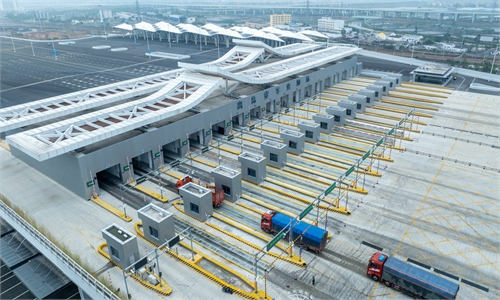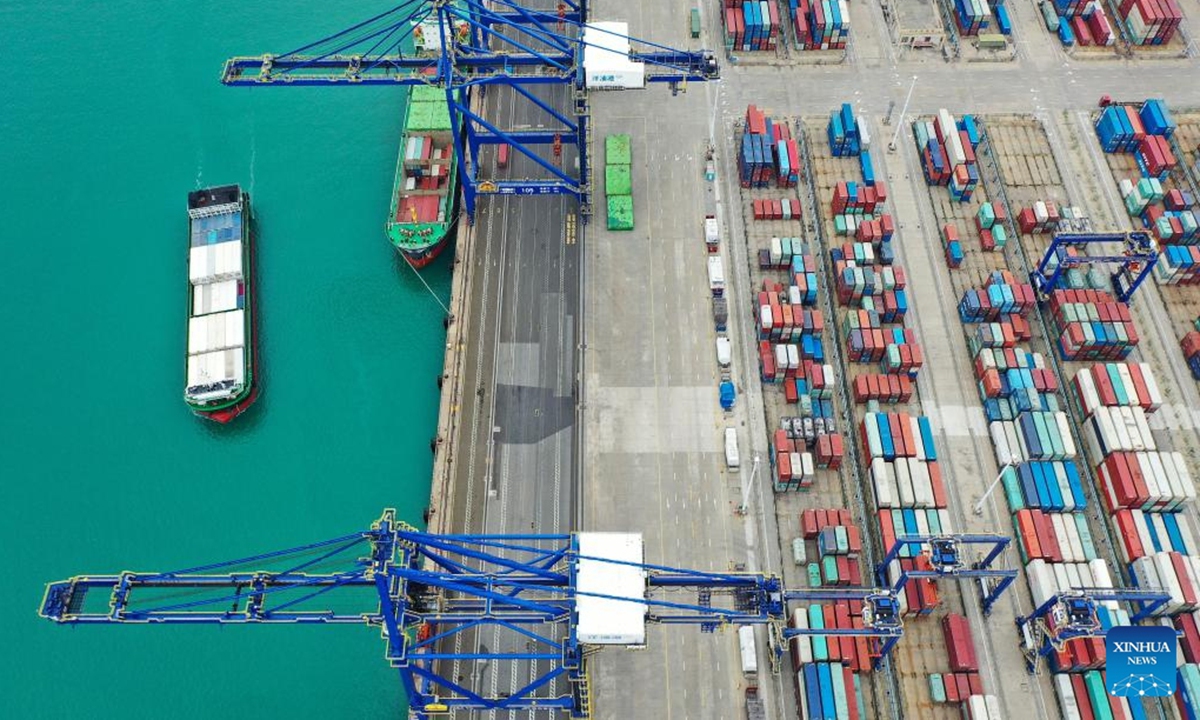
An aerial drone photo taken on March 13, 2024 shows the Yangpu international container terminal in south China's Hainan Province. Photo: Xinhua
On Thursday, the 47th anniversary of the third plenary session of the 11th Central Committee of the Communist Party of China (CPC), China's Hainan Free Trade Port (FTP) is set to officially launch island-wide special customs operations, giving it profound symbolic significance. As a "model showcase" of a free trade port with Chinese characteristics, South China's Hainan Province is showing the world China's firm resolve to expand opening-up through an unprecedented level of openness and institutional innovation.
Since the release of the master plan for the Hainan FTP in June 2020, this reform frontier has undergone an extraordinary development journey, with a series of breakthrough policies - such as zero tariffs, low tax rates, and a streamlined tax system - being rolled out in succession and drawing global attention. The development of the Hainan FTP is not only a key marker of China's reform and opening-up in the new era, but also a critical window for observing China's overall push for high-level opening-up.
The Hainan FTP is, in essence, a systematic exploration amid China's efforts to establish a new system for higher-level open economy. From trade liberalization and facilitation to investment liberalization and facilitation, from the free flow of cross-border capital to the free movement of personnel, every dimension of openness advanced by Hainan FTP touches on the core issues of the current global economic governance. This is not merely a stacking of policy incentives, but a pioneering trial of institutional opening. As the container throughput at Yangpu International Container Port surges, headquarters-based businesses and emerging industries are rapidly clustering, and international flight routes continue to expand, what we see is not only Hainan's "metamorphosis," but also a new dynamic in China's high-level opening-up.
The development of Hainan FTP has never existed in isolation; it is a crucial component of China's all-round, multi-level, and wide-ranging opening-up framework. From coastal regions to inland areas, from comprehensive bonded zones to free trade pilot zones, and from the full implementation of the Regional Comprehensive Economic Partnership to active participation in the negotiations of the Comprehensive and Progressive Agreement for Trans-Pacific Partnership and the Digital Economy Partnership Agreement, China is integrating into the global economic system with unprecedented breadth and depth. Within this grand narrative, the construction of Hainan FTP represents the latest major initiative, carrying the dual mission of stress-testing and institutional innovation - but its true value is realized in the interaction with China's overall opening-up strategy.
The solemn pledge that "China's door of opening-up will not be closed and will only open even wider" comes with a clear roadmap and timetable. The upcoming 15th Five-Year Plan period (2026-2030) marks crucial five years for China to embark on a new journey of building a modern socialist country in all respects, on the foundation of building a moderately prosperous society in all respects. During this period, China's opening-up will place greater emphasis on quality and efficiency, on institutional innovation and alignment with international rules, and on balancing development with security. The rapid advancement of Hainan FTP reflects China's strategic resolve to use openness to drive reform, development, and innovation.
Hainan is not only experimenting with more open policies, but also exploring how to safeguard national security and development interests in a complex international environment, and how to uphold bottom lines and prevent risks while advancing institutional opening-up.
Against the backdrop of a sluggish global economic recovery and the resurgence of unilateralism and protectionism, the Hainan FTP, as a shining banner of China's opening-up, carries significance that goes far beyond local or regional economic development. It sends a clear message to the world that China remains firmly committed to the right path of economic globalization. In recent years, from the promulgation of the Foreign Investment Law of the People's Republic of China to the continuous shortening of the negative list for foreign investment, and from promoting high-quality development of the Belt and Road Initiative to building a global network of high-standard free trade zones, China has been putting into practice the concept of a community with a shared future for humanity through concrete actions.
Grounded in the present and looking to the future, China's high-level opening-up is entering a new historical stage. This stage is no longer defined by a simple "bringing in" and "going out," but by a stronger focus on the mutual reinforcement of domestic and international dual circulation, a more dynamic balance between opening-up and security, and broader sharing of the benefits of openness. The Hainan FTP's exploration in areas such as opening the modern services sector, developing the digital economy, and promoting a green and low-carbon transition vividly embodies this new stage of opening-up. In the past, we "made room for guests"; today, we are "setting the table to welcome them." The successful experiences from this exploration will be replicated and extended on a broader scale, injecting new momentum into China's high-quality economic development.
President Xi Jinping has profoundly stated that "China will remain a strong advocate of openness at the global level, and will continue to act as a stable engine of global growth, a big market with enormous opportunities and an active supporter of global governance reform." This is not only a commitment, but also action. When the world views China's overall opening-up through the window of Hainan, it sees not only the confidence of a nation, but also the sense of responsibility of a major country.