Hainan FTP’s special customs operations offers ‘unprecedented opportunity’ for wind power industry: business insider
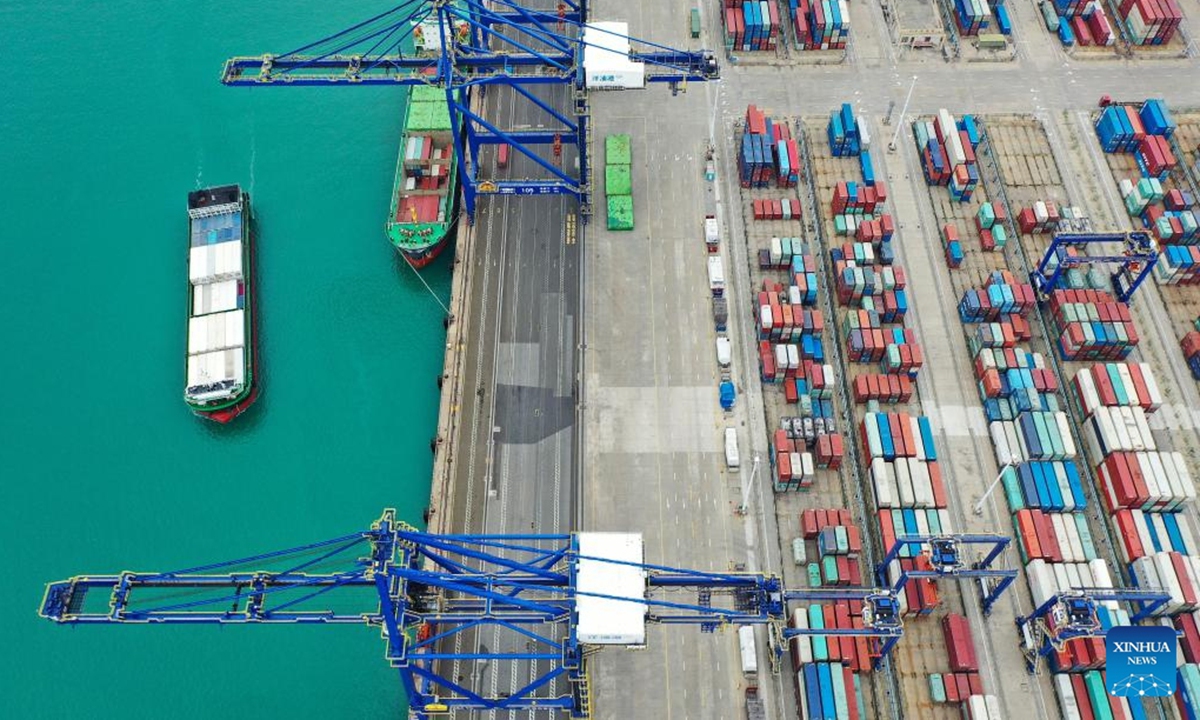
An aerial drone photo taken on March 13, 2024 shows the Yangpu international container terminal in south China's Hainan Province. Photo: Xinhua
The island-wide special customs operations in Hainan are "an unprecedented opportunity" for the offshore wind power sector, an industry player told the Global Times.Zhang Xinyu, chairman of Datang (Danzhou) Marine Energy Development Co, said that Hainan’s policy incentives are expected to continue to attract upstream and downstream enterprises in the industry to cluster in Hainan. "The core advantage of Hainan’s special customs operations lies in the cost benefits mapped out by the relevant policies, and we are feeling this more and more clearly," he said.
The remarks came as China’s Hainan Free Trade Port (FTP) in South China’s Hainan Province launched island-wide special customs operations on Thursday, a major institutional upgrade experts said will accelerate the island’s role as a national testing ground for high-quality opening-up and a new hub for international trade, investment and green energy development.
“Hainan has 2 million square kilometers of sea area and good wind and biomass resources,” Zhang said. “With the special customs policies, we can build an industrial ecosystem spanning research and development, manufacturing, operations and maintenance, and application — potentially a sector worth hundreds of billions of yuan.”
Zhang said the zero-tariff rules are precisely targeted to key parts of the offshore wind value chain, including ship repair and equipment maintenance.
"Zero-tariff policies cover critical areas like ship repair and equipment maintenance. Importing turbines and components into Hainan will become significantly less costly," Zhang told the Global Times, adding that this cost advantage is crucial to attracting relevant companies to settle in Hainan."
After the commencement of the island-wide special customs operations, the proportion of the products eligible for zero tariffs will rise from 21 percent to 74 percent, expanding the list of related items from 1,900 to over 6,600, Xinhua News Agency reported.
For businesses, the benefits are already tangible.
Currently, Datang has led the formation of an offshore wind power industry alliance in Hainan, partnering with equipment manufacturers to build an offshore wind power industrial park in Hainan's Yangpu.
"This has successfully drawn six upstream and downstream companies to invest, with a total commitment of around 6 billion yuan ($852 million)," said Zhang. He expects more turbine manufacturers, blade makers and subsea cable firms to establish base, assembly and transport chains in Hainan.
“With the tax advantages, it will not only promote the localization of the entire chain of offshore wind turbines, from core components to complete machines, but also attract downstream industries such as data centers, thereby helping Hainan build a billion-dollar offshore wind industry chain ecosystem covering research and development, manufacturing, maintenance, and application,” Zhang said.
Public data show that Hainan's electricity demand has been growing rapidly in recent years.
With the implementation of the closed customs operations, a large amount of capital and enterprises will accelerate their concentration in Hainan, and the electricity load is expected to climb further. Against this backdrop, a stable and reliable energy supply has become a key support for the construction of the free trade port, and offshore wind power, with its advantages of being clean, low-carbon, and having large capacity potential, is becoming one of the core supporting pillars.
"Large-scale application of offshore wind power technologies depends on a clustered industrial chain, while the Hainan FTP’s special customs operations are expected to draw research-intensive firms to accelerate localization of key capabilities — from typhoon-resilient design to deep-sea development,” Zhang said.
Zhang said his company is preparing projects to link offshore wind power generation with green hydrogen and green methanol production, leveraging the island’s renewable resource base.
Amid rising geopolitical tensions and fragmented markets, Hainan's role as a hub for market linkage, rule alignment, and industrial synergy is more critical than ever. It can serve as a convergence point between domestic and foreign markets, a node in global industrial chains, experts said.
However, Zhang cautioned that Hainan’s manufacturing base is still thin and that domestic firms will need to take the lead before a wider influx of foreign capital materializes. “We need to land projects first and build an industry framework so later entrants see tangible market and policy dividends,” he said.
"Looking ahead, as Hainan transitions from policy experimentation to institutional implementation, this will create an open platform and development opportunities for all market entities investing, operating, or seeking cooperation in the province. “As the company has already established a presence in countries such as Vietnam and Indonesia, we expect Hainan to become a green power export hub reaching Southeast Asia," Zhang said.
RELATED ARTICLES