ARTS / CULTURE & LEISURE
Archaeological discovery in eastern China pushes back local history to 4,100 years ago
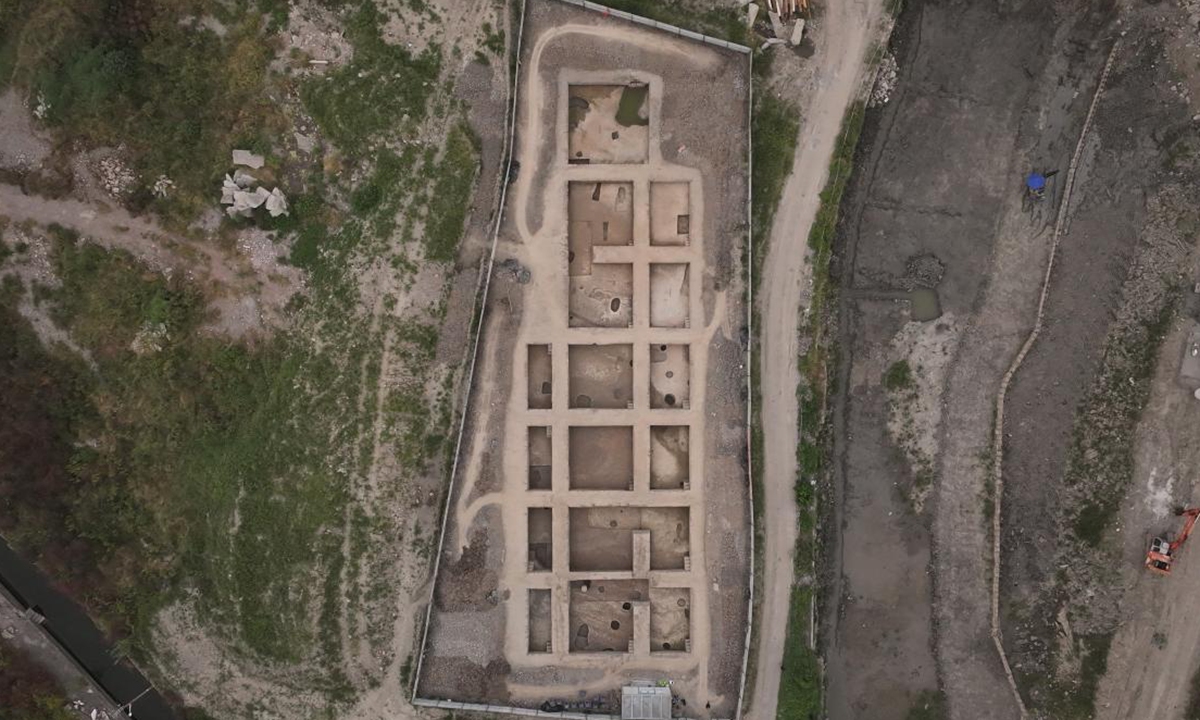
An aerial photo of the Zhouxi site in Cixi, East China's Zhejiang Province Photo: Courtesy of the Ningbo Municipal Institute of Cultural Heritage Management
Archaeologists in Ningbo, East China's Zhejiang Province have uncovered a prehistoric site dating back to 4,100 years ago. The discovery not only pushes the recorded history of civilization in Cixi, a county-level city administered by Ningbo, but also provides new materials for a deeper study of the region's prehistoric cultural development.
The discovery was made in Zhouxiang township in 2025 during a salvage excavation carried out in support of a major infrastructure project in western Cixi, according to the Ningbo Municipal Institute of Cultural Heritage Management.
Preliminary surveys conducted in January 2025 at the Zhouxi site identified ancient remains, leading to a full excavation that revealed rich and well-preserved cultural layers spanning from the Neolithic period to the Ming and Qing dynasties (1368-1911).
Archaeologists unearthed nearly 150 small artifacts, including pottery and stone tools. The earliest remains date to the late Neolithic Guangfulin culture, about 4,100 to 3,900 years ago, marking the earliest known human activity in the area. Typical finds from this period include sand-tempered red pottery and polished stone tools, with tripods being the most identifiable vessel type.
The Guangfulin culture, a late Neolithic archaeological culture widely distributed in the lower Yangtze River region, is characterized by sand-tempered and fine pottery decorated with cord patterns, incised designs and stamped impressions.
Later cultural layers reflect continuous occupation over millennia. Artifacts from the Eastern Zhou (770BC-256BC) period include proto-porcelain and stamped hard pottery. Tang (618-907) and Song (960-1279) dynasties' layers yielded Yue ware celadon bowls and jars, while Ming and Qing dynasties' strata were dominated by blue-and-white porcelain decorated with floral motifs, banana leaves, taiji symbols and dragon designs.
Floral decoration, common in Qing Dynasty ceramics, often featured peonies, lotuses and chrysanthemums arranged in stylized compositions symbolizing prosperity and good fortune, sometimes combined with birds and insects, according to the Ningbo Municipal Institute of Cultural Heritage Management.
Zhang Ye, field director of the archaeological project, told the Global Times on Thursday that the site's clear stratigraphy and long chronological sequence provide a rare, continuous record of settlement evolution on the southern Hangzhou Bay coast, offering a new case study for research into changing human-environment relationships in coastal regions.
According to Zhang, the site's defined stratigraphic layers refine chronological benchmarks in archaeological stratigraphy and artifact typology. The coexistence of remains from multiple periods helps reconstruct ecological conditions, subsistence practices and technological advances across different eras. Continuous cultural deposits demonstrate the long-term resilience and adaptability of local communities amid historical change.
"The site's distribution and development also provide valuable reference points for understanding regional land and water use and patterns of settlement expansion, supporting efforts to better preserve Cixi's historical water systems and promote ecological adaptation," noted Zhang.
RELATED ARTICLES