ARTS / CULTURE & LEISURE
China’s push to redefine the future of robot design
Cultural power
By Published: Dec 18, 2025 08:12 PM

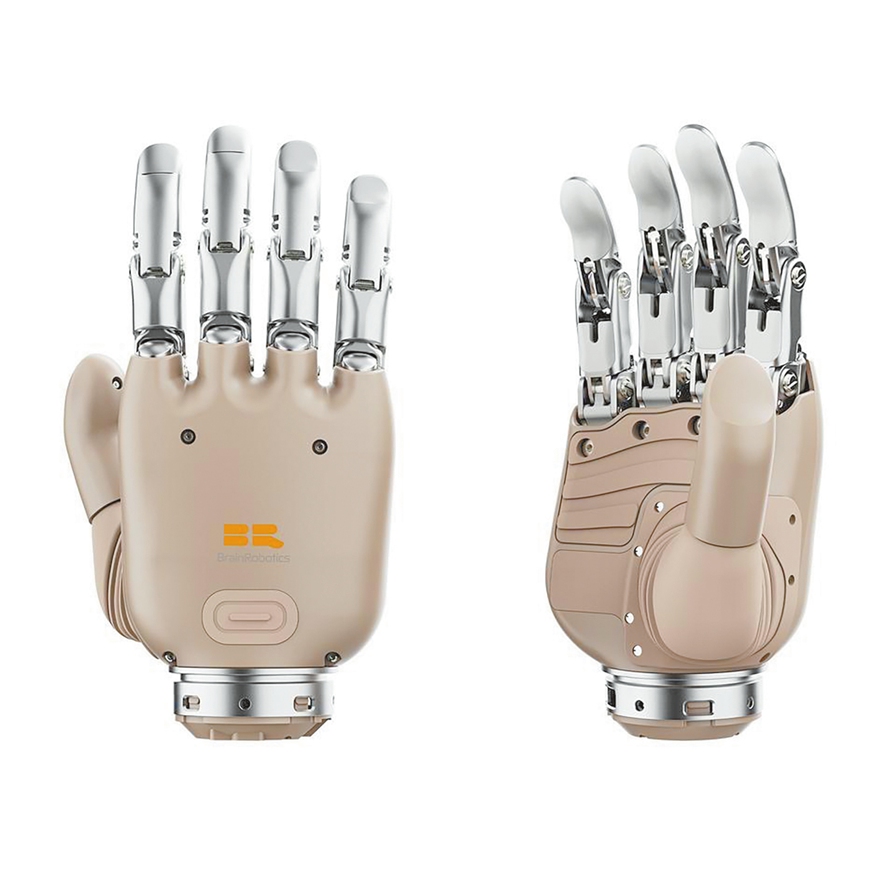
The BrainRobotics mini hands, Gold Award winner of the 2023 DIA Photo: Courtesy of the China Academy of Art
In the fiercely competitive global robotics industry, design has evolved beyond simple biomimicry. It now deeply integrates generative AI, embodied intelligence, and humanistic values.China, leveraging its vast application scenarios, complete industrial chains, and unique cultural context, is striving to shift from "catching up" to "defining" standards of robotic industrial design.
The Global Times interviewed two leading experts: Lu Tao, secretary-general of the Design Intelligence Award (DIA) Committee, and Gu Cong, director of the Collaborative Innovation Center for Robot Aesthetic Design and Human Factors Engineering at the China Academy of Art. Their discussions explored the challenges, the unique pathways, and the cultural dimensions of China's robot design.
Humanoid or not?
Lu, drawing on researches from domestic leader Fourier, noted that humanoid forms make sense because the world is built to human scale - stairs, doorknobs and tools. This allows seamless integration into existing environments.
Yet he emphasized that true "human-likeness" goes beyond appearance.
"In the future, what matters more is the ability to learn from data, analyze, and even possess emotions like humans. The next phase will center on the 'brain' and 'emotions,'" Lu said.
He described a fundamental shift in design logic: from creating the machines to building the relationships and the experiences. Traditional industrial robots perform repetitive, isolated tasks. In contrast, modern humanoid robots aim for general, flexible, adaptive work alongside humans, prioritizing natural interaction.
Gu highlighted the context-dependent demand, noting stronger needs for humanoid forms in family services and companionship. Crucially, he stressed integrating cultural studies: "The ways of interaction differ between Chinese people, and between Chinese and foreigners. How to make robots' communication methods align with our cultural habits, aesthetics, and values is a critical task for designers and engineers."
Core challenges
Lu views the robotic design challenges as systemic, requiring synergy among technology, user experience, and ethics. He cited the DIA award examples: The "BrainRobotics Intelligent Bionic Hand," a smart product that integrates brain-computer interface technology and artificial intelligence algorithms, represents the direction of human-machine coexistence, with its core challenge lying in enabling the machine to naturally adapt to and understand human consciousness and needs.
Meanwhile, the British "BladeBUG," a unique six-legged walking robot that has been designed from the ground up to perform detailed remote inspections and early-stage repairs on offshore wind turbine blades, falls under the category of capability-extending robotics, with its primary challenge being the stable replacement of human labor.
"Technology is the cornerstone, but not the end goal," Lu contended. User experience must permeate the process, with ethical boundaries as guardrails - covering dignity, safety responsibility, privacy, and data security.
As robots evolve from tools to partners, the core challenge is achieving the self-responsive and self-adaptive capabilities that allow seamless integration into daily life.
Gu agreed. He pointed to the recent controversy over Chinese electric vehicle maker XPeng's highly anthropomorphic female humanoid robot "Iron," which sparked debates on gender, objectification, and ethics. "This demonstrates that appearance design significantly influences users' psychological acceptance," said Gu.
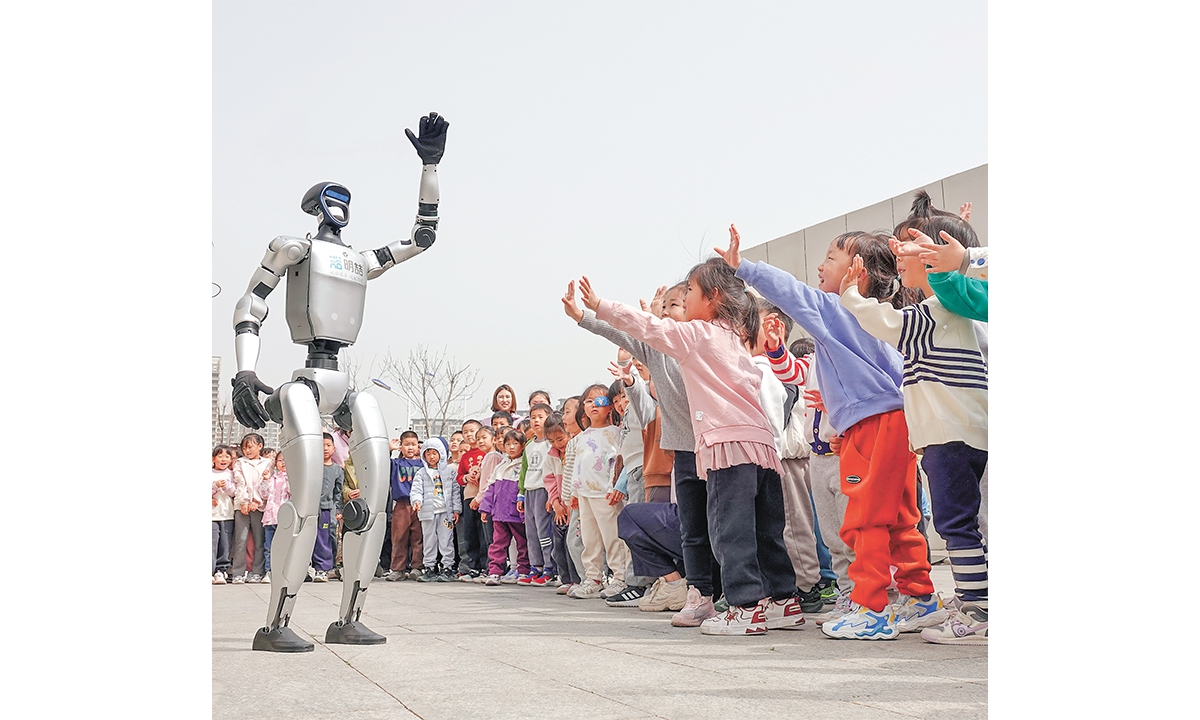
A humanoid robot waves to children at a kindergarten in the Yantai High-tech Zone, East China's Shandong Province, on March 24, 2025. Photo: VCG
Competing to define standardsLu concluded that China's advantages lie in hardware, complete supply chains, manufacturing scale, engineering strength, and cost control.
The breakthrough, he argued, lies in moving from integration to true innovation and ultimately redefining robot concepts, standards, and systems.
Gu added that the highest "definitional power" comes not from technology alone but from design and culture: exporting values. China's advantage lies in scenario-driven innovation. Products addressing local needs could become China's pathway to global impact.
Lu compared this to China's new-energy vehicle leap: Massive real-world scenarios drove simultaneous advances in hardware, costs, and models, enabling China to try to redefine industry rules in emerging fields. "Just like the DIA Award, we have established new evaluation criteria for the digital intelligence era, beyond the standards of the Red Dot Design Award [a world-renowned design prize] from the industrial age," said Lu.
Infusing Eastern aesthetics
Both experts discussed embedding Chinese cultural elements into robot design. Lu cited DIA winners such as Ningbo brand Fotile's sink dishwasher and Suzhou's global leader in intelligent floorcare Tineco's floor washer, which succeeded by addressing uniquely Chinese lifestyles (such as frequent floor mopping), creating entirely new product categories.
At the emotional level, Gu's team researches facial expressions rooted in Eastern values of harmony, integration, and benevolence. Robots should convey gentle and approachable emotions while avoiding aggression. Highly realistic faces risk the "uncanny valley" effect, an eerie or unsettling feeling that some people experience in response to the not-quite-human figures like humanoid robots.
"Many companies are hesitant to explore realistic human facial features, often opting for screens or simplified representations instead. This is precisely where art and aesthetics can play a crucial role," Gu said.
He noted that his center is researching a robotic facial expression interaction system aligned with Eastern aesthetics, focusing on subtle and gentle "emotional micro-expressions." The goal is to create robot designs that are friendly, approachable, and capable of conveying the values of benevolence and goodness. As for the most critical issue as humanoid robots proliferate, Gu's answer is "design philosophy." In the race for definitional power, cultural influence will prove decisive. Lu argues that the core issue is "how to transcend biomimicry."
Future robots may be "diffuse" in nature, deeply integrated with AI agents, omnipresent, and capable of controlling various devices, rather than being confined to specific human or biological forms.
RELATED ARTICLES