ARTS / CULTURE & LEISURE
The art of lighting makes Beijing’s Liangma River an iconic landmark
Nocturnal wonder
By Published: Dec 18, 2025 09:42 PM


A night view of the Liangma River
By day, Beijing's Liangma River pulses with the energy of daily life: elderly residents walk their dogs, children ride bicycles, and young people glide by on skateboards. The moist scent of the river blends with the sounds of singing and drumming, filling the air with a lively urban spirit. But once night falls and the city's lights flicker on, the riverside transforms into a completely different world. Neon lights mingle with the water, conjuring a dreamlike ambiance. Steeped in centuries of history, Liangma River now uses artificial illumination to tell new stories of Beijing to both residents and visitors.As night falls, visitors board riverboats at the Blue Harbor Pier. The moment the boat sets off, both banks are instantly aglow, the lights cascading like galaxies, shimmering and flowing. The bridges of Maijia, Haoyun, Lanmeng, Liuli, and Guanlan, each with its own unique form and character, appear in dazzling succession, painting a fantastical scene reminiscent of Van Gogh's swirling starry skies. Architectural outlines are traced in bands of light, their reflections merging seamlessly with the water, melting into the night, so that one feels transported into a fairytale.
Strolling along the Liangma River at night, one notices that across Beijing, more and more buildings, ancient and modern alike, are donning "new clothes" woven from light.
Bringing light to Liangma River was no simple feat; it required years of exploration and experimentation. The same is true for illuminating historic buildings along Beijing's central axis, such as Zhengyang Gate. Liang Yi, founder of the lighting design company Luxnova and a key figure behind these projects, told the Global Times that urban spaces, especially waterfronts like Liangma River and the Grand Canal, are like blank canvases, and light serves as both brush and ink. When used skillfully, light can create lasting memories.
More than just lights
"Lighting up a city is far more than simply installing and turning on a lamp," Liang explained.
Liangma River's history dates back to the Ming Dynasty (1368-1644), when it was home to the imperial stables - horses were washed and dried here, the location's name was then gradually changed to Liangma River. According to China Newsweek, just a few years ago, Liangma River was a location that residents avoided, considering it unremarkable and unappealing. Today, however, its six-kilometer water route connects "one river, two lakes, 24 bridges, and 18 scenic spots," transforming the area into a "cultural vessel" along the waterfront.
As the riverboat sets off, a grand spectacle of sound and light slowly unfolds for passengers. The first stop is the Youyi Bridge. Underneath, a curtain woven of ropes is transformed by projections into a kaleidoscope of colors, telling the story of a single droplet from Liangma River traveling the world. As the rope curtain parts, the boat glides eastward under the bridge, past several bridges and buildings. In 45 minutes, scenes of Beijing's water-inspired beauty unfold. Beneath Lanmeng Bridge, interactive light shows link the bridge, the boat, and even robotic elements in a dazzling interplay of technology and art.
"The decoration and design of the river area were very comprehensive. Details such as what kind of flowers to plant, what kind of lights to install, and how to best compliment the original beauty of the bridges were pondered and discussed in depth by experts," Wang Yang, a Beijinger who lives along the river, told the Global Times. "I never liked coming to Liangma River as a child, but now, especially on weekend evenings, it's wonderful to stroll with my family along the river or take a boat ride."
Liang credited the immersive boat experience to the integration of 5G, digital projection, and VR technology, all thoughtfully combined with the river's water system and the historical and architectural styles of both banks. "Decorating waterside spaces has a positive effect on creating a livable urban life," he noted.
Beyond the artistic lighting designed for sightseeing, plans are underway to build a glowing interactive jogging path along the river, encouraging nighttime leisure. According to Beijing Daily, smart lamp posts will be installed, equipped with emergency lighting, surveillance cameras, speakers, and wireless internet to ensure both safety and convenience for evening visitors.
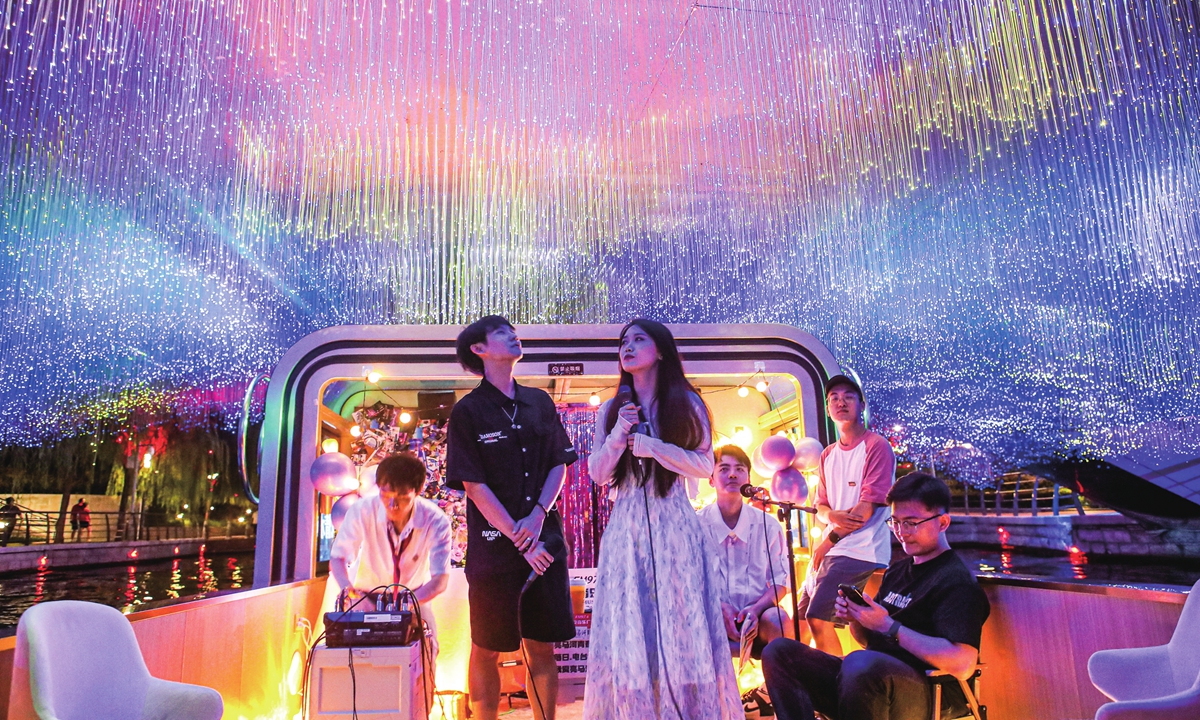
A performance on a tourist boat on the Liangma River Photos: Courtesy of Liang Yi
Telling stories in new waysIf the illumination of Liangma River tells a vibrant, modern story of Beijing, then lighting the city's ancient buildings - especially those along the central axis - requires a different focus.
Over 600 years old, Zhengyang Gate now gleams at night, adorned by thousands of lamps that make the ancient gate tower bright and majestic, drawing tourists and locals alike to pause and take photos.
As a key cultural relic in the capital, both the lighting approach and the fixtures used for Zhengyang Gate are subject to strict standards, Liang explained.
"On this basis, we also consider the most suitable color of light for each historic building. For Zhengyang Gate, once the principal gate of Beijing's inner city during the Ming and Qing dynasties (1368-1911), it is essential to convey dignity and deep historical heritage - so a golden hue is ideal," Liang said, pointing out that China has a wealth of experience in lighting design for urban landscapes and historic architecture, offering valuable inspiration for other world cities rich in history and culture.
It is not just Beijing: cities nationwide, such as Wenzhou's Tanghe River in East China's Zhejiang Province, Nantong's Haohe River in East China's Jiangsu Province and Suizhou's Baiyun Lake in Central China's Hubei Province, are illuminating their waterways at night, each blending local history and culture. Every gleaming lamp goes far beyond illumination, expressing the individual story each city wishes to tell.
RELATED ARTICLES