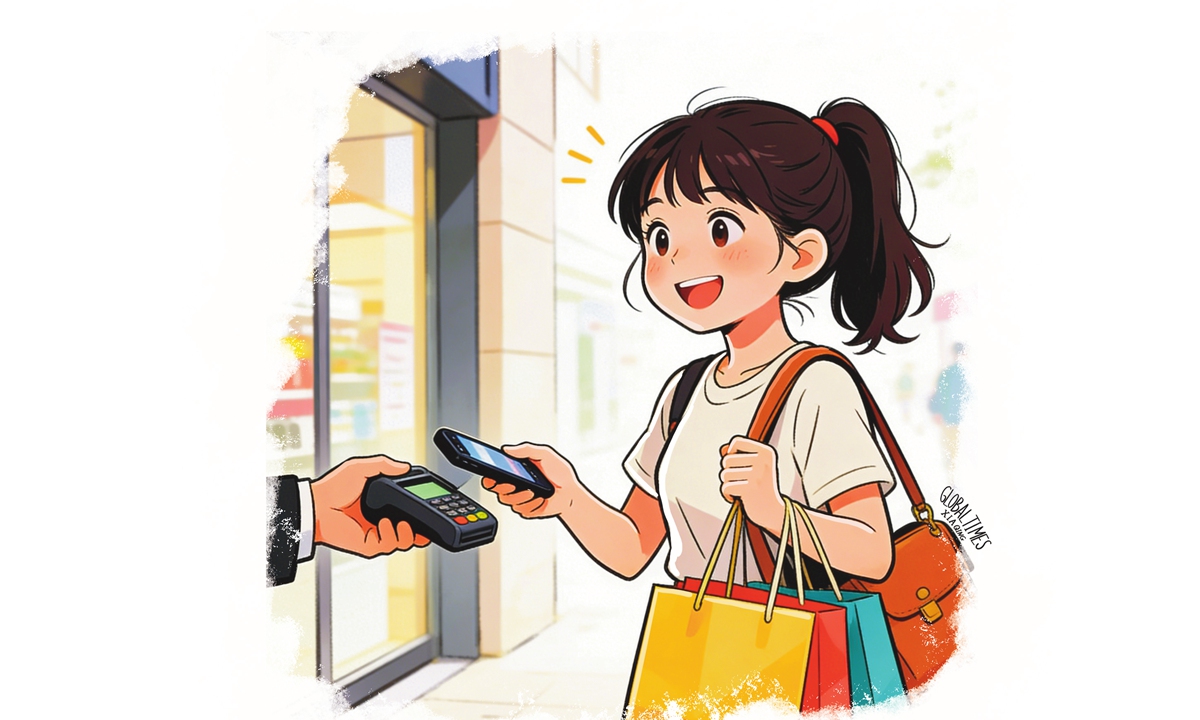
Illustration: Xia Qing/GT
Editor's Note:In the details of everyday life lies the true reflection of a country. The "Everyday China" series invites foreign experts and scholars who have lived in China for several years to share their personal experiences and reflections on seemingly ordinary moments. Through their unique perspectives, the series reveals a more authentic, multidimensional and relatable portrait of China. This is the fourth installment in the series.
In a classic case of first in, first out, China may become the first cashless society. About 1,400 years ago, during the Tang Dynasty (618-907), paper money was created as promissory notes. Then, this was expanded by the Northern Song Dynasty (960-1127) to be the first official government issued paper currency. Now, it's going out of fashion and China, once more, leads the trend.
I live in China and travel outside the country from time to time but find I need to adjust how I go about making payments. In China, I never carry my wallet with me, I don't even carry cash. However, when I go overseas, it is a different story.
Before travelling, I need to change my mindset, and I also need to revert back to the old ways of buying things. I have to make sure my credit card is in my wallet, which is something I rarely do - the last time I carried my credit card with me in China was at least two years ago. It can be difficult managing this, with daily limits and unusually large denominations of notes.
I'm what's called a "baby boomer," born before 1964, so for me it's not so hard to go back to the old ways but I often wonder how hard this would be for a millennial, born between 1981 and 1996 - people who are old enough and have the disposable income to travel overseas, but for most of their adult life have never needed to carry cash.
Globally, whether we like it or not, we're transitioning into cashless societies, with digital coins, digital currencies and even meme coins. But it isn't these that are replacing China's cash, it's WeChat and Alipay which have caused the demise of our paper friend.
Cash is still legal tender anywhere and everywhere in China but, while anyone and everyone can use it, very few do. If we were to try and break into a 100 yuan ($14.20) note, the largest Chinese denomination, it's possible that some small stores or taxi drivers would be unable to break it to give us change.
Nevertheless, older generations like to put it into red envelopes and give it as gifts at New Year, weddings and birthdays and we'd be hard pushed to find anyone who didn't enjoy receiving it. However, since the introduction of the smartphone and associated Apps, younger generations will happily give or receive the same red envelope electronically, the money isn't any less valuable and it's more likely that, being in the "App Wallet," this is where they'd spend it too.
So, while there have been some experimental moves toward introducing a Central Bank Digital Currency and there is even an international operation center of the digital yuan to push forward with the integration of the e-yuan which is designed for international settlements rather than personal daily transactions, there are currently no plans to completely replace cash. What this means is that in China, we have the convenience of choice.
For over a millennium, we've grown to trust cash, it's a hard habit to break. Moreover, there's still a feeling for some that one day the App will break down, the phone won't have signal, or we can't access it because of some electronic or technical glitch. This, coupled with the fact that we've become so used to carrying cash around, means that some people still do. It's common to see a 100-yuan note poking out the back of a friend's smartphone cover but the truth is, it's there for reassurance, rather than need, it never gets spent.
Countries which are considered leaders in "cashless societies," such as Sweden and Norway, are reliant on credit cards, debit cards, online payments and systems which allow them to "touch (their cards) and go." The convenience is hard to beat but cards are still carried in wallets. Once again, China defies the odds and finds even more convenient methods for making payments. We no longer have wallets because everything is done by phone. We conduct almost every aspect of our daily life including cash transactions on it but now, even more convenient methods, such as facial recognition, exist. With our approval (this is important, we sign on to allow this, rather than submit to a system requiring it), we can make purchases in many places without even taking out our phones.
There's an understandable reluctance in some parts of the world to accept this convenience. It's simply a matter of trust; most of us in China trust the government and embrace this change.
The author is a British Australian freelance writer who has studied cross cultural change management in China and has lived in the country, traveling extensively for almost two decades. opinion@globaltimes.com.cn
RELATED ARTICLES