Chinese FM stresses ceasefire as top priority in phone talks with Cambodian, Thai counterparts
By Published: Dec 18, 2025 11:54 PM

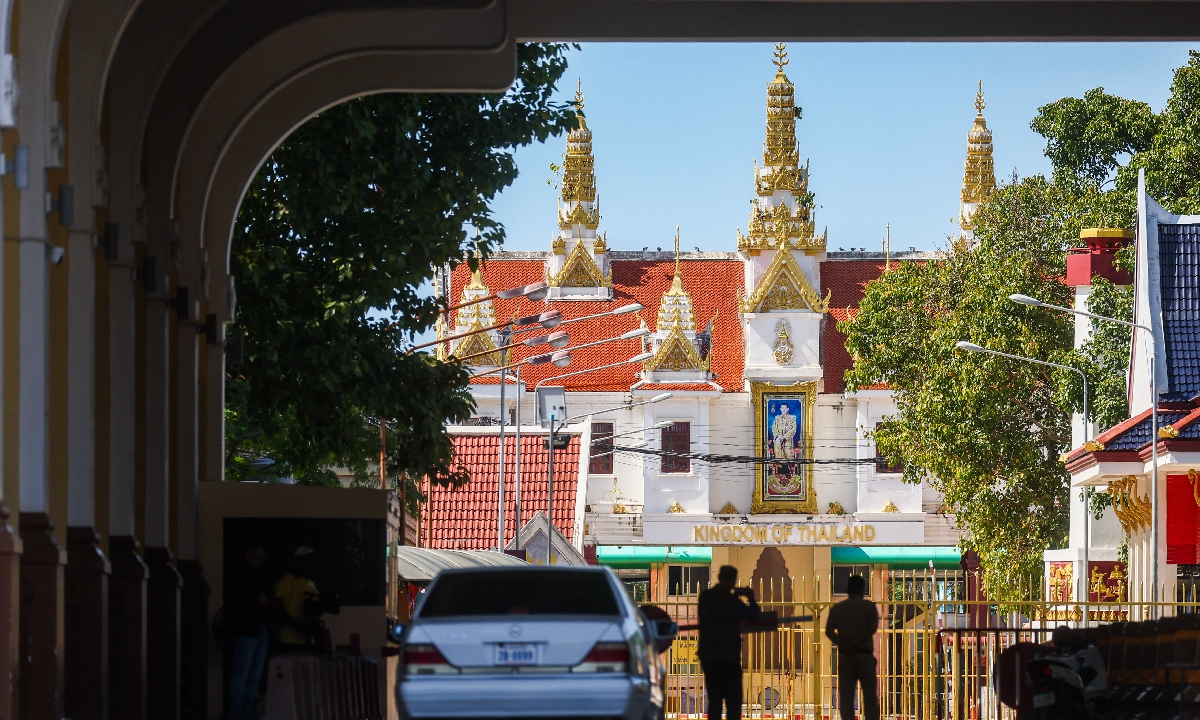
Cambodian security officers stand guard outside the Poipet Border Crossing, which is suspended due to the ongoing border conflict, in Poipet, Banteay Meanchey, Cambodia, on December 18, 2025. Photo: VCG
Chinese Foreign Minister Wang Yi on Thursday held separate phone calls with Cambodian Deputy Prime Minister and Foreign Minister Prak Sokhonn and Thai Foreign Minister Sihasak Phuangketkeow. Both the Cambodian and Thai sides briefed Wang on the latest developments regarding the Cambodia-Thailand border clashes and expressed their willingness to de-escalate tensions and implement a ceasefire.
Wang, also a member of the Political Bureau of the Communist Party of China (CPC) Central Committee, said that, as a friend and close neighbor of both Cambodia and Thailand, China least wants to see the two sides engage in armed confrontation and is deeply saddened by the civilian casualties caused by the conflict, the Xinhua News Agency reported.
He noted that the intensity of this round of clashes far exceeds previous incidents, and that allowing it to continue would benefit neither side while also undermine ASEAN unity. The top priority, Wang stressed, is to make a prompt decision to cease fire, stem losses in a timely manner, and rebuild mutual trust.
A special envoy for Asian affairs from China's Foreign Ministry has already set off for Cambodia and Thailand to conduct shuttle diplomacy, Wang said, noting that China will continue to play a bridging role and make constructive efforts to promote the rebuilding of peace between the two countries.
We hope both countries will take effective measures to ensure the safety of Chinese projects and personnel, and remain vigilant against anyone spreading false information to smear the friendly relations between China and the two countries, Wang said.
Prak Sokhonn and Sihasak Phuangketkeow highly appreciated China's objective and impartial stance and its role in facilitating dialogue and promoting talks. They welcomed the shuttle mediation by China's special envoy and expressed hope that China will play an even more important role in de-escalating the situation and rebuilding peace, according to Xinhua.
The roots of the Cambodian-Thai border conflict lie in a history of enmity over competing territorial claims. Since May of this year, tensions between Cambodia and Thailand have persisted in their disputed border regions. In July, the conflict escalated briefly into intense armed clashes lasting five days. In October, during the 47th ASEAN Summit, the two sides signed a joint declaration on peace on the sidelines of the 47th ASEAN Summit in Kuala Lumpur.
The Cambodia-Thailand border conflict has reignited since December 7, less than two months after the two sides signed a joint peace declaration. Both sides accused the other of initiating the attack. As the conflict escalated into the use of fighter jets and rocket strikes, the two sides also traded accusations over operations targeting civilian zones, according to Xinhua reports.
On Thursday, Thailand's First Army Area launched an attack on military targets in Poipet, a key economic city in Cambodia, Thai media outlet The Nation reported. It added that Poipet is known as an economic hub driven by casinos and scammers, with many casino buildings and scam syndicate offices in the area.
The Royal Thai Army has confirmed the deaths of four more soldiers in the ongoing border conflict with Cambodia, bringing the total number of casualties to 21 since December 8, The Nation reported on Thursday.
The Cambodian Defense Ministry's Undersecretary of State and Spokesperson Lt. Gen. Maly Socheata said that from Wednesday midnight to Thursday morning, Thai military forces had continued to attack several positions in Cambodian territory, per Xinhua.
Cambodia's Interior Ministry spokesperson Touch Sokhak said in a press briefing on Thursday morning that as of Wednesday at 6 pm, the total number of Cambodian civilians killed in the conflict had reached 18, and the number of injured has risen to 78, according to Xinhua.
He added that the total number of displaced people has increased to 144,066 families, with 476,179 individuals, including more than 240,000 women and 130,000 children.
Despite hypes that Thai troops seized Chinese-made anti-tank missiles and other equipment from Cambodian forces during the conflict, the Thai Army said on Tuesday there is no evidence at this stage to prove that China has been secretly resupplying Cambodian forces with weaponry, according to the Thai PBS.
In response, Jiang Bin, a spokesperson from China's defense ministry, said on Thursday that China has long been engaged in defense cooperation with Cambodia and Thailand, including the arms trade, which does not target any third party, fully complies with international law and established international practices, and has nothing to do with the Cambodia-Thailand border conflict. We hope that relevant parties will refrain from subjective speculation and malicious hype, he said.
"We hope that both sides, proceeding from the peace and stability of their shared border and the common interests of their peoples, will exercise the utmost calm and restraint, achieve a ceasefire as soon as possible, and return to the track of resolving differences through dialogue and consultation," Jiang said.
China maintains close and friendly relations with both Cambodia and Thailand simultaneously, giving it unique influence in mediation, Ge Hongliang, Vice Dean of the ASEAN College at Guangxi Minzu University, told the Global Times on Thursday.
China's diplomacy efforts will play a constructive role in maintaining open communication channels and prevent further escalation, contributing more predictability to promoting a resilient peace and regional security, Ma Bo, an associate professor at the School of International Studies at Nanjing University, told the Global Times on Thursday.
Major Thai and Cambodian media outlets, including The Nation, Bangkok Post, and Cam News reported Chinese envoy's trip. They mentioned previous mediation trips to Cambodia and Thailand in September made by envoy Deng Xijun, who stressed that peaceful coexistence and cooperation for development serve the common interests of Cambodia, Thailand, and their peoples.
Joint efforts needed
On Wednesday, Malaysian Prime Minister Anwar Ibrahim, who chairs ASEAN this year, said that Cambodia and Thailand have agreed to an ASEAN foreign ministers' meeting scheduled to be held in Kuala Lumpur on December 22, a Malaysia- and ASEAN-initiated effort aimed at easing tensions and preventing further escalation along the Cambodia-Thailand border, the Malaysian National News Agency (Bernama) reported.
According to Anwar, both Cambodia and Thailand have agreed to the deployment of an ASEAN observer team. In addition, Malaysia's engagement will continue across multiple channels, including communications between leaders, foreign ministers and the respective armed forces chiefs, and a meeting between ASEAN foreign ministers.
The US is also a major stakeholder in pushing for peace since the conflict initially broke out.
On December 13, US President Donald Trump claimed that Cambodia and Thailand have agreed to go back to the cease-fire deal reached in October in a social media posting, following his calls with Thai Prime Minister Anutin Charnvirakul and Cambodian Prime Minister Hun Manet, according to an AP report.
In an interview with the Wall Street Journal on December 12, Trump threatened to impose new tariffs on Cambodia and Thailand if the two countries do not stop their war.
According to Ma, ASEAN can bring both Cambodia and Thailand to the negotiating table and ease the situation, but it lacks mechanisms with binding enforcement power. On the US side, economic and trade pressure can force both parties to reach a temporary compromise, but it lacks constructiveness in addressing the root causes of the conflict between the two sides, thus lacking sustainability.
"The characteristic of China's mediation is low-key and pragmatic, striving within the ASEAN framework to achieve a solution acceptable to both sides in a way that avoids interfering in their internal affairs as much as possible," said Ma.
China emphasized long-term trust building and procedural continuity through discreet diplomacy and regional institutions, offering gradual but potentially more sustainable progress, Ma said.
The expert believed that the key to achieving long-lasting peace lies in all parties conducting multi-level coordination and communication through bilateral channels, small multilateral settings, and within the ASEAN framework, so as to create more opportunities for reaching a sustainable peace agreement.
"The Cambodia-Thailand border dispute has persisted for decades, posing challenges not only to the two countries but also to regional economic and security dimensions," Ge said. "It is believed that Cambodia and Thailand, as well as other regional countries, share a strong political will to resolve longstanding grievances and defuse the conflict."
Li Weilin contributed to the story
RELATED ARTICLES