Takaichi slammed by lawmaker as 'obstinately unrepentant' after dodging question without retraction of remarks during House meeting: media
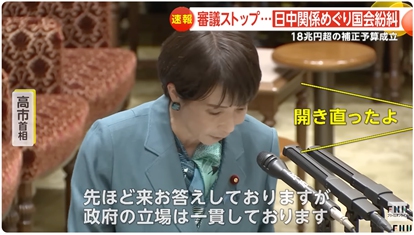
After Japanese PM Sanae Takaichi claimed "as I had answered, the stance of the government is consistent," an opposition party member criticizes her as "obstinately unrepentant." Photo: screenshot from video clip by Fuji TV
At the House of Councillors Budget Committee meeting on Tuesday, Japanese Prime Minister Sanae Takaichi, after nearly an hour of being repeatedly questioned over her erroneous Taiwan-related remarks, still claimed "The government's position has been consistent," without substantially retracting her previous words, leading an opposition party member to criticize her as "obstinately unrepentant," according to Japanese media and their attached video clips.
According to a video clip from Fuji TV, after Takaichi said "as I had answered, the stance of the government is consistent," someone from the opposition seats slammed her as "obstinately unrepentant."
Takaichi claimed on November 7 at a Diet meeting that the Chinese mainland's "use of force on Taiwan" could constitute a "survival-threatening situation" for Japan, triggering strong backlash from China and within Japan.
On Tuesday, such remarks came under intense scrutiny for nearly an hour during the deliberations, Fuji TV reported. According to reports from Kyodo News and other Japanese media outlets, the live broadcast of the parliamentary session was subjected to three instances of audio interruption, totaling 238 seconds.
Takaichi arrived at the meeting room with a smile, and maintained that expression when she was about to answer questioning from the opposition party member. But when the phrase "national survival-threatening situation" was brought up, the prime minister frowned her brows.
At first, Hajime Hirota, Member of the House of Councillors, Constitutional Democratic Party of Japan, stated the content of Takaichi's response on November 7 was completely absent from the pre-prepared briefing materials. "We understand this as the prime minister expressing her personal opinion or views," Hirota added.
According to the report, in response, Takaichi claimed "On that day, I repeatedly stated clearly that the determination of a national survival-threatening situation must be made by the government through a comprehensive assessment of all available information, based on the specific circumstances of the situation as it actually unfolds." Takaichi's response did not satisfy Hirota who pressed further as Takaichi answered questions while glancing down at written documents. But it was Defense Minister Shinjiro Koizumi who stepped up to the podium. The opposition parties voiced fierce opposition to Koizumi's attempt to answer questions on behalf of the prime minister, forcing the deliberations to halt.
Takaichi then took the podium, and repeated "determination of a national survival-threatening situation requires the government to make a comprehensive judgment based on all information and claimed "The government's position has been consistent."
Deliberations quickly descended into chaos once again and were suspended for a second time, Fuji TV reported.
Abema Times reported the third audio interruption came approximately seven minutes later.
Hirota questioned: "The government's position is exactly its long-standing official stance—it is an iron-clad response. The government has maintained this position all along, but first, I must point out that Prime Minister Takaichi has exceeded it."
At the same time, you have not answered my question. Prime Minister Takaichi clearly stated that "the government will refrain from responding to hypothetical questions about a 'Taiwan contingency' and will continue to uphold this position in the future." If that is the case, then your statement that a "Taiwan contingency could, by any measure, become a national survival-threatening situation" is contradictory—should it not be retracted?
Takaichi again repeated aforementioned statements. But just like before, by the time Takaichi finished speaking, multiple lawmakers had stood up in protest, then resulting in the third audio cut, Abema Times reported.
After 110 seconds of suspension, the session resumed.
Hirota further said "It has become clear that Prime Minister Takaichi's responses are highly contradictory and full of inconsistencies..." He pointed out that Takaichi's Taiwan-related remarks "have not only chilled Japan-China relations economically but also heightened tensions in the security realm..."
In response to a question over latest China-Japan row due to Takaichi's erroneous remarks, Chinese Foreign Minister Guo Jiakun said on Wednesday that the erroneous remarks on Taiwan have been met with the Chinese people's indignation as well as opposition and criticism from Japan and some other countries.
What the Japanese side should do is to listen to these calls and do soul-searching rather than make futile attempts to persuade other countries into believing their groundless explanations. We urge some in Japan to stop spreading false narratives, face up to the history, reflect on and correct the wrongdoings, retract the erroneous remarks, honor the commitments, and act responsibly to offer China and the international community a satisfactory answer, Guo said.
RELATED ARTICLES