There is no need for Reuters to be anxious about China’s technological progress: Global Times editorial
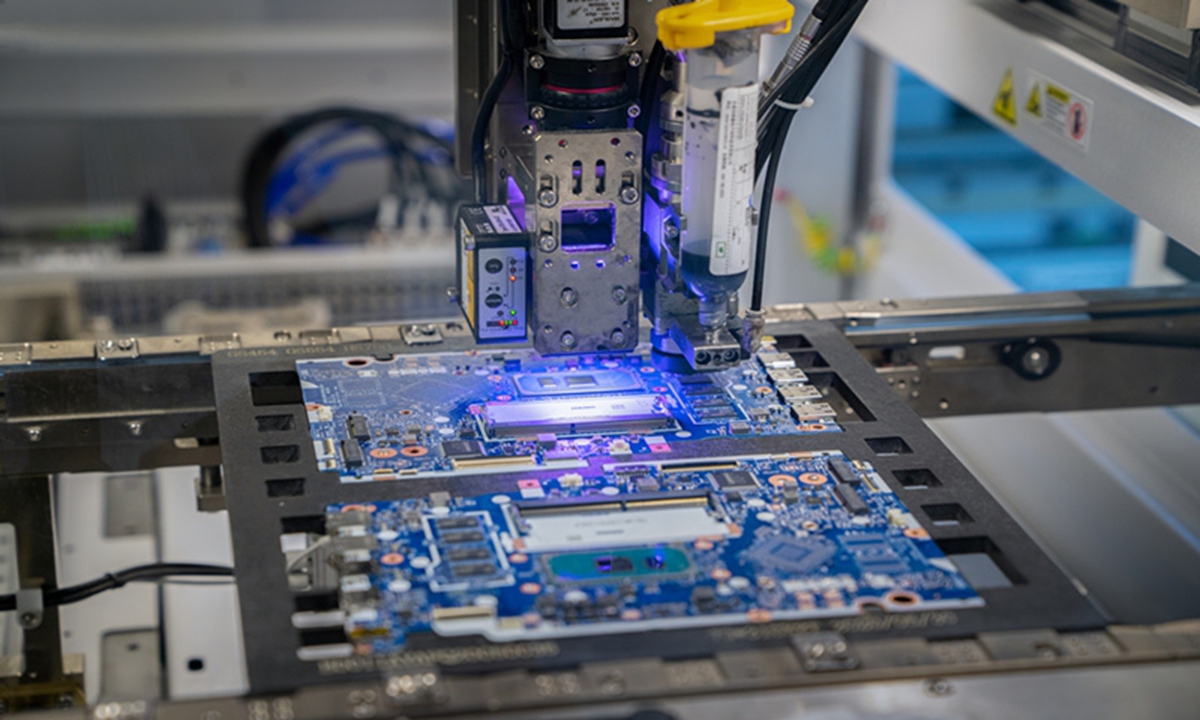
A chip manufacture machine Photo: VCG
Reuters recently published an "exclusive" story about a so-called Chinese "Manhattan Project," claiming that Chinese scientists have built what Washington has spent years trying to prevent: a prototype extreme ultraviolet (EUV) lithography machine. Regardless of whether the report - replete with "sources say" - was a smokescreen or not, the anxiety it conveys over China's technological progress is palpable. This anxiety precisely reveals to the world an unhealthy mindset that often appears in the West.
Lithography machines are major technical equipment that some countries believe it is the "last bastion" of Western technological leadership. At present, only the ASML can make EUV machines in the world. China has long been constrained in the field of lithography machines, with high-end equipment previously dependent mainly on imports, and has therefore been continuously exploring domestic alternatives. In fact, foreign media need not speculate. China's deep ultraviolet (DUV) lithography machines have official progress announcements. In September 2024, China's Ministry of Industry and Information Technology published in the Guiding Catalogue on Promoting the Use of First Set of Important Technical Equipment (2024 Version) the technical specifications of domestically made DUV lithography machines - lithography machines with 65 nm resolution and 8 nm overlay accuracy. The future technological roadmap for domestically made lithography machines is clear: China will continue to advance toward independent and controllable development.
International cooperation in the semiconductor industry is crucial, especially for highly integrated and complex systems such as lithography machines. In advanced chips, the number of transistors per square millimeter exceeds 100 million, and the processes of design, manufacturing, packaging, and testing are highly specialized and complex, requiring collaboration among companies from multiple countries to produce such refined products. Even if China makes breakthroughs in lithography machines, it will not change the fundamental nature of the semiconductor industry. China has a clear understanding of this and has consistently emphasized openness and international cooperation, welcoming companies from all countries to work together along the industrial chain. The tangible benefits gained by some Western chip companies from actively conducting business in the Chinese market are proof of this.
China's insistence on independent innovation in science and technology aims at self-reliance and strength. No matter how far breakthroughs in cutting-edge technologies advance, they do not affect international cooperation - a point repeatedly demonstrated in fields such as aerospace and green energy. Bill Gates admitted that US tech bans on China have forced China to "go full speed ahead" in terms of chip manufacturing and other fields. NVIDIA CEO Jensen Huang has also stated on multiple occasions that export controls have failed to slow the pace of AI development in China. Instead, they have led to a sharp decline in NVIDIA's market share in China's AI chip sector. China has turned the so-called "chokepoint" lists into task lists for scientific research and technological breakthroughs. French media outlets commented that "all of China is moving forward with a spirit of 'if you block me, I'll make it myself.'" Facts have proven that China's current technological base, talent pool, and industrial foundation are more than sufficient to withstand any blockade.
Technology is a shared asset of all humankind and should serve the well-being of people around the world. What blockade strategies truly shut off is cooperation with China, and the ultimate damage will be to the overall welfare of the global technology industry - including, the interests of the West itself. The World Economic Forum has noted that collaboration between the US and China is a bedrock of global scientific progress, and that over 30 percent of the US' high-impact international research has involved Chinese scientists. When the US suppresses the chip products of companies such as Huawei under the banner of "national security," it is precisely this cooperative foundation that drives human progress that is being undermined, pointing instead toward a misguided path of technological fragmentation, market division, and slower innovation. The many internal disputes and policy reversals within the US, such as disagreements over export rules for NVIDIA's H200 chips to China, only underscore how unsustainable and self-defeating such blockade strategies are.
Our goal has never been to build a self-sufficient "technology island" in isolation, but rather, on the basis of achieving autonomy and control over key technologies, to integrate more deeply and equally into the global innovation network and contribute to it. We believe that only by tearing down the walls in our minds called "fear" and "hegemony," and by embracing openness and cooperation, can we truly share the dividends of technological progress and jointly address the challenges facing humanity. Those who try to block out the sunlight with an "iron curtain" will ultimately leave themselves in the shadows. The door to win-win cooperation remains wide open, but the key must be held by those who value respect, equality, and mutual trust.
RELATED ARTICLES