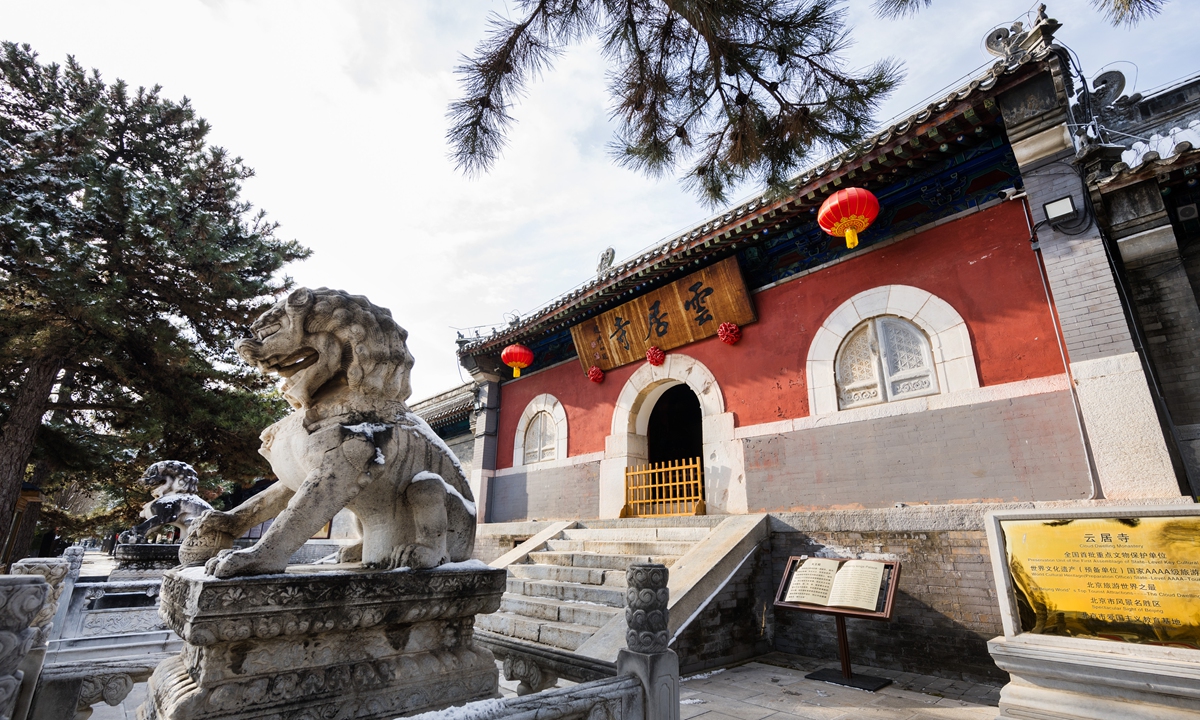
A view of the Yunju Temple in Fangshan district, Beijing Photo: Chen Tao/GT
"In Beijing, anyone with a love for history and culture has probably heard of this place." Standing amid the crisp winter air on Shijing Mountain, gaze fixed on the grottoes dotting the slopes, visitor Mr Ke told the Global Times on a quiet Monday afternoon.
Even on a weekday in the depths of winter - with patches of snow still clinging to the mountain's stone paths, and the bustle of downtown Beijing a 70-kilometer drive away - Yunju Temple and Shijing Mountain drew a steady stream of visitors. Some trekked slowly with hands tucked in coats, others leaned in to listen as guides wove tales of the site's past; the allure of this millennium-old heritage remained undimmed by the season.
After exchanging a quick farewell, Ke continued downhill, his itinerary a deliberate nod to the legacy he'd come to explore: first the caves storing sacred scriptures atop Shijing Mountain, then the temple's collections below - the two inseparable facets of the Fangshan stone scriptures.
The origin of these scriptures can be traced back to centuries ago. During the Sui Dynasty (581-618), the monk Jingwan vowed to carve Buddhist scriptures into stone on Shijing Mountain (originally called Baidai Mountain), seeking to preserve the dharma for eternity in a form resistant to time and turmoil. By the late Liao Dynasty (916-1125), when the mountain's nine caves were filled to capacity, newly engraved sutras found a new home in an underground chamber within Yunju Temple's grounds.
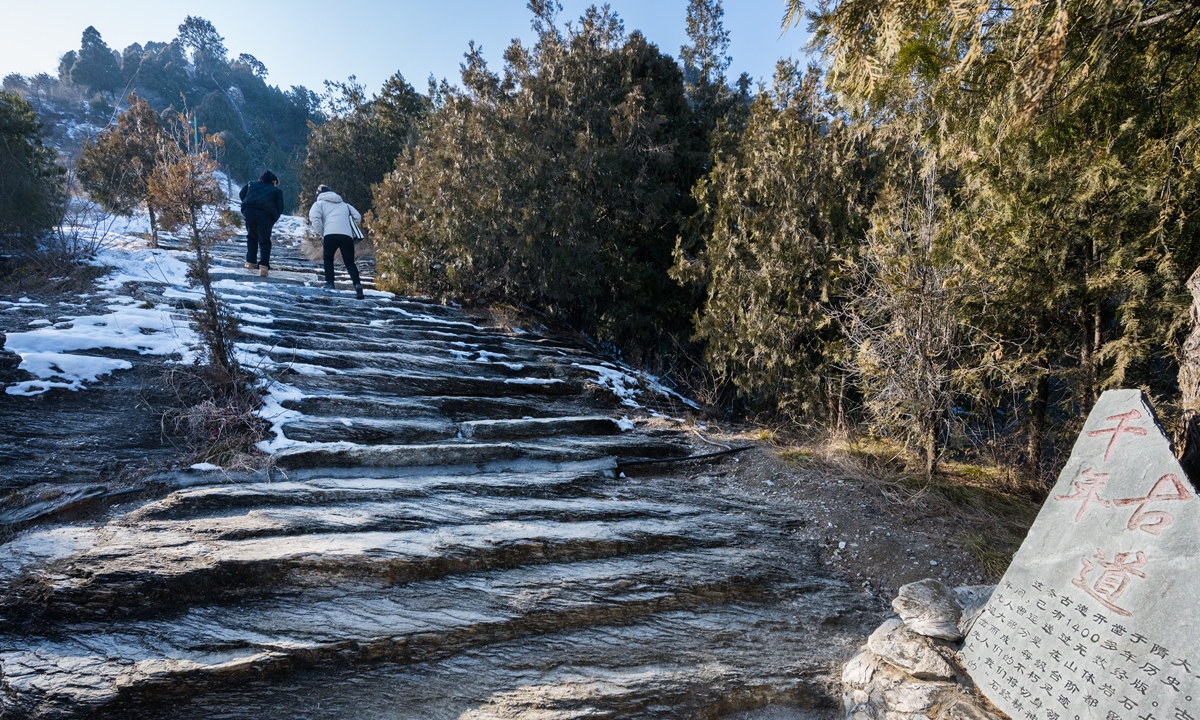
A Global Times reporter (right), guided by a docent, explores Shijing Mountain in Fangshan district, Beijing, on December 15, 2025. Photo: Chen Tao/GT
Today, the temple complex - home to the Yunju Temple Stone Scripture Museum - safeguards over 30,000 sets of scripture-related cultural relics, including stone, paper and wooden scriptures. Among these, the most awe-inspiring are the 1,122 volumes of stone scriptures carved on 14,278 stone slabs, together with 77 exposed stone tablets and pagodas - a project spanning more than 1,300 years from the Sui Dynasty through multiple dynasties, with a total of over 35 million characters, the Global Times learned from Yunju Temple. Hailed as the world's largest, longest-compiled and most content-rich collection of Chinese Buddhist stone carvings, it boasts world-class historical, cultural, artistic and academic value, and has long been a national calling card recognized globally.
In 2025, this ancient heritage stepped into a dynamic new era of preservation and global collaboration. On June 9, the temple's collection was officially inscribed on China's documentary heritage list, with the National Archives Administration of China highlighting its unparalleled value for studying the evolution of Buddhism and the transmission of sacred texts. In September, the site opened its doors wider still, launching a global call for proposals on protection, development, and utilization.
Among China's countless efforts to preserve and revitalize cultural heritage, Yunju Temple's journey carries unique weight. Through its ancient gates, lies a narrative that China shares with the world. One rooted in profound cultural reverence, guided by scientific stewardship, and driven by innovative progress.
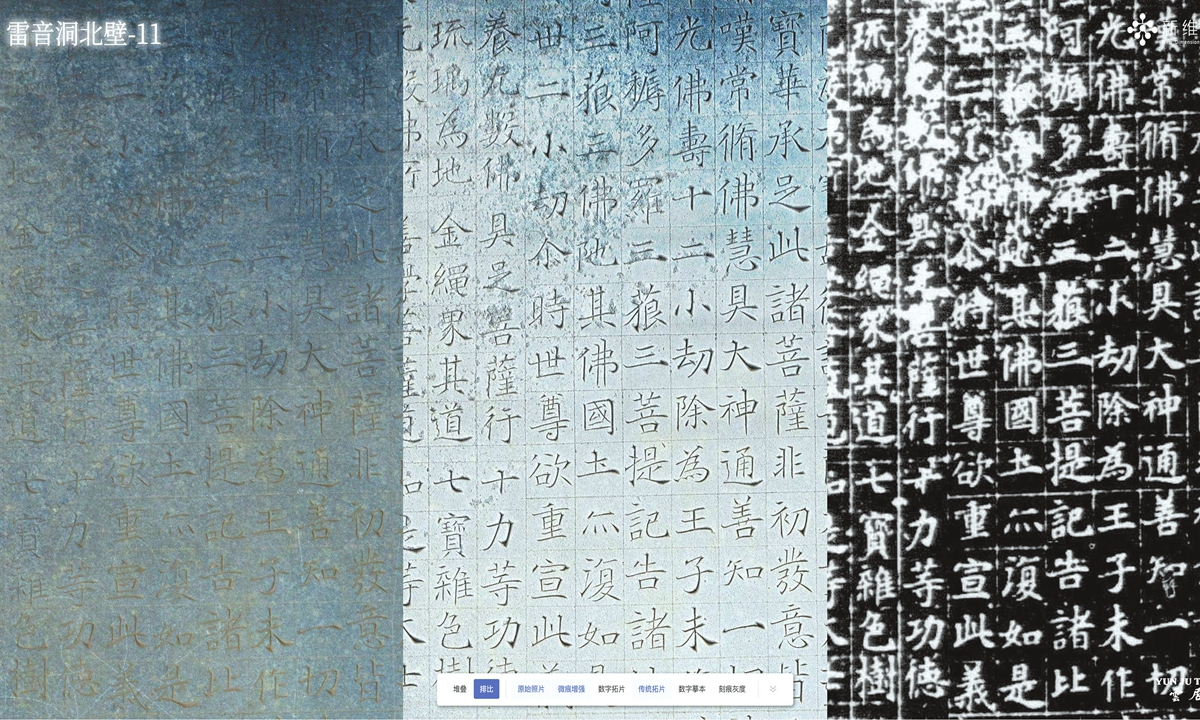
An image of a stone scripture processed and enhanced using algorithms from the micro-trace digital application project Photo: Courtesy of Hui Pengyu
A world-class national card
"Any researcher of Chinese Buddhist history will have some knowledge of Fangshan's stone-carved Tripitaka. Throughout Buddhist history, this is an astonishingly magnificent achievement," Japanese Buddhist scholar Tsukamoto Zenryu once said of Yunju Temple. This quote, included in Collation and Research on the Inscriptions of Fangshan Stone Scriptures by stone sutra expert Zhang Yongqiang, reflects the enduring global academic interest in Yunju Temple's canons.
Zhang told the Global Times that Yunju Temple has attracted international attention since the early 20th century. "Scholars from Japan, France, Germany, and Russia, have conducted multi-faceted research on the Fangshan stone scriptures, hailing them as 'world treasures' and 'immortal classics,' contributing significantly to dialogue between civilizations."
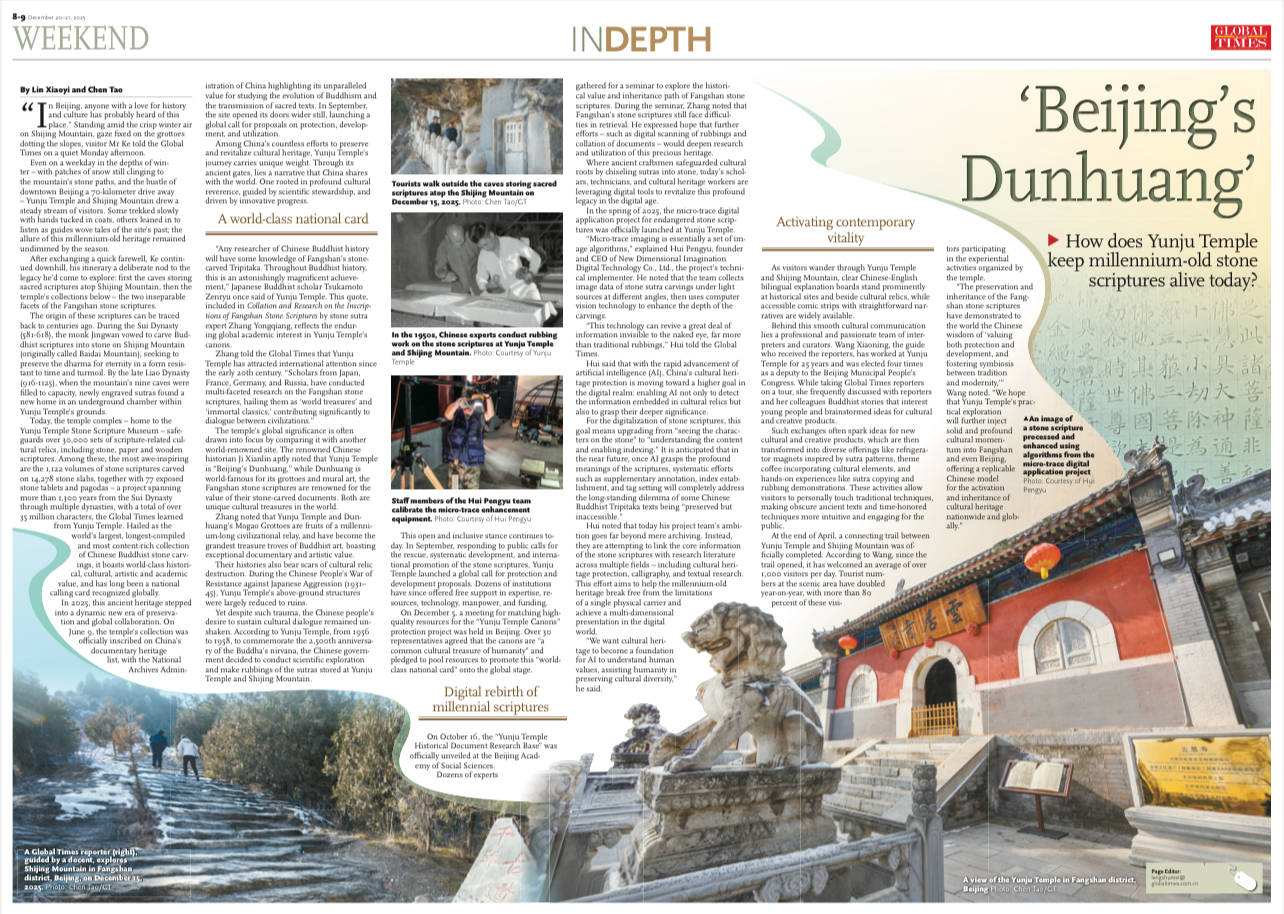
The temple's global significance is often drawn into focus by comparing it with another world-renowned site. The renowned Chinese historian Ji Xianlin aptly noted that Yunju Temple is "Beijing's Dunhuang," while Dunhuang is world-famous for its grottoes and mural art, the Fangshan stone scriptures are renowned for the value of their stone-carved documents. Both are unique cultural treasures in the world.
Zhang noted that Yunju Temple and Dunhuang's Mogao Grottoes are fruits of a millennium-long civilizational relay, and have become the grandest treasure troves of Buddhist art, boasting exceptional documentary and artistic value.
Their histories also bear scars of cultural relic destruction. During the Chinese People's War of Resistance against Japanese Aggression (1931-45), Yunju Temple's above-ground structures were largely reduced to ruins.

In the 1950s, Chinese experts conduct rubbing work on the stone scriptures at Yunju Temple and Shijing Mountain. Photo: Courtesy of Yunju Temple
Yet despite such trauma, the Chinese people's desire to sustain cultural dialogue remained unshaken. According to Yunju Temple, from 1956 to 1958, to commemorate the 2,500th anniversary of the Buddha's nirvana, the Chinese government decided to conduct scientific exploration and make rubbings of the sutras stored at Yunju Temple and Shijing Mountain.
This open and inclusive stance continues today. In September, responding to public calls for the rescue, systematic development, and international promotion of the stone scriptures, Yunju Temple launched a global call for protection and development proposals. Dozens of institutions have since offered free support in expertise, resources, technology, manpower, and funding.
On December 5, a meeting for matching high-quality resources for the "Yunju Temple Canons" protection project was held in Beijing. Over 30 representatives agreed that the canons are "a common cultural treasure of humanity" and pledged to pool resources to promote this "world-class national card" onto the global stage.

Staff members of the Hui Pengyu team calibrate the micro-trace enhancement equipment. Photo: Courtesy of Hui Pengyu
Digital rebirth of millennial scriptures
On October 16, the "Yunju Temple Historical Document Research Base" was officially unveiled at the Beijing Academy of Social Sciences. Dozens of experts gathered for a seminar to explore the historical value and inheritance path of Fangshan stone scriptures. During the seminar, Zhang noted that Fangshan's stone scriptures still face difficulties in retrieval. He expressed hope that further efforts - such as digital scanning of rubbings and collation of documents - would deepen research and utilization of this precious heritage.
Where ancient craftsmen safeguarded cultural roots by chiseling sutras into stone, today's scholars, technicians, and cultural heritage workers are leveraging digital tools to revitalize this profound legacy in the digital age.
In the spring of 2025, the micro-trace digital application project for endangered stone scriptures was officially launched at Yunju Temple.
"Micro-trace imaging is essentially a set of image algorithms," explained Hui Pengyu, founder and CEO of New Dimensional Imagination Digital Technology Co., Ltd., the project's technical implementer. He noted that the team collects image data of stone sutra carvings under light sources at different angles, then uses computer vision technology to enhance the depth of the carvings.
"This technology can revive a great deal of information invisible to the naked eye, far more than traditional rubbings," Hui told the Global Times.
Hui said that with the rapid advancement of artificial intelligence (AI), China's cultural heritage protection is moving toward a higher goal in the digital realm: enabling AI not only to detect the information embedded in cultural relics but also to grasp their deeper significance.
For the digitalization of stone scriptures, this goal means upgrading from "seeing the characters on the stone" to "understanding the content and enabling indexing." It is anticipated that in the near future, once AI grasps the profound meanings of the scriptures, systematic efforts such as supplementary annotation, index establishment, and tag setting will completely address the long-standing dilemma of some Chinese Buddhist Tripitaka texts being "preserved but inaccessible."
Hui noted that today his project team's ambition goes far beyond mere archiving. Instead, they are attempting to link the core information of the stone scriptures with research literature across multiple fields - including cultural heritage protection, calligraphy, and textual research. This effort aims to help the millennium-old heritage break free from the limitations of a single physical carrier and achieve a multi-dimensional presentation in the digital world.
"We want cultural heritage to become a foundation for AI to understand human values, assisting humanity in preserving cultural diversity," he said.
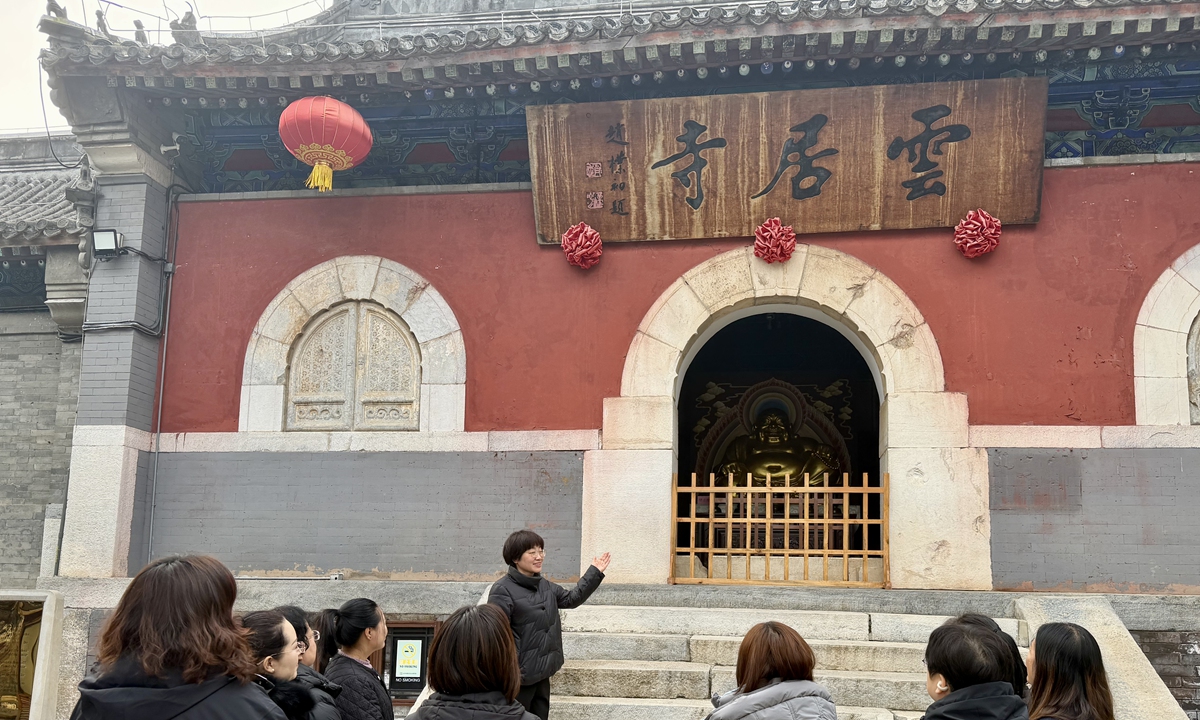
Wang Xiaoning gives a tour guide presentation to visitors at Yunju Temple on December 19, 2025. Photo: Courtesy of Yunju Temple
Activating contemporary vitality
As visitors wander through Yunju Temple and Shijing Mountain, clear Chinese-English bilingual explanation boards stand prominently at historical sites and beside cultural relics, while accessible comic strips with straightforward narratives are widely available.
Behind this smooth cultural communication lies a professional and passionate team of interpreters and curators. Wang Xiaoning, the guide who received the reporters, has worked at Yunju Temple for 25 years and was elected four times as a deputy to the Beijing Municipal People's Congress. While taking Global Times reporters on a tour, she frequently discussed with reporters and her colleagues Buddhist stories that interest young people and brainstormed ideas for cultural and creative products.
Such exchanges often spark ideas for new cultural and creative products, which are then transformed into diverse offerings like refrigerator magnets inspired by sutra patterns, theme coffee incorporating cultural elements, and hands-on experiences like sutra copying and rubbing demonstrations. These activities allow visitors to personally touch traditional techniques, making obscure ancient texts and time-honored techniques more intuitive and engaging for the public.
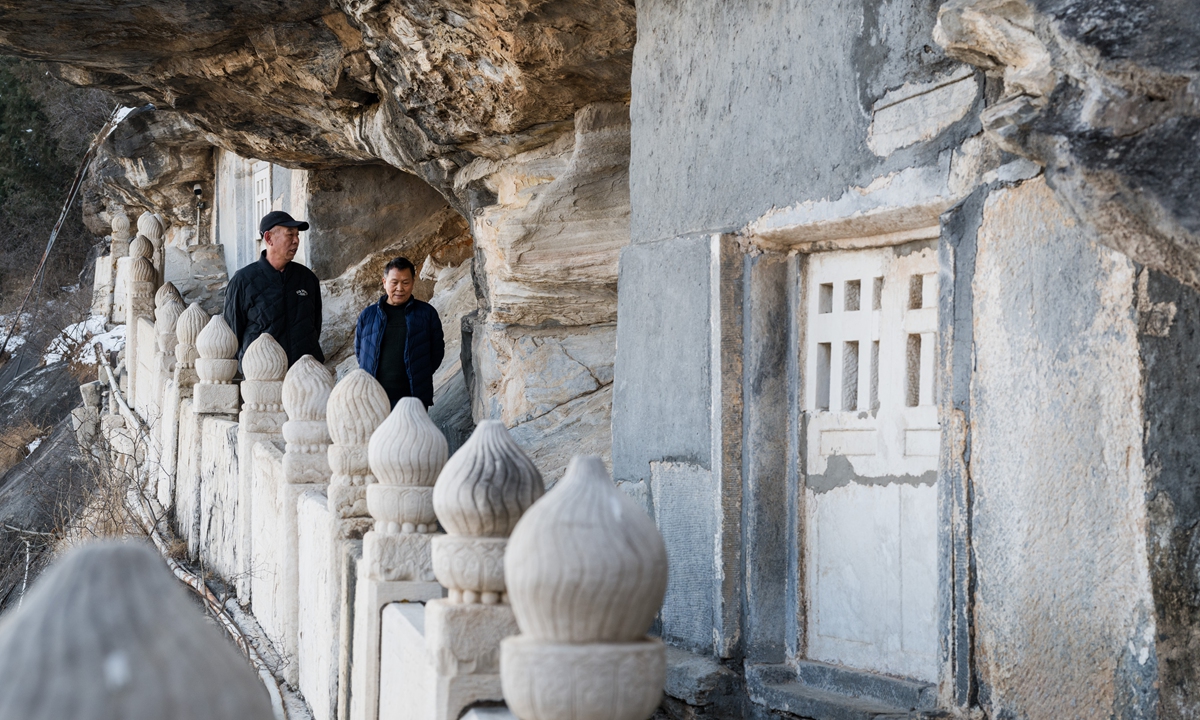
Tourists walk outside the caves storing sacred scriptures atop the Shijing Mountain on December 15, 2025. Photo: Chen Tao/GT
At the end of April, a connecting trail between Yunju Temple and Shijing Mountain was officially completed. According to Wang, since the trail opened, it has welcomed an average of over 1,000 visitors per day. Tourist numbers at the scenic area have doubled year-on-year, with more than 80 percent of these visitors participating in the experiential activities organized by the temple.
"The preservation and inheritance of the Fangshan stone scriptures have demonstrated to the world the Chinese wisdom of 'valuing both protection and development, and fostering symbiosis between tradition and modernity,'" Wang noted. "We hope that Yunju Temple's practical exploration will further inject solid and profound cultural momentum into Fangshan and even Beijing, offering a replicable Chinese model for the activation and inheritance of cultural heritage nationwide and globally."
'Beijing's Dunhuang' Photo: Global Times