Russia-China ties crucial for global stability: Putin at annual conference
Relations set model for major-power interaction in contrast to 'transactional diplomacy:' expert
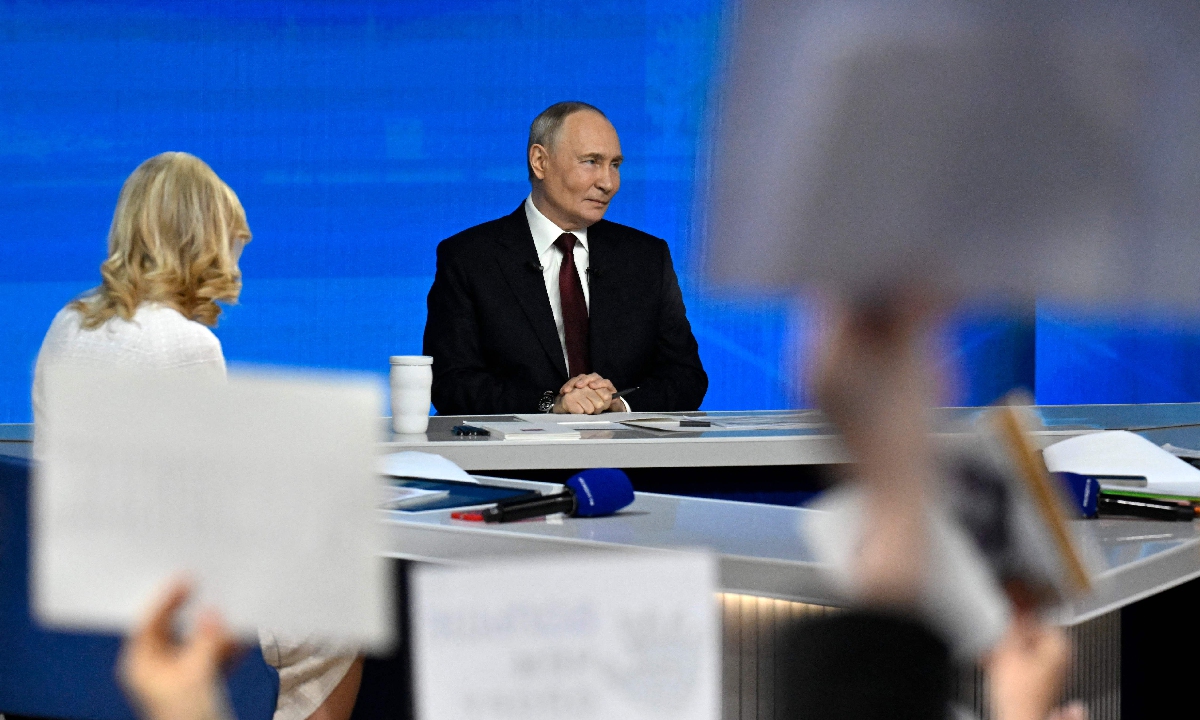
Russian President Vladimir Putin holds his annual end-of-year press conference in Moscow on December 19, 2025. Photo: VCG
Russian President Vladimir Putin held his annual press conference in Moscow on Friday to look back on the results of 2025, and forward to 2026, during which he highly evaluated Russia-China relations as "an essential factor for global stability," according to media reports.
During the press conference, Putin fielded a wide range of questions, from road repairs and tax increases to reports of fraud, drones for Russian troops, birthrates, per Russian media reports. According to media reports, the Kremlin said that before the event began on Friday, they had already received more than 2.6 million questions.
Answering questions on Russia-China relations constitutes a standout part of his year-end press. Putin pointed out that Russia is China's biggest trading partner among European states, with bilateral trade reaching $240-250 billion, Sputnik News reported.
Putin said that Russian-Chinese relations are an essential factor for global stability, per Sputnik News.
Beyond the macro level, Putin also spoke highly of Russia-China cooperation across multiple fields. He said, "covering high tech, education, humanitarian ties, exploration of outer space - we cooperate," per Russia Today (RT).
"We cooperate in the military field, and regularly conduct joint exercises: strategic aviation patrols, at sea and between ground forces," Putin said, per Sputnik News.
The Russian and Chinese foreign ministries are in constant contact and coordinate approaches regarding the global agenda, Putin added.
He noted that "It testifies the high level of trust between our countries," per the report.
High-level exchanges between the two countries have been frequent and dynamic. On the occasion of the 80th anniversary of the victory in the Chinese People's War of Resistance against Japanese Aggression and the Soviet Union's Great Patriotic War, the two countries' leaders exchanged visits in the year, attending the commemorative events in each other's countries respectively.
Under the strategic guidance of the two heads of state, a number of Chinese senior officials visited Russia, while more than a dozen Russian senior officials, including Prime Minister Mikhail Mishustin and Chairman of the State Duma Vyacheslav Volodin, paid visits to China.
On December 17, Zhang Hanhui, Chinese Ambassador to Russia, stated in an interview with RT that from January to November this year, the China-Russia trade volume reached $203.67 billion, exceeding $200 billion for three consecutive years, with rapid growth registered in emerging categories such as biotech products and aerospace.
Sun Xiuwen, an associate professor at the Institute for Central Asian Studies at Lanzhou University, told the Global Times on Friday that in the current complex international situation, China and Russia, as permanent members of the UN Security Council and nuclear powers, play a crucial role as pillars in safeguarding global strategic stability.
This stabilizing role is achieved through multi-level coordination and balance, Sun explained that both countries have been jointly advocating the concept of equal and indivisible security, oppose bloc confrontation, and coordinate their positions in key areas such as nuclear security and outer space security to reduce the risk of conflict.
Cui Heng, a scholar from the Shanghai-based China National Institute for SCO International Exchange and Judicial Cooperation, added that the two sides have consistently supported each other on issues concerning their core interests and jointly resisted external interference.
"On one hand, China and Russia have been committed to upholding international fairness and justice in global governance, resolutely opposing all forms of hegemony and power politics, and jointly defended the UN-centered international system; on the other hand, as major victors of World War II, China and Russia safeguarded the historical truth and opposed its distortion," Cui explained.
"Such a relationship sets a model for major-power interaction, conveying strong stabilizing expectations that starkly contrast with 'transactional diplomacy,'" Cui told the Global Times on Friday.
At Putin's press conference on Friday, the Russia-Ukraine topic is also a major focus. He said that so far, Moscow has not really seen readiness from Ukraine, but there are certain signals that they are ready to engage in some kind of dialogue.
On NATO, the Russian leader said that he would very much like to live in peace next year, free of any military conflicts, and strive to resolve all contentious issues through negotiations. "The movement of (NATO) military infrastructure toward our borders raises, and has raised, and continues to raise, our legitimate concerns ... We're not demanding anything out of the ordinary; we're not saying that any country doesn't have the right to choose its own defense. But it must be a method that doesn't threaten anyone, including us," Putin said.
Putin urged his Western partners to fulfil the promises and commitments. "We've been deceived, and we want to achieve a situation where a reliable security system is built in Europe."
RELATED ARTICLES