The four global initiatives are China’s response to the gravity of the crisis of the global order: British scholar at Global Times Annual Conference
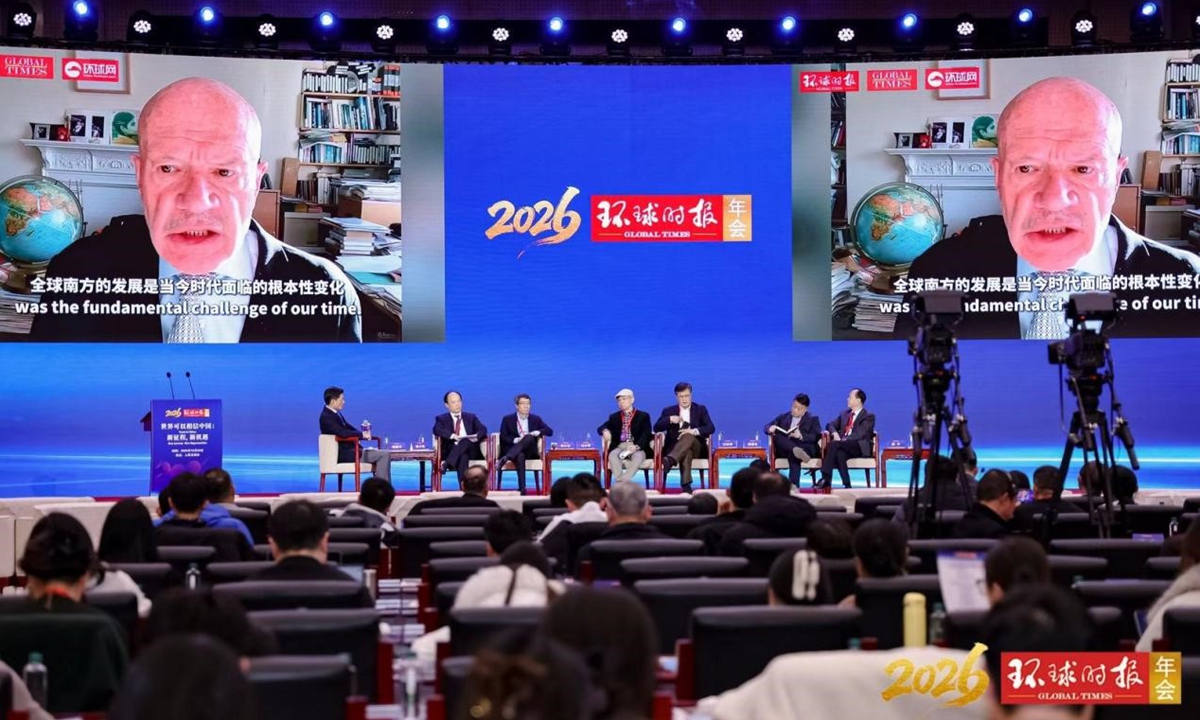
British scholar Martin Jacques delivers a video address at the Global Times Annual Conference 2026 on December 20, 2025, in Beijing. Photo: Li Hao/GT
The Global Times Annual Conference 2026 took place in Beijing on Saturday, under the theme of "Trust in China: New Journey, New Opportunities." During the discussion on the topic "A civilizational country: why the Chinese approach is the most implementable," Martin Jacques, a British scholar and a senior fellow at the China Institute, Fudan University, stated that the four global initiatives are China's response to the gravity of the crisis of the global order.
The following is the full text of Jacques' remarks:
Since 2012, starting with the launch of the highly original Belt and Road Initiative, China has developed a very creative, distinctive and proactive foreign policy, which is deeply rooted in Chinese history and traditions. The four global initiatives, Global Development Initiative (2021), Global Security Initiative (2022), Global Civilization Initiative (2023), and Global Governance Initiative (2025) are an articulate summary and statement of China's foreign policy as it has evolved.
Let me make a point here about timing. By 2021, it was clear that the post-1945 global order was coming under growing pressure as the US tried to undermine and block China's economic development by restricting trade and technology transfer. This process was greatly accelerated with Trump's championing of tariffs and abandonment of multilateralism during 2025. In historical retrospect, it is now clear that the postwar global order slowly began to break down following the Western financial crisis in 2008. That process is now well advanced.
The postwar order is dying and a new order, though still in its infancy, is beginning to emerge, with China at its heart. In this situation it became increasingly incumbent on China to develop and articulate its views on the global order for the rest of the world, above all the Global South. The four initiatives are part of China's response to the gravity of the crisis of the global order that is becoming ever more evident. They are China's response to increasingly widely asked questions: What is China's position on the global order? How should it be reformed? How does China see the future of the international system? These are the subjects the Global Governance Initiative.
Above all, the four initiatives are directed to the Global South. China has seen itself as an integral part of the developing world ever since 1949. And with the passage of time, and the growing importance of the Global South, this has become increasingly the case. China regards the relationship with the Global South as the primary relationship in its present and future foreign policy. It is this relationship which China believes will be at the core of a new and reformed global order.
It was no accident that the first global initiative in 2021 was the Global Development Initiative. This spelt out that, for China, the development of the Global South was the fundamental challenge of our time. The Global Civilization Initiative is similarly directed at the Global South. Its primary audience is certainly not the West, which rarely uses the term civilization, and which was culpable for the immense damage inflicted on the civilizations of the Global South during their colonization. The blossoming of the societies of the Global South depends not only on development but also their civilizational renewal.
This brings me finally to the Chinese roots of the four initiatives and China's foreign policy more generally. Hitherto, during the Age of the West, international relations have been dominated by the agenda, concepts, and language of the West. This is patently not the case with China's foreign policy since 2012. The reason why the West has failed to come up with a serious alternative to Belt and Road is its continuing neo-colonial view of the developing countries combined with its inability to think in such pan-national and global terms.
Or take the Global Civilization Initiative. Civilizational thinking is second nature to the Chinese. China emerged as a civilization-state and only much later as a nation-state; its primary identity is that of a civilization. This is a wholly different way of thinking. It is why China has a deep understanding of the importance of civilization to the Global South. Together the four initiatives signal what might be described as the beginning of the sinicization of international relations.
RELATED ARTICLES