Chinese public security authorities crack down money-laundering case following US tip-off
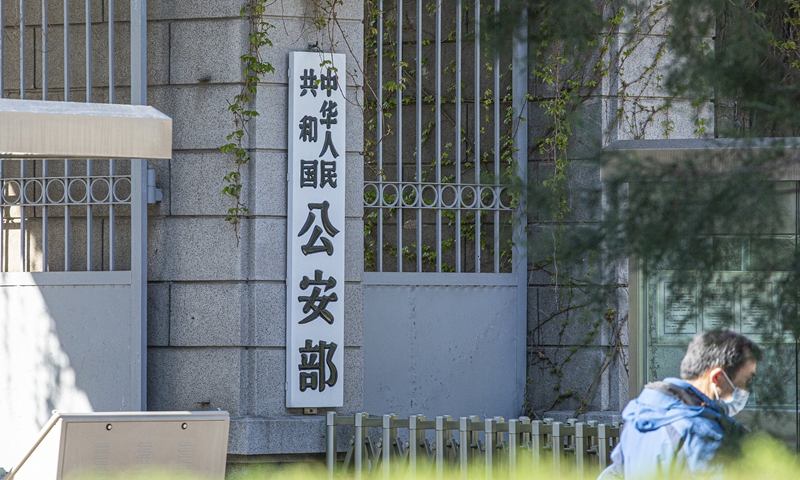
China’s Ministry of Public Security Photo: VCG
The Shenyang Public Security Bureau in Northeast China's Liaoning Province have dismantled an illegal business operation ring led by a suspect surnamed Tong , acting on a tip from US authorities, China's Ministry of Public Security (MPS) announced on Sunday.
In April 2024, a tip-off provided by the US indicated that Tong, a Chinese national, was suspected of money laundering for drug traffickers. Upon receiving the information, the MPS promptly directed the Liaoning provincial public security department to verify it.
Based on preliminary investigations, the Liaoning police lawfully filed a case for suspected illegal foreign exchange operations. The case was then transferred to the Shenyang police, within whose jurisdiction Tong's registered residence,for continued investigation.
The Shenyang police then set up a special task force. Overcoming challenges such as fragmented clues, difficulties in collecting evidence overseas, and differences between Chinese and US legal systems, investigators conducted a multi-dimensional, meticulous investigation and secured key evidence quickly.
On May 20, 2024, the Shenyang police arrested Tong and another person surnamed Chen in Wuhan, Central China's Hubei Province, as the suspects attempted to flee the country.
During the investigation, Shenyang police have dispatched 25 evidence-collection teams to 16 provinces and 43 cities to conduct on-site verification of the illegal foreign exchange transactions of the suspects.
The case involved more than 2,000 individuals, hundreds of companies, 49,000 bank accounts, and 10.56 million transaction records. Confronted with this massive dataset, the task force carefully pieced together the evidence chains and ultimately uncovered the full picture of Tong and Chen's illegal activities, according to MPS.
Investigations showed that since 2017, Tong, who ran a car dealership in the US, initially provided currency exchange services for his customers before turning fully to illegal foreign exchange transactions.
From January 2020 to June 2021, Tong conducted illegal exchanges through via a "mirror transfer" method, in which he directed Chen and others in China to collect renminbi payments from clients through multiple domestic bank cards. After the funds were received in China, Tong would pay the equivalent amount in US dollars in the US, charging a 1-2 percent fee. Audits show that Tong illegally exchanged more than 16 million yuan ($2.2 million).
Tong admitted that while operating the car dealership, he met a Mexican businessman known as JC. Learning that Tong needed US dollars for his exchange operations, JC proposed buying cryptocurrency with US currency. Tong then instructed Chen to purchase Bitcoin, Tether and other virtual currencies through multiple channels, and sold them to JC in exchange for US cash.
According to Tong, JC's transactions were only a portion of his business. Tong mainly provided exchange services for Chinese students, businesspeople with large exchange needs, and local gamblers in the US.
Police noted that while Tong conducted exchange activities in the US, he claimed he did not know the exact source of JC's funds, and existing evidence does not prove he clearly understood their upstream criminal nature.
Investigators also found that some criminals have been evading US regulatory scrutiny in large cash transactions and virtual currency dealings. This information has been communicated to the US through China-US anti-money laundering cooperation channels, and both sides agreed to strengthen law enforcement cooperation in this area.
On November 26, 2024, the case was transferred to the procuratorate for prosecution in China. In September 2025, after trial, the People's Court of Huanggu District in Shenyang ruled that Tong and Chen had violated national regulations, illegally traded foreign exchange and disrupted the financial market.
Both were convicted of illegal business operations and sentenced to one year and seven months and one year and four months in prison, respectively, and fined, according to the MPS.
Global Times
RELATED ARTICLES