Carney's security 'guardrails' remarks in seeking ties with China reflect inherent contradictions within policy framework, 'lack of strategic autonomy,' say experts
By Published: Dec 21, 2025 06:32 PM

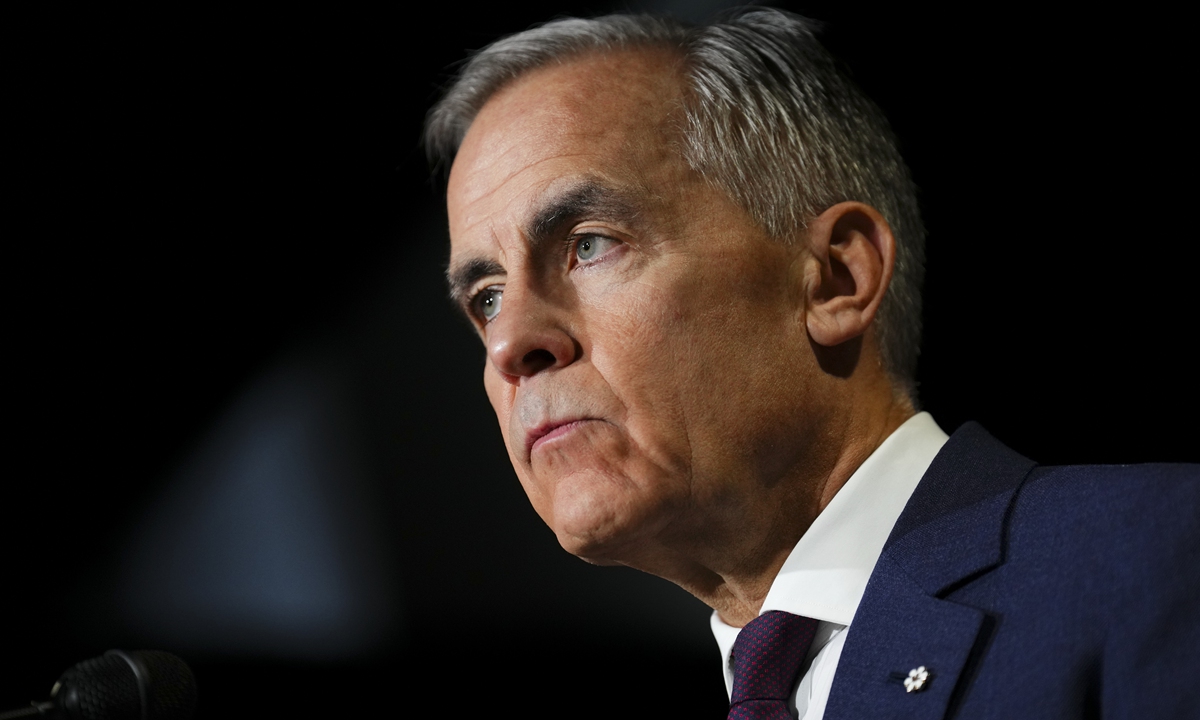
Canadian Prime Minister Mark Carney holds a press conference during the G20 Summit in Johannesburg, South Africa, on November 23, 2025. Photo: IC
Since taking office in March, Canadian Prime Minister Mark Carney has notably departed from the approach of his predecessor Justin Trudeau, seeking to diversify Canada's trade relations amid increasingly strained relations with the United States. In an interview on Sunday, Carney expressed his intention to make new progress in Canada-China bilateral ties. However, he also publicly outlined what he described as "guardrails," security-related boundaries that he believes should guide engagement with China.
Experts said that on dealing with China, it seems that current Canadian administration has been exhibiting a dual nature, reflecting inherent contradictions within the policy framework.
In the interview with CBC, the prime minister said "Never have all your eggs in one basket. We have too many eggs in the American basket… and we would like to maintain that relationship and grow others, but we absolutely need to grow others."
The list includes "China and India," Carney said - two countries the Liberal government had a fractured relations with under Justin Trudeau, CBC reported.
Asked if Carney sees risks in Canada aligning economically with China in the interview, the prime minister replied that "The question is how deep is the relationship and how clear are the guardrails around that relationship."
"There are areas, artificial intelligence, critical minerals, defence, where clearly the security threats are such that we would not have a deep relationship with China in those areas," he said.
Carney acknowledged that outside the European Union and the United Kingdom, he doesn't see Canada having "deep relationships with many countries" in areas such as artificial intelligence, critical minerals, defence, — even Canada's once closest ally.
Li Haidong of China Foreign Affairs University noted that Carney's stance reflects an adjustment based on the new reality of Canada's relations with the US, marking an initial step toward policy diversification. However, Li observed that while Ottawa shows a proactive attitude toward diversification, its position remains noticeably ambivalent.
Lü Xiang, a research fellow at the Chinese Academy of Social Sciences, interpreted the "guardrails" framing as a cautious formulation aimed at avoiding provocation toward the US while pursuing diversification through engagement with China.
This could mean that if the US imposes technological restrictions on China, Canada may follow suit, Lü elaborated to the Global Times.
Speaking to the media on the sidelines of the ASEAN meeting in Kuala Lumpur, Malaysia in October, Carney noted that China is Canada's second-largest trading partner, the world's second-largest economy, and one of the most influential countries globally, according to CBC. He also said that he hopes to reset expectations in Canada's relationship with China.
A Reuters report highlighted that it was Canada's move to "reduce its heavy dependence on the United States and redefine its foreign policy to pursue new markets" under the US tariff pressure.
On dealing with China, it seems that current Canadian administration has been exhibiting a dual nature, reflecting inherent contradictions within the policy framework, Chinese analysts noted.
On one hand, there is an active pursuit of cooperation and dialogue in the economic and trade spheres; on the other hand, in the political and security domains, emphasis is still placed on security "guardrails," they said.
In April, Carney claimed that China is one of the largest threats with respect to foreign interference in Canada, in a federal leaders' debate, ahead of the April 28 election, when asked to name Canada's biggest security threat, according to news report by Reuters.
In April, Chinese Ambassador to Canada Wang Di in an exclusive interview to Canada's largest news agency, The Canadian Press, answered the related question. Wang said "what threat Canada is faced with, and whether China is Canada's threat, the answer is very clear in the calls and voices of the people of Canada," while emphasizing that China is Canada's opportunity, not Canada's threat.
If China and Canada can earnestly uphold the principle of correct perception, mutual respect and seeking common ground while reserving differences, the two countries can reinforce each other and make each other better, Wang said.
Analysts noted that China should maintain realistic expectations regarding Canada's pragmatic approach. They recommended gradually rebuilding mutual trust through ongoing dialogue, while staying alert to potential negative actions by Canada under external pressure.
Li further emphasized that meaningful diversification and risk reduction would require Canada to demonstrate stronger strategic autonomy and political resolve.
RELATED ARTICLES