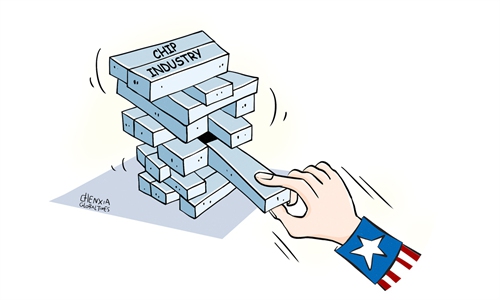
Illustration: Liu Xidan/GT
When news broke that US-based Roomba vacuum cleaner maker iRobot filed for bankruptcy protection and would be acquired by a Chinese company, certain US media outlets were quick to drum up concerns over the so-called "data security risks." Such a narrative does nothing to address real technological challenges, but distorts the healthy international trade and investment environment.Roomba producer iRobot recently filed for Chapter 11 bankruptcy in Delaware as part of a restructuring agreement with Shenzhen-based Picea Robotics, its lender and a key supplier, which will acquire iRobot's equity. The Washington Post published an analysis during the weekend, headlined "Should you worry that most robot vacuums are Chinese now?" which deliberately raising concerns about "data privacy risks" the newspaper article claimed in the business deal.
Although The Washington Post article acknowledged that "the takeover by a Chinese company isn't necessary nefarious," it proceeded to speculate without evidence that "Picea Robotics might cut corners on data security or privacy." The report further contended that the US government's "abdication on these issues" would amount to "helping China" and hurting American consumers. Such rhetoric inappropriately associates a commonplace cross-border corporate restructuring case with private data security risks.
According to iRobot's official announcements, to efficiently implement this transaction, iRobot and its affiliates voluntarily commenced a pre-packaged chapter 11 process in the District of Delaware. The process is expected to be completed by February 2026. The entire transaction will "go through an open and transparent process" that aligns with market principles and international business practices.
Notably, iRobot CEO Gary Cohen clarified in a recent interview with British technology media outlet TechRadar that his company reached out to Shenzhen-based Picea Robotics for a potential acquisition when the company faced financial difficulties.
"So this isn't a story about being taken over by a Chinese company. This is a story of a partner kind of saving a company, and a partner that we have a really good experience with," Cohen said. The deal would keep the brand alive and save 500 jobs, underscoring the transaction's constructive significance.
Nevertheless, certain American media outlets have selectively ignored the positive aspects, but chose to amplify allegations of ungrounded "data risks," a reflection of their preconceived political stance. Data security and privacy protection are indeed shared challenges in the digital era, requiring both nations and companies to abide by international rules and local laws while establishing credible technological and managerial mechanisms.
Deliberately using a company's country of origin as a criterion for judging its trustworthiness constitutes a biased and politicized narrative. This approach not only fails to tackle genuine technological and privacy issues but also undermines healthy international trade, investment, and cooperation within the global technology sector.
This is not the first time that US media outlets have hyped "data security" to scrutinize Chinese companies. In recent years, a number of opinion makers or media pundits have deliberately exaggerated data risks, effectively stretching the concept of national security with the apparent aim of restraining competitive companies from other countries.
Obviously, the repeated politicization of ordinary business merge and acquisition deals disrupts the stability of global industrial and supply chains and also harms US' own interests - depriving American firms of complementary partnerships, imposing unnecessary operational costs, and limiting American consumers' access to higher-quality and inexpensive products.
Chinese companies are committed to regulatory compliance and to delivering secure and reliable products and services to the global market. The pace of Chinese technology firms' participation in global supply chain cooperation remains resolute and will not be derailed by unfounded claims or smears. Genuine data security should always be built on an open, transparent, and rules-based international governance framework, not held hostage to politically motivated defamation.
RELATED ARTICLES