Chinese contest robot takes top prize at Abu Dhabi competition, showcasing advanced system integration
By Published: Dec 21, 2025 11:27 PM


Photo: Screenshot of CCTV's report
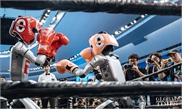
The robot "Deep-Sea Shark 3," independently designed and manufactured by a Chinese club, participated in the battle of robots competition at the Games of the Future Abu Dhabi 2025 and defeated its foreign rival in the final to win the championship, CGTN reported on Sunday.
A Chinese expert said that the achievement highlighted the strong system integration capability for robotics of the Chinese offerings.
The robot fighting competition featured 16 teams from countries and regions, including the US, Russia, Belarus and India, many of which had won multiple championships in international competitions.
Thanks to its advanced design, the "Deep-Sea Shark 3" robot, weighing 110 kilograms, continuously knocked down opponents directly during the competition, ultimately winning the championship, according to CGTN.
Qi Wenjie, a leader of the Chinese club, revealed that the circuit system of the robot was protected by a purposefully developed algorithm that promptly suppresses current spikes when the robot experiences stalling to protect its motors from overloading in the harsh working condition of a robot fight, according to CGTN.
The second Games of the Future are being held from December 17 to 23 in Abu Dhabi in the United Arab Emirates.
The event brings together the world's most dynamic athletes from across the phygital ecosystem, showcasing competitors who excel in both physical performance and digital proficiencies, with star players, elite esports talent, and rising phygital specialists all convening in Abu Dhabi, according to the Emirates News Agency.
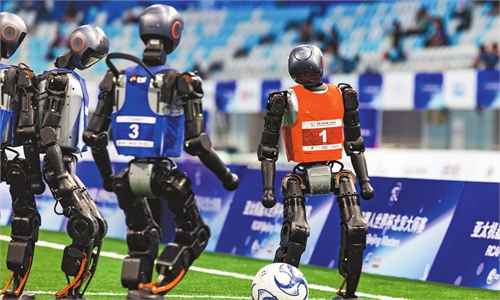
A Chinese analyst said that the performance of the Chinese-made robots is an epitome of the overall progress made by China and Chinese industries in the field of robotics, a rising sector in China's economic growth.
Separately, US tech billionaire Elon Musk recently retweeted a related video on X about six humanoid robots taking the stage at Chinese-American singer-songwriter Wang Leehom's concert, and wrote "impressive."
On Saturday, Musk retweeted on X platform that read "Robots in China are doing it all now, even dancing on stage like pros," adding his own comment: "Impressive."
Videos circulating online show the robots, made by Hangzhou-based robotics company Unitree Robotics, at a concert in Chengdu, Southwest China's Sichuan Province, synchronizing complex movements such as arm waving, leg kicks, turns, and Webster flips during the performance.
"While the robot built for the purpose of a contest is not meant for mass application, the robot itself demonstrated that China is gradually mastering technologies that ensure the robot, which is a complicated system, can run robustly under extreme and complicated working conditions such as a fight in the battle of robots," Chen Chen, director of the China Machine Think Tank of the Machinery Industry Information Institute, told the Global Times on Sunday.
"Like a fighter jet among planes, the contest robot has the highest performance attributes," Chen said.
"Winning in a highly competitive, highly destructive contest involving multiple powerful opponents reflects the capabilities of Chinese robotics in various specific areas, such as mechanical structural design, electrical architecture, battery density, and electronic control technology, as well as the comprehensive design proficiency and integration capabilities behind them," the expert said.
During the 14th Five-Year Plan (2021-25) period, China's robotics product technology has seen accelerated innovation and upgrading. The supporting capabilities for key components such as displays, servo systems, and controllers have significantly improved, according to media reports.
China's Minister of Science and Technology Yin Hejun said at a State Council Information Office press conference in September that during the period, China's technology breakthroughs have accelerated the application of humanoid robots in the automobile manufacturing, logistics handling and power inspection scenarios, among others, laying a solid foundation for the development of the future industry with a scale of 1 trillion yuan ($142.01 billion).
The domestic market share of self-owned brand industrial robots has surpassed 50 percent for the first time, according to officials in November.
RELATED ARTICLES