Draft law on childcare services submitted for 1st reading to China's top legislature, to provide legal foundation to resolve challenges
By Published: Dec 22, 2025 12:14 PM


A child learns to identify grains under the guidance of a volunteer at a kindergarten in Tianjin, north China, on Oct. 14, 2025. Theme events have been carried out across China to mark World Food Day that falls on Oct. 16. (Photo by Du Penghui/Xinhua)
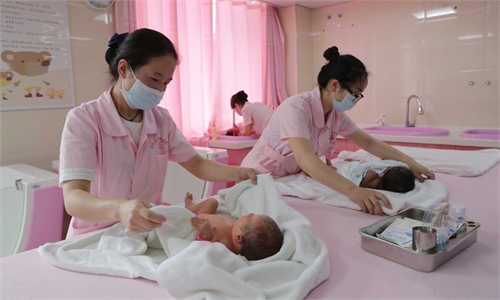
A draft law on childcare services was submitted for first reading to the 19th session of the Standing Committee of the 14th National People's Congress on Monday. The law is believed to provide a solid legal foundation for resolving challenges on the childcare services facing Chinese families.
The draft law comprises eight chapters with 76 articles, covering general provisions, childcare institutions, caregivers, service provision, safeguarding measures, supervision and management, as well as legal liability and supplementary provisions, according to the Xinhua News Agency.
Enacting the law on childcare services will promote and regulate the development of childcare services, offering solid legal protection for the most vulnerable group of infants and children under the 3 years of age, the report said.
The development of childcare services is a key component of the country's efforts to establish a supportive policy system for encouraging childbirth. The law on childcare services would be the first national legal document concerning childcare services since the founding of the People's Republic of China, holding significant importance for promoting and regulating the development of childcare services, Song Jian, a demographer from the Center for Population and Development Studies at Renmin University of China, told the Global Times.
This legislation represents a crucial step in improving birth support policies, reducing the cost of family care and enhancing the quality of the population. It holds significant importance for fostering a fertility-friendly society and promoting high-quality population development, according to the Xinhua report.
By the end of 2023, China had provided 4.77 million nursery care slots nationwide and the number of slots per 1,000 people had reached 3.38, including community-based childcare, employer-run nurseries, family daycare and comprehensive childcare centers, according to data from a report from National Health Commission delivered to State Council in September, 2024.
Meanwhile, more than half of the 1.12 million full-time employees in the sector were nursery care workers, the data showed.
However, challenges are still evident. In some places, only the role of the market mechanism is emphasized, while the role of the government is not effectively exerted, resulting in a relatively small supply of inclusive childcare services. Surveys in multiple regions show that over 30 percent of families with infants and toddlers under the age of 3 require the services of a daycare center.
Due to various factors, the current actual enrollment rate in daycare across the country is only 7.86 percent and there is a significant shortage of existing daycare centers, the report said.
Media reports said that there is no specific law or administrative regulations concerning childcare services for infants and young children. At the local level, regions like Southwest China's Sichuan Province, Wuhan in Hubei Province, Taizhou in Jiangsu Province formulated and implemented the relevant regulations to provide legal support for childcare, reports said.
The rollout of the draft law is part of the country's effort to support childbirth, Song said. She explained that during the 14th Five-Year Plan period, the country has established a system of policies supporting childbirth, continuously strengthening the four pillars - economic support, service support, time support and cultural support.
The law would provide a solid legal foundation for resolving challenges on the childcare services facing Chinese families, such as whether they are able to get access to affordable and inclusive childcare, focus on addressing issues such as the difficulty in accessing services, high costs and parental concerns about reliability, Song added.
Institutions and individuals who are committed to providing childcare services also need to be legally protected so that they can better offer support to families in need, Song said.
The latest move on childcare is the country issuing a nationwide cash subsidy policy for parents including those with only one child aged 3 or younger. Efforts to help alleviate the financial pressure on families raising children and boost the country's birth rate have been implemented across multiple provinces.
The Standing Committee of the 14th National People's Congress will hold its 19th session in Beijing from December 22 to 27. According to the proposed session agenda, a draft law on childcare services and another on activities and environmental protection in Antarctica will be submitted to the session for the first time, Xinhua said.
Also on the agenda will be a draft environmental code, a draft law aimed at promoting ethnic unity and progress, a draft law on national development planning and draft revisions to the foreign trade law, among others, per the report.
RELATED ARTICLES