IN-DEPTH / IN-DEPTH
CPC in Global Eyes: CPC members ‘liberate China and propel it toward strong, sustainable development’: Vietnamese ‘red study tour’ delegate
Inspirational journeys
By and Li Xundian Published: Dec 22, 2025 11:00 PM


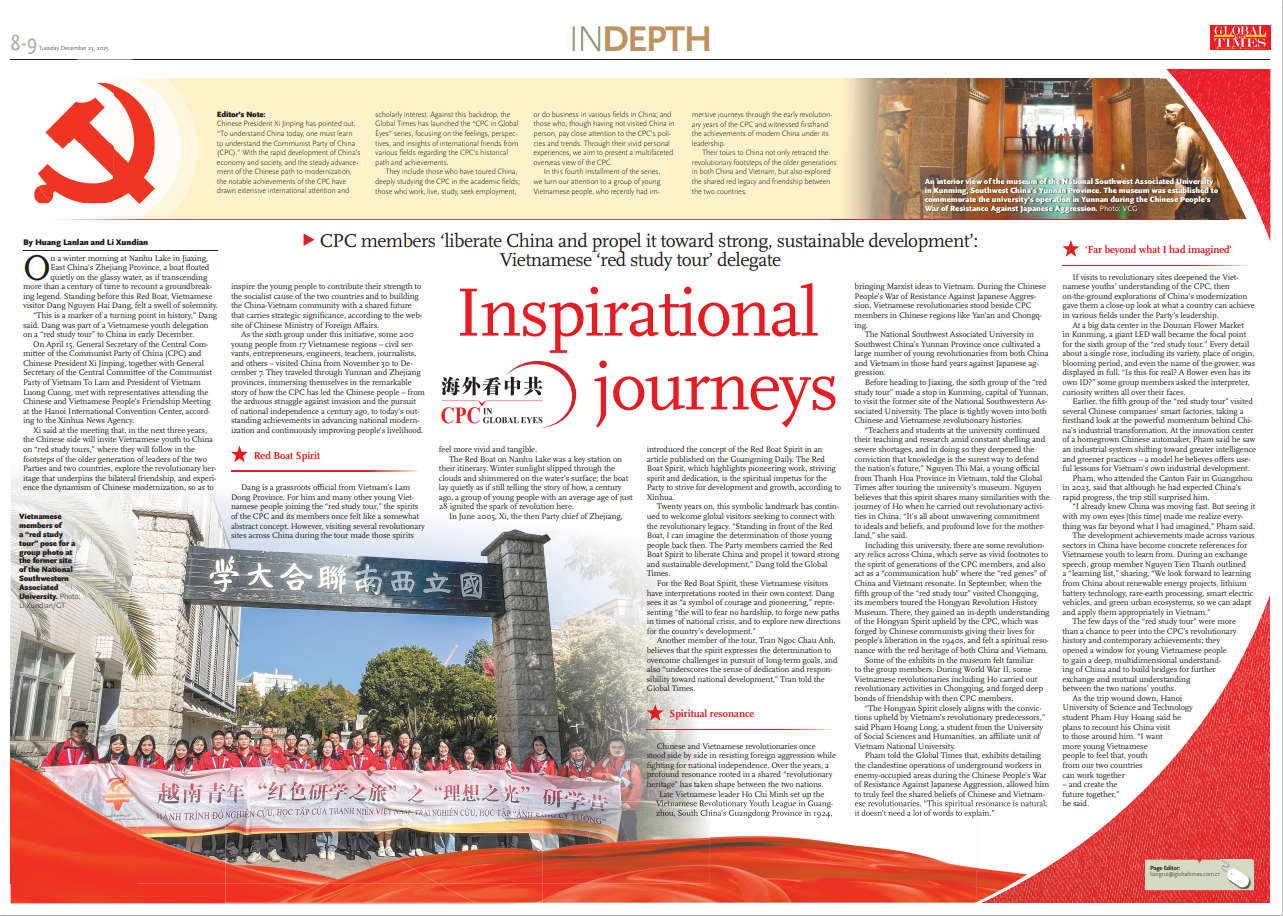
Vietnamese members of a "red study tour" pose for a group photo at the former site of the National Southwestern Associated University. Photo: Li Xundian/GT
Editor's Note:
Chinese President Xi Jinping has pointed out, "To understand China today, one must learn to understand the Communist Party of China (CPC)." With the rapid development of China's economy and society, and the steady advancement of the Chinese path to modernization, the notable achievements of the CPC have drawn extensive international attention and scholarly interest. Against this backdrop, the Global Times has launched the "CPC in Global Eyes" series, focusing on the feelings, perspectives, and insights of international friends from various fields regarding the CPC's historical path and achievements.
They include those who have toured China, deeply studying the CPC in the academic fields; those who work, live, study, seek employment, or do business in various fields in China; and those who, though having not visited China in person, pay close attention to the CPC's policies and trends. Through their vivid personal experiences, we aim to present a multifaceted overseas view of the CPC.
In this fourth installment of the series, we turn our attention to a group of young Vietnamese people, who recently had immersive journeys through the early revolutionary years of the CPC and witnessed firsthand the achievements of modern China under its leadership. Their tours to China not only retraced the revolutionary footsteps of the older generations in both China and Vietnam, but also explored the shared red legacy and friendship between the two countries.
On a winter morning at Nanhu Lake in Jiaxing, East China's Zhejiang Province, a boat floated quietly on the glassy water, as if transcending more than a century of time to recount a groundbreaking legend. Standing before this Red Boat, Vietnamese visitor Dang Nguyen Hai Dang, felt a swell of solemnity.
"This is a marker of a turning point in history," Dang said. Dang was part of a Vietnamese youth delegation on a "red study tour" to China in early December.
On April 15, General Secretary of the Central Committee of the Communist Party of China (CPC) and Chinese President Xi Jinping, together with General Secretary of the Central Committee of the Communist Party of Vietnam To Lam and President of Vietnam Luong Cuong, met with representatives attending the Chinese and Vietnamese People's Friendship Meeting at the Hanoi International Convention Center, according to the Xinhua News Agency.
Xi said at the meeting that, in the next three years, the Chinese side will invite Vietnamese youth to China on "red study tours," where they will follow in the footsteps of the older generation of leaders of the two Parties and two countries, explore the revolutionary heritage that underpins the bilateral friendship, and experience the dynamism of Chinese modernization, so as to inspire the young people to contribute their strength to the socialist cause of the two countries and to building the China-Vietnam community with a shared future that carries strategic significance, according to the website of Chinese Ministry of Foreign Affairs.
As the sixth group under this initiative, some 200 young people from 17 Vietnamese regions - civil servants, entrepreneurs, engineers, teachers, journalists, and others - visited China from November 30 to December 7. They traveled through Yunnan and Zhejiang provinces, immersing themselves in the remarkable story of how the CPC has led the Chinese people - from the arduous struggle against invasion and the pursuit of national independence a century ago, to today's outstanding achievements in advancing national modernization and continuously improving people's livelihood.
Red Boat Spirit
Dang is a grassroots official from Vietnam's Lam Dong Province. For him and many other young Vietnamese people joining the "red study tour," the spirits of the CPC and its members once felt like a somewhat abstract concept. However, visiting several revolutionary sites across China during the tour made those spirits feel more vivid and tangible.
The Red Boat on Nanhu Lake was a key station on their itinerary. Winter sunlight slipped through the clouds and shimmered on the water's surface; the boat lay quietly as if still telling the story of how, a century ago, a group of young people with an average age of just 28 ignited the spark of revolution here.
In June 2005, Xi, the then Party chief of Zhejiang, introduced the concept of the Red Boat Spirit in an article published on the Guangming Daily. The Red Boat Spirit, which highlights pioneering work, striving spirit and dedication, is the spiritual impetus for the Party to strive for development and growth, according to Xinhua.
Twenty years on, this symbolic landmark has continued to welcome global visitors seeking to connect with the revolutionary legacy. "Standing in front of the Red Boat, I can imagine the determination of those young people back then. The Party members carried the Red Boat Spirit to liberate China and propel it toward strong and sustainable development," Dang told the Global Times.
For the Red Boat Spirit, these Vietnamese visitors have interpretations rooted in their own context. Dang sees it as "a symbol of courage and pioneering," representing "the will to fear no hardship, to forge new paths in times of national crisis, and to explore new directions for the country's development."
Another member of the tour, Tran Ngoc Chau Anh, believes that the spirit expresses the determination to overcome challenges in pursuit of long-term goals, and also "underscores the sense of dedication and responsibility toward national development," Tran told the Global Times.
Spiritual resonance
Chinese and Vietnamese revolutionaries once stood side by side in resisting foreign aggression while fighting for national independence. Over the years, a profound resonance rooted in a shared "revolutionary heritage" has taken shape between the two nations.
Late Vietnamese leader Ho Chi Minh set up the Vietnamese Revolutionary Youth League in Guangzhou, South China's Guangdong Province in 1924, bringing Marxist ideas to Vietnam. During the Chinese People's War of Resistance Against Japanese Aggression, Vietnamese revolutionaries stood beside CPC members in Chinese regions like Yan'an and Chongqing.
The National Southwest Associated University in Southwest China's Yunnan Province once cultivated a large number of young revolutionaries from both China and Vietnam in those hard years against Japanese aggression.
Before heading to Jiaxing, the sixth group of the "red study tour" made a stop in Kunming, capital of Yunnan, to visit the former site of the National Southwestern Associated University. The place is tightly woven into both Chinese and Vietnamese revolutionary histories.
"Teachers and students at the university continued their teaching and research amid constant shelling and severe shortages, and in doing so they deepened the conviction that knowledge is the surest way to defend the nation's future," Nguyen Thi Mai, a young official from Thanh Hoa Province in Vietnam, told the Global Times after touring the university's museum. Nguyen believes that this spirit shares many similarities with the journey of Ho when he carried out revolutionary activities in China. "It's all about unwavering commitment to ideals and beliefs, and profound love for the motherland," she said.
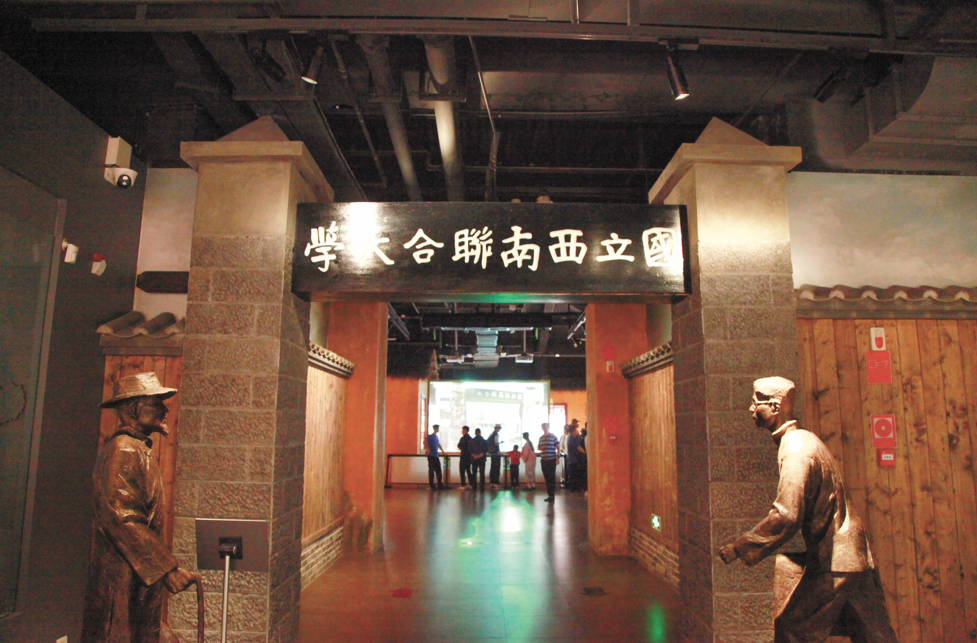
An interior view of the museum of the National Southwest Associated University in Kunming, Southwest China's Yunnan Province. The museum was established to commemorate the university's operation in Yunnan during the Chinese People's War of Resistance Against Japanese Aggression. Photo: VCG
Including this university, there are some revolutionary relics across China, which serve as vivid footnotes to the spirit of generations of the CPC members, and also act as a "communication hub" where the "red genes" of China and Vietnam resonate. In September, when the fifth group of the "red study tour" visited Chongqing, its members toured the Hongyan Revolution History Museum. There, they gained an in-depth understanding of the Hongyan Spirit upheld by the CPC, which was forged by Chinese communists giving their lives for people's liberation in the 1940s, and felt a spiritual resonance with the red heritage of both China and Vietnam.
Some of the exhibits in the museum felt familiar to the group members. During World War II, some Vietnamese revolutionaries including Ho carried out revolutionary activities in Chongqing, and forged deep bonds of friendship with then CPC members.
"The Hongyan Spirit closely aligns with the convictions upheld by Vietnam's revolutionary predecessors," said Pham Hoang Long, a student from the University of Social Sciences and Humanities, an affiliate unit of Vietnam National University.
Pham told the Global Times that, exhibits detailing the clandestine operations of underground workers in enemy-occupied areas during the Chinese People's War of Resistance Against Japanese Aggression, allowed him to truly feel the shared beliefs of Chinese and Vietnamese revolutionaries. "This spiritual resonance is natural; it doesn't need a lot of words to explain."
'Far beyond what I had imagined'
If visits to revolutionary sites deepened the Vietnamese youths' understanding of the CPC, then on‑the‑ground explorations of China's modernization gave them a close‑up look at what a country can achieve in various fields under the Party's leadership.
At a big data center in the Dounan Flower Market in Kunming, a giant LED wall became the focal point for the sixth group of the "red study tour." Every detail about a single rose, including its variety, place of origin, blooming period, and even the name of the grower, was displayed in full. "Is this for real? A flower even has its own ID?" some group members asked the interpreter, curiosity written all over their faces.
Earlier, the fifth group of the "red study tour" visited several Chinese companies' smart factories, taking a firsthand look at the powerful momentum behind China's industrial transformation. At the innovation center of a homegrown Chinese automaker, Pham said he saw an industrial system shifting toward greater intelligence and greener practices - a model he believes offers useful lessons for Vietnam's own industrial development.
Pham, who attended the Canton Fair in Guangzhou in 2023, said that although he had expected China's rapid progress, the trip still surprised him.
"I already knew China was moving fast. But seeing it with my own eyes [this time] made me realize everything was far beyond what I had imagined," Pham said.
The development achievements made across various sectors in China have become concrete references for Vietnamese youth to learn from. During an exchange speech, group member Nguyen Tien Thanh outlined a "learning list," sharing, "We look forward to learning from China about renewable energy projects, lithium battery technology, rare-earth processing, smart electric vehicles, and green urban ecosystems, so we can adapt and apply them appropriately in Vietnam."
The few days of the "red study tour" were more than a chance to peer into the CPC's revolutionary history and contemporary achievements; they opened a window for young Vietnamese people to gain a deep, multidimensional understanding of China and to build bridges for further exchange and mutual understanding between the two nations' youths.
As the trip wound down, Hanoi University of Science and Technology student Pham Huy Hoang said he plans to recount his China visit to those around him. "I want more young Vietnamese people to feel that, youth from our two countries can work together - and create the future together," he said.
Inspirational journeys
RELATED ARTICLES