Illustration: Chen Xia/GT
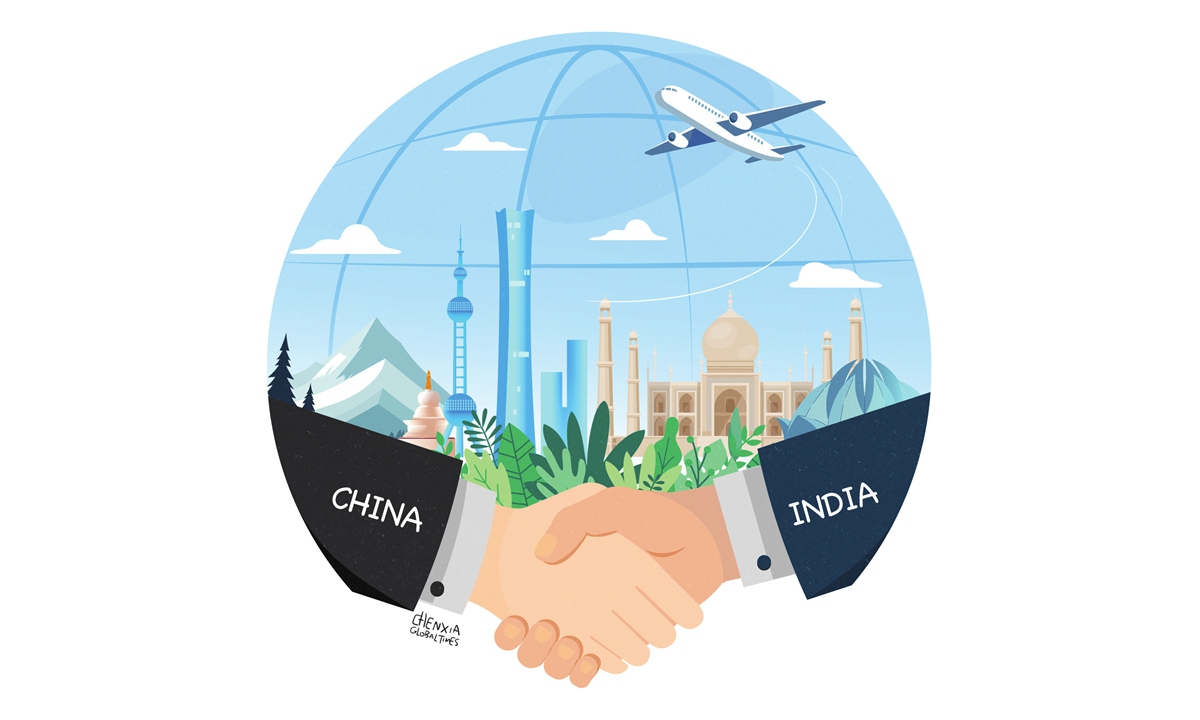
Against the backdrop of global economic turbulence and a sluggish recovery, recent measures facilitating people-to-people exchanges between China and India are injecting fresh vitality into bilateral economic and trade cooperation.Starting on Monday, Indian citizens applying for Chinese visas could complete the process online, the Chinese Embassy in New Delhi said earlier this month.
The move followed the resumption of direct flights between India and China in October after a five-year suspension. Together, these pragmatic steps are advancing the normalization of personnel exchanges and laying a solid foundation for cooperation across various fields, including the economy and trade, a sign of progress reflecting the cumulative improvement in bilateral relations.
Since the Kazan meeting between the leaders of the two countries in October last year, China-India relations have continued to improve. The foreign ministers of the two countries have exchanged visits, and increasingly close exchanges in various fields have been carried out.
According to India's Ministry of Commerce and Industry, bilateral trade grew 11.95 percent year-on-year to $104 billion in the first nine months. India has resumed issuing tourist visas to Chinese citizens. Direct flights between the Chinese mainland and India have been restored. These measures have been warmly welcome by the peoples of both countries, demonstrating the positive impact of normalizing people-to-people exchanges.
The drive toward normalized personnel exchanges stems from strong endogenous demand in economic, trade, and cultural engagement between China and India. The flow of people serves as the cornerstone of economic and trade relations. The facilitation of visas and flights is not just limited to the convenience of tourism and family visits, but drives cooperation in multiple dimensions such as the economy, trade, science and technology, and education.
Moreover, the smooth flow of personnel exchanges will accelerate the alignment of complementary industries, unlocking synergistic effects.
India possesses global competitiveness in information technology services, software development, and pharmaceutical research, and it is actively working to elevate its manufacturing capabilities.
China has accumulated extensive experience in electronics manufacturing, infrastructure construction, new-energy equipment production, and digital application scenarios, and it continues to advance high-level openness.
In the digital economy, for instance, China's hardware manufacturing and platform applications can form powerful partnerships with India's software talent and services outsourcing. In this context, the increase in direct personnel exchanges will help translate such cooperative ideas into concrete joint ventures, research partnerships, and market development initiatives.
That said, it must be acknowledged that there are still many areas of exchange that need to be revived. For years, some Indian politicians have stubbornly viewed China as a "main competitor," and there has been an inclination among some shapers of Indian public opinion and policy-makers to create additional barriers for the pragmatic development of bilateral relations. Such perceptions, often based on misunderstandings, do not align with economic logic and may even hinder India's own goal of becoming a global manufacturing hub.
A healthy and sustainable economic and trade relationship needs to be based on mutual respect, fairness and transparency. China has always maintained an open attitude, welcoming high-quality Indian goods to share development dividends with Chinese consumers. Similarly, we hope that India will provide a fair, non-discriminatory business environment for Chinese companies. By expanding two-way openness, the vast potential of both markets can be transformed into a driving force for shared development, delivering benefits to both peoples.
The smooth flow of people-to-people exchanges through visa facilitation and resumed direct flights has opened a new window of opportunity for China-India economic and trade cooperation. It is hoped that the two countries will take this opportunity to continuously deepen practical cooperation in various fields, fully release the dividends of connectivity, and inject stable impetus into the peace and development of Asia and the world at large.
RELATED ARTICLES