‘Chinese brands’ should not be used as a pretext for protectionism by Germany: Global Times editorial
Listen
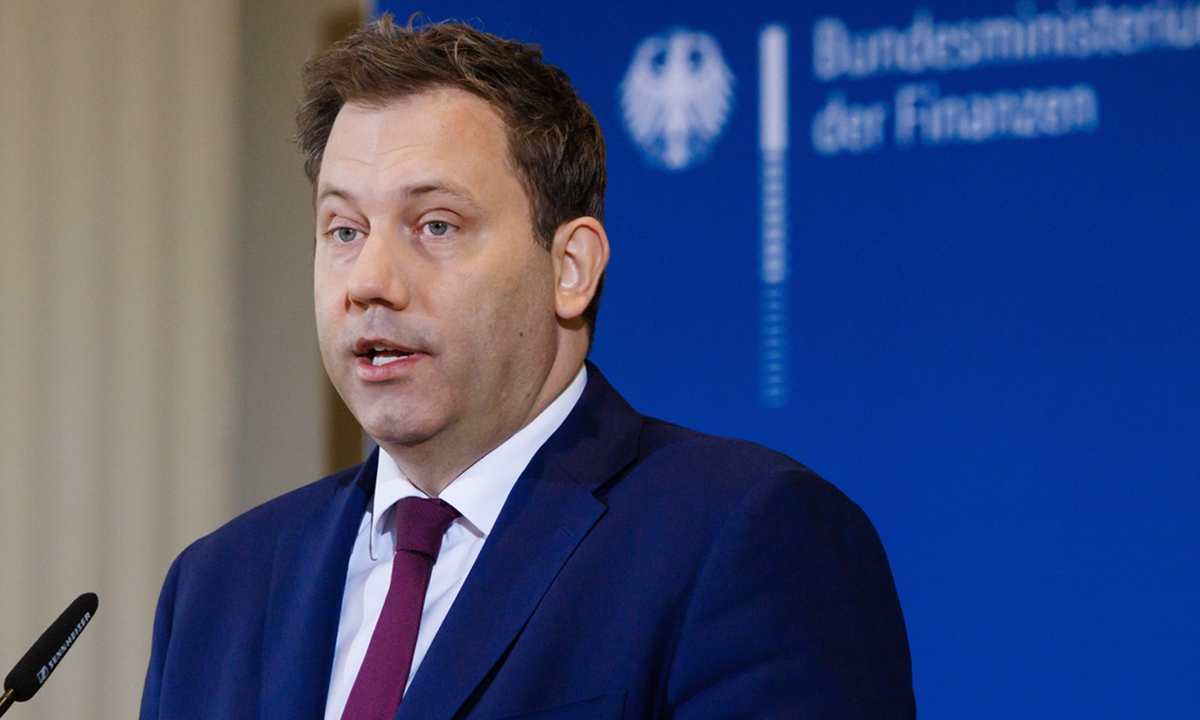
German Finance Minister Lars Klingbeil speaks during a press conference on the 169th tax estimate at the Finance Ministry in Berlin, Germany, 23 October 2025. Photo: VCG
The industrial civilization nurtured along the Rhine River was once known for its precision, rationality, and openness. However, two recent controversies in German politics concerning Chinese electric vehicles have revealed an anxious mind-set that seems inconsistent with this tradition.First, Germany's Federal Minister of Finance Lars Klingbeil publicly expressed dissatisfaction with Deutsche Bahn's procurement of electric buses from BYD, advocating for what he termed "healthy local patriotism" and arguing that Deutsche Bahn should place orders with German or European manufacturers. Second, the German government announced plans to revive subsidies for electric vehicle purchases, raising concerns among Deloitte's automotive experts about "subsidy funds flowing to China," which attempts to create invisible barriers for Chinese brands through policy design. These discussions, in essence, reflect a tendency to politicize normal market choices.
Truly responsible "local patriotism" should focus on the long-term competitiveness of the national industry, rather than confining itself to short-term market share. It should also not be distorted into a rejection of foreign products and investments. Taking Deutsche Bahn's procurement of electric buses as an example, BYD secured only about 200 units of the 3,000-vehicle order, and these vehicles were produced at a Hungarian factory, making them strictly "Made in Europe." This reflects a normal commercial choice under globalized division of labor, as well as a rational judgment by enterprises based on cost, efficiency, and reliability.
If even such limited, transparent, and compliant procurement is repeatedly scrutinized under the political microscope, then the problem likely lies not in "Made in China" or the Chinese brands. A confident industrial power should be willing to absorb high-quality global supply on the application side and improve the efficiency of its own system through competition, rather than tying taxpayers' interests and corporate operations to emotionally driven political gestures.
Similar anxieties are evident in discussions around new energy subsidies. Worries that subsidies might "end up in Chinese pockets" are essentially an extension of zero-sum thinking, ignoring the highly interdependent reality of modern supply chains. The sale of an electric vehicle does not mean a one-way outflow of funds; it triggers a whole set of local economic activities, including logistics, sales, after-sales service, construction of charging infrastructure, and energy services. Chinese companies' advantages in battery technology and cost control objectively provide Europe with tools to "reduce costs and increase efficiency" in its green transition.
If this chain is artificially cut, the result would be that European consumers bear higher transition costs, domestic companies lose the "catfish effect" brought by competition dynamics, and industrial upgrading is actually slowed down. In a global economic system where everyone is interconnected, capital flows are not plunder but rather part of a cyclical process of value creation. China neither intends nor has the capacity to "take all the money," because truly sustainable profits always flow to the more efficient and faster-innovating segments.
Viewing external competition as a "threat to survival" often obscures the urgency of addressing structural issues during a transition period. The challenges currently facing the German automotive industry are fundamentally the growing pains associated with transitioning from the internal combustion engine era to the era of electrification and digitalization. This is the result of a technological paradigm shift, not a product of any one country "squeezing" others. Focusing on guarding against Chinese vehicles and excluding Chinese investment essentially substitutes geopolitical narratives for discussions about industrial policy. This approach does not help address real shortcomings such as software capabilities, battery raw material supply, and energy costs, and it may also cause Germany to miss its window for self-renewal.
History has repeatedly shown that using political measures to "build walls" around lagging capacities only provides temporary psychological comfort while causing those being protected to lose their vitality in a greenhouse environment. The future of the German automotive industry does not depend on keeping competitors out but rather on whether it can regain the spirit of self-negation on the new track and rebuild genuinely competitive industrial advantages on a global scale.
The growth of China's electric vehicle industry is never aimed at weakening the European industries; rather, it represents a form of public supply developed in the process of the global response to climate change. From the flow of components on the China-Europe Railway Express to German automakers establishing R&D centers in China and Chinese battery companies investing in factories in Germany, Spain and Hungary, a deeply intertwined community of interests has formed within the China-Europe automotive industry. The Chinese market and supply chain are also important pillars supporting the global strategies of European automakers. According to estimates by the International Energy Agency, there will be a shortage of 27 million new energy vehicles globally by 2030. China and Germany have strong complementarities in the electric vehicle sector, and both sides can fully share the development dividends of this production and supply chain in a healthy atmosphere of open cooperation.
RELATED ARTICLES