Tokyo’s plan to boost coast guard including increasing patrol vessels amid military expansion moves particularly dangerous, further exposes militaristic ambition, expert warns
By , and Liang Rui Published: Dec 23, 2025 07:56 PM


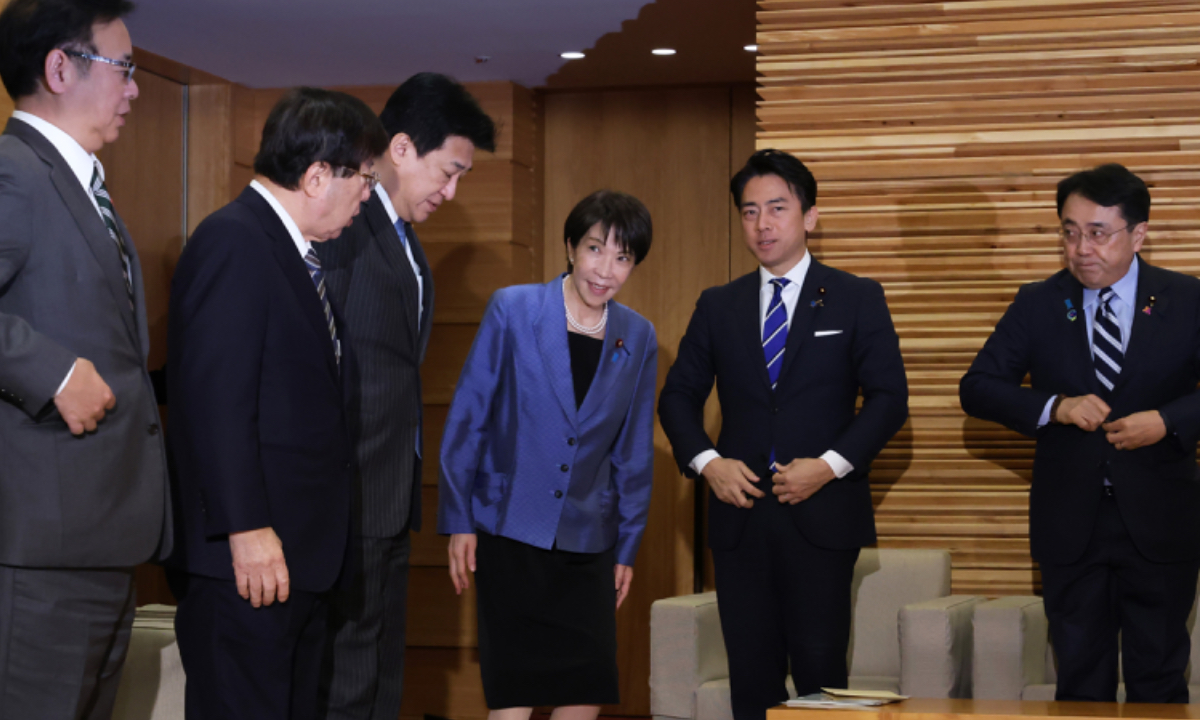
Japanese Prime Minister Sanae Takaichi (center) and other ministers attend the cabinet meeting at the Prime Minister's Office in Tokyo, Japan, on December 23, 2025. Photo: VCG
Against the backdrop of recent series of worrying military expansion moves, the Japanese Prime Minister Sanae Takaichi administration is openly stating its maritime ambitions with the latest intent to advance the enhancement of the Japan Coast Guard’s capabilities, including by increasing the number of large patrol vessels, according to TV Asahi on Tuesday. The report cited the so-called China's maritime advancement as excuse.
A Chinese military affairs expert commented Tuesday that this indicates that Japan is now also expanding its paramilitary force, and this is particularly dangerous amid Japan’s growingly undisguised military expansion moves. By defiantly advancing this latest initiative, it would only heighten the threat it poses to the regional peace and stability, the expert warned.
TV Asahi reported Tuesday that following the launch of her administration, Takaichi convened her first meeting of relevant ministers aimed at strengthening maritime security capabilities, indicating plans to continue bolstering capabilities such as through the addition of large patrol vessels in the next fiscal year, consistent with previous administrations.
During the meeting, Takaichi claimed that "The situation surrounding Japan's peripheral waters is becoming increasingly severe, but we must resolutely defend our nation's territory and territorial waters," according to TV Asahi.
The Prime Minister’s Office of Japan also released the information about the meeting in a X post on Tuesday afternoon.
Wang Yunfei, a Chinese military affairs expert, told the Global Times on Tuesday that Japan's plan to further boost its coast guard forces comes amid the country's recent consecutive moves to develop its military capabilities, in another attempt to break away from its pacifist constitution and undermine the post-war international order. This is a dangerous sign of Japan's militaristic ambition, Wang said. Tokyo’s recent provocative remarks and actions have already raised vigilance of regional countries, he added.
Wang said that the Japan Coast Guard forces are already relatively concentrated along the Ryukyu Islands line. He noted that coast guard vessels’ operational scope is wider and vaguer than that of warships, warning that if Japan unrestrictedly expands the operational scope of its coast guard vessels and escalates confrontation, it will inevitably heighten uncertainty in the regional situation. The expert further pointed out that Japan may harbor deeper intentions, potentially provoking troubles on the Diaoyu Dao issue and the Taiwan question.
Wang added that Japan already operates a large number of coast guard ships in good qualities. However, if Japan attempts to gain advantages over China when it comes to Chinese sovereignty and territorial integrity, it would be a futile act, Wang said.
Also, TV Asahi reported that during the meeting, Takaichi stressed the intent to collaborate with the US, South Korea, the Philippines, Australia, and others to "vigorously advance a free and open Indo-Pacific."
Wang criticized this as an act of "forming cliques and gangs." Takaichi’s remarks exposed that Japan is trying to rally other countries to put pressure on China, which is a move that undermines regional stability and stir up troubles, Wang said.
Over the years, the Japanese right-wing forces have been advancing Japan’s military buildup.
Recently, according to media reports, a senior official in charge of security and defense at the Japanese Prime Minister’s Office told reporters that Japan should have nuclear weapons. Japanese Defense Minister Shinjiro Koizumi on Friday claimed that they left open the possibility of Japan reviewing its non-nuclear principles in the future. These remarks were met with strong criticism from various sectors in Japan and its neighboring countries.
Commenting on the dangerous remarks, Chinese Foreign Ministry spokesperson Lin Jian stated Monday that the latest statement by the senior official from the Japanese Prime Minister’s Office of “possessing nuclear weapons” is an example of how Japanese right-wing forces are trying to “remilitarizing” and “rearming” Japan. It also says a lot about why Prime Minister Takaichi could make such erroneous and dangerous remarks concerning Taiwan on November 7. After coming into office, Prime Minister Takaichi has hyped up the “survival-threatening situation” and kept blurring policy boundaries. She has taken a number of steps to cross the red line and played deaf to domestic and international criticisms. Many with vision in Japan have warned against that. We cannot but ask: Where exactly is the Takaichi Administration taking Japan?
Also, in response to reports that the Japanese government sold its domestically produced Patriot air-defense missiles to the US and Liberal Democratic Party of Japan has started discussions on revising its three security documents, Senior Colonel Jiang Bin, spokesperson for the Ministry of National Defense, stated on November 27 that It is an ironclad fact that Japan was a defeated country in WWII. International treaties and instruments such as the Cairo Declaration, the Potsdam Proclamation, and the Japanese Instrument of Surrender, explicitly ban Japan from rearmament. The international community must be on high alert against Japan's revisionist attempts to break away from the restraints of its pacifist Constitution by brazenly expanding its military build-up, drastically increasing its defense budget, expediting the revision of its security policies, relaxing restrictions on weapons export, and attempting to revoke the three non-nuclear principles. It is even attempting to intervene militarily on the Taiwan question. These moves pose serious threats to regional peace and stability.
RELATED ARTICLES