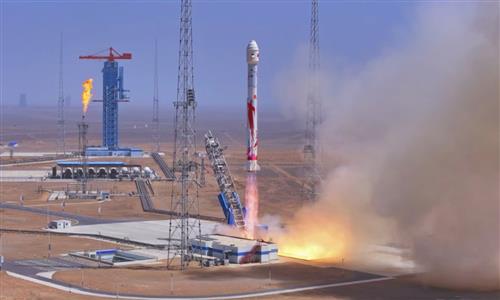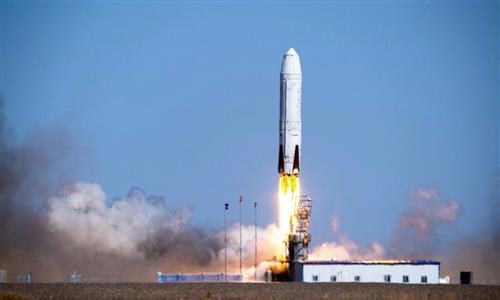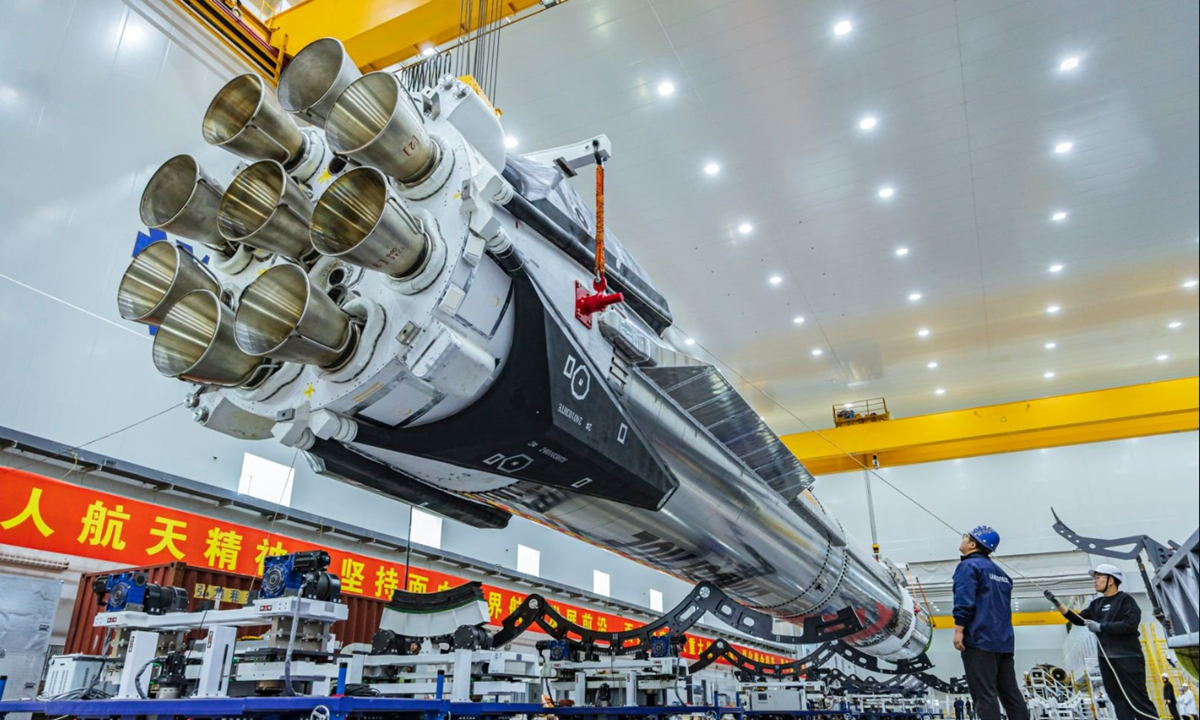
LandSpace's Zhuque-3 rocket Photo: Courtesy of LandSpace
Chinese private space company LandSpace took a key step toward an initial public offering (IPO), Shanghai Securities News reported on Tuesday, signaling accelerating capital-market momentum in the country's commercial space sector.
According to information released on the website of the China Securities Regulatory Commission (CSRC), LandSpace's IPO tutoring status has been updated to "completed," marking an important milestone in the company's listing process, said the report.
Wang Peng, an associate researcher at the Beijing Academy of Social Sciences, told the Global Times that the development not only reflects the company's growth, but also symbolizes how commercial spaceflight—designated a strategic emerging industry by China—is beginning to achieve scalable breakthroughs through capital markets.
Founded in 2015, LandSpace is among China's top private aerospace companies, focusing on the research, development and operation of medium- and large-sized launch vehicles powered by liquid oxygen-methane propellants, the company's website shows.
On July 29, LandSpace filed its IPO tutoring record with the Beijing bureau of the CSRC, appointing China International Capital Corporation (CICC) as its tutoring institution. CICC said that following the tutoring process, it believes LandSpace possesses the key characteristics and qualifications required of a listed company, said the report.
LandSpace has drawn growing public attention for its technological advances. According to Xinhua News Agency, on December 3, the company successfully launched the Zhuque-3 reusable rocket, The second stage of this rocket managed to enter the designated orbit, but recovery of its first stage failed.
As the recovery ultimately failed due to a braking issue during the landing phase, according to the chief commander of the test flight project, the mission was widely viewed by industry observers as a valuable technical test with important reference significance in Chinese commercial aerospace sector.
Against the backdrop of China's rapidly expanding satellite constellation projects—which are driving strong demand for launch capacity and cost control—the country's commercial space industry has grown at a fast pace in recent years. LandSpace's IPO progress is not an isolated case.
CSRC disclosures show that commercial aerospace firm Space Pioneer signed an IPO tutoring agreement with China Securities Co on October 14 with registered capital of 391 million yuan. According to its website, Tianbing is a high-tech enterprise specializing in next-generation liquid rocket engines and medium- to large-sized liquid launch vehicles, China Securities Journal reported on October 19. The company is preparing for the maiden flight of its first reusable rocket model, Tianlong-3.
On October 22, Beijing-based Galactic Energy completed its IPO tutoring filing with the Beijing CSRC bureau, with Huatai Securities acting as the tutoring institution. Founded in 2018, Galactic Energy is China's first private rocket company to achieve mass production, high-frequency launches and full commercialization, accounting for more than 51 percent of all successful launches conducted by China's private rocket sector, Securities Times reported on October 23.
Other Chinese firms are also advancing toward capital markets. iSpace disclosed progress in its IPO tutoring work in July and plans to list on the STAR Market, while CAS Space officially launched its IPO tutoring process in early August, according to media reports.
Research forecasts suggest that China's commercial space market could reach a scale of 2.8 trillion yuan by 2025, and the number of commercial space enterprises in China has now surpassed 600. Wang said the wave of IPO activity among leading commercial aerospace firms reflects a resonance between policy support, capital inflows and an increasingly mature industrial ecosystem.
The Recommendations of the Central Committee of the Communist Party of China for Formulating the 15th Five-Year Plan for National Economic and Social Development noted that China should accelerate the development of industrial clusters in strategic emerging fields such as new energy, new materials, aviation and aerospace, and the low-altitude economy.
Meanwhile, China National Space Administration (CNSA) on November 25 released an action plan to promote high-quality development of commercial space from 2025 to 2027. The plan aims to integrate commercial space into the country's overall space development plan. On November 29, CNSA announced that it has recently set up a new department dedicated to overseeing the rapidly growing commercial space sector, signaling a more institutionalized phase for China's aerospace sector, Xinhua News Agency reported.
Wang noted that the entry of private space firms into capital market is likely to reshape China's aerospace industry landscape. In the long term, he said, the IPO wave will help drive the sector toward greater market orientation, technological independence and global competitiveness, laying the foundation for a technologically advanced and securely controlled aerospace industrial system.
RELATED ARTICLES