Legislative Affairs Commission of China's top legislature addresses concern over revised regulations on drug-use records sealing
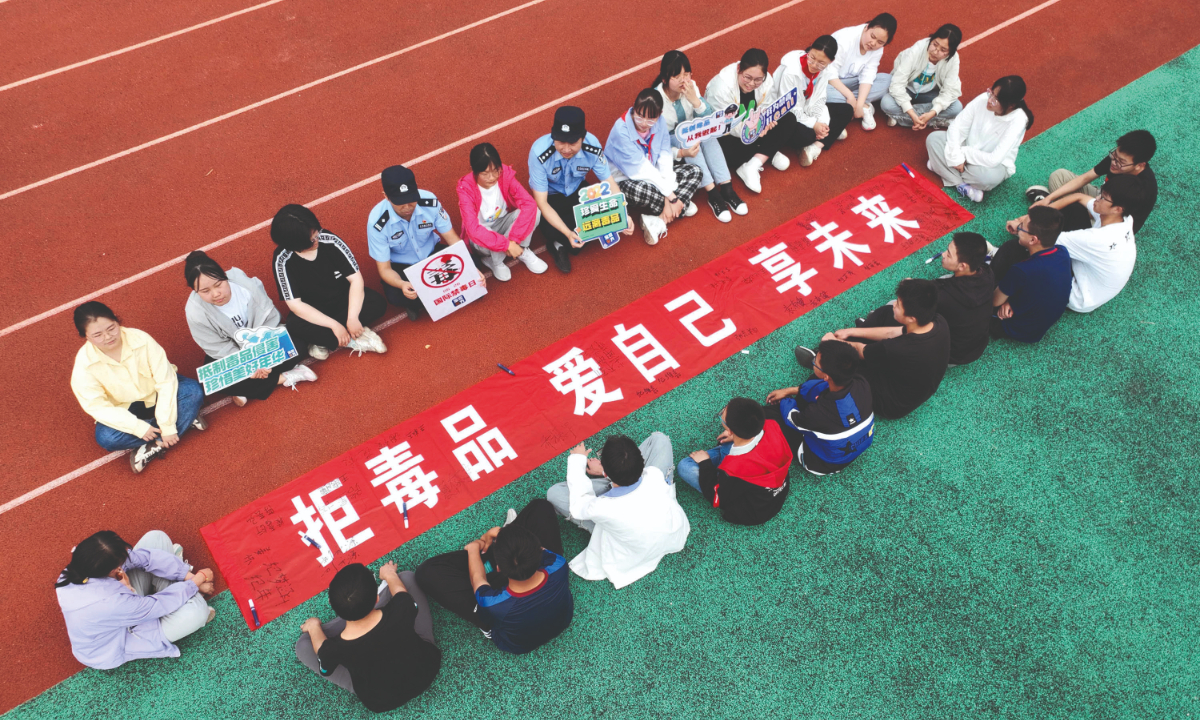
Police officer tells drug control stories to students at the Central Junior Middle School in Baoying county, Yangzhou, East China's Jiangsu Province on June 26, 2023. Photo: VCG
In response to some public concerns over the newly revised version of the Law on Penalties for Administration of Public Security, which involves sealing individual records containing petty offenses such as those relating to drug use, a spokesperson for the Legislative Affairs Commission of the National People's Congress (NPC) Standing Committee said on Wednesday that implementing a system for sealing records of public security violations would help reduce and prevent situations in which "a single punishment leads to lifelong restrictions," and would also provide practical experience for the possible future establishment of a system for sealing records of minor criminal offenses, according to the Xinhua News Agency.The newly revised law stipulates in Article 136 that records of public security violations shall be sealed and must not be disclosed to any organization or individual, except when relevant state organs require them for investigations or when authorized entities access them in accordance with laws and regulations. Agencies that obtain such records are required to keep them confidential.
After being adopted at the 16th session of the Standing Committee of the 14th NPC on June 27, 2025, the draft revision is scheduled to take effect on January 1, 2026.
Since the revised version of the Law on Penalties for Administration of Public Security was released, no differing opinions regarding Article 136 of the law were received, the spokesperson said.
Recently, some comments have raised the question of "which privileged individual was involved" in connection with the record-sealing measures. From the perspective of the rule of law, all citizens of the People's Republic of China are equal before the law, which is a fundamental principle enshrined in the Constitution, the spokesperson said, per Xinhua.
In all aspects of the rule of law — legislation, law enforcement, judicial proceedings, and law observance — no organization or individual may enjoy privileges that place them above the Constitution or the law, and all acts in violation of the Constitution and laws and regulations must be investigated and dealt with in accordance with the law, the spokesperson added.
The spokesperson further explained that the sealing of records of public security violations is a measure for managing and controlling relevant information, rather than a punitive measure.
The purpose of implementing a record-sealing system for public security violations is to ensure necessary control and regulation of violation-related information, and to reduce and prevent situations in which "a single punishment results in lifelong restrictions" for the person penalized. Sealing records does not mean erasing or deleting records: The relevant violation information remains on file, but may not be accessed, provided or disclosed at will.
The Article 136 provides that records subject to sealing may not be provided or made public to any unit or individual, while also stipulating two categories of exceptions: First, where relevant state organs need to conduct inquiries for case-handling purposes; and second, where relevant units conduct inquiries in accordance with state regulations. Article 136 further stipulates that units conducting lawful inquiries must keep confidential the information contained in sealed violation records.
Under China's legal system, drug use is classified as an illegal act but not a criminal offense. The record-sealing measure for public security violations provided for in Article 136 of the Law on Penalties for Administration of Public Security applies to drug use.
In response to concerns and expressed confusion regarding the "sealing of drug-use records," the spokesperson made following clarifications:
First, China punishes drug-related crimes in accordance with the Criminal Law. Section 7 of Chapter VI of the Specific Provisions of the Criminal Law clearly defines drug-related crimes and the corresponding penalties, covering a total of 12 offenses.
Whoever smuggles, traffics in, transports or manufactures narcotic drugs, regardless of the quantity involved, shall be investigated for criminal responsibility and given criminal punishment, according to the Article 347.
The country's stance, measures, and institutional framework for lawfully punishing and combating drug-related crimes remain unchanged, and there has been no relaxation whatsoever in drug control efforts. China is among the countries that impose the most severe penalties for drug-related crimes in the world, the spokesperson said.
Second, the basic approach and key focus of the state's governance of drug use is to strengthen drug rehabilitation measures. Under China's legal system, drug use does not constitute a criminal offense but is a public security violation subject to public security administration penalties, the spokesperson said.
However, upon closer examination, if drug users are not effectively assisted in achieving rehabilitation, any form of punishment imposed on them will have limited practical significance or effect. The priority — and also the challenge — in addressing drug use lies in rehabilitation. China has long attached great importance to drug rehabilitation, establishing robust and effective systems and working mechanisms in this regard, the spokesperson added.
Third, the country has long exercised control over information related to drug users and individuals undergoing rehabilitation. Article 7, paragraph 2, of the Regulations on Drug Rehabilitation rules that personal information of individuals undergoing drug rehabilitation shall be kept confidential in accordance with the law. Article 43 of the same Regulations stipulates that staff members of relevant departments such as public security, judicial administration, and health administration who disclose personal information of individuals undergoing drug rehabilitation shall be subject to disciplinary sanctions in accordance with the law, and where a crime is constituted, criminal responsibility shall be pursued in accordance with the law.
The record-sealing measure for public security violations applies to drug use and, in substance, does not alter China's long-standing practices and approaches to the management and control of drug rehabilitation and drug-use information, the spokesperson said.
With respect to the management of information concerning individuals undergoing drug rehabilitation and drug users, there has been no substantive change before or after the implementation of the sealing measure. The two categories of exceptions set out in the proviso to Article 136 represent an improvement and refinement of the existing information-control regime, the spokesperson added.
RELATED ARTICLES