Chinese team develops 3D in-chip implantation model, fully recreates human embryo implantation in lab for the first time
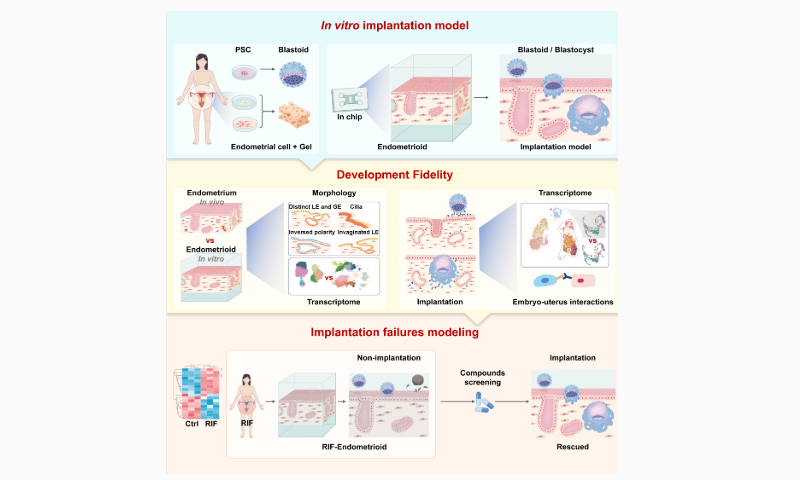
Overview of the 3D in vitro model of human implantation and implantation failure. Photo: screenshot of the CCTV News
A 3D uterus embryo implantation simulation chip developed by a Chinese research team has, for the first time, fully replicated the entire process of human embryo implantation in a laboratory setting, offering new hope for identifying the causes of repeated failures in assisted reproduction, according to the CCTV News on Wednesday.
The 3D in-chip implantation model using human blastoids or blastocysts co-cultured with a bioengineered human endometrial tissue, termed endometrioid was successfully developed by researchers at the Institute of Zoology of the Chinese Academy of Sciences in collaboration with domestic and international research teams. The findings were published on Tuesday in the international academic journal Cell, the report said.
The research showed that among patients in China undergoing assisted reproductive technology (ART) treatments, around 10 percent still fail to achieve clinical pregnancy even after three or more embryo transfers, falling into a condition known as recurrent implantation failure (RIF).
This remains a major challenge in the field of assisted reproduction. The new technology helps clarify the core causes of RIF, enables the screening of personalized and effective drugs, and simplifies diagnostic procedures.
The research team found significant abnormalities in the endometrial cells of patients with RIF, including increased cell apoptosis, reduced proliferative capacity, and accumulated DNA damage. This condition was likened to soil that has become infertile: even high-quality embryos struggle to implant, said CCTV.
In the study, patients need only provide a small endometrial sample for the model to determine whether functional abnormalities of the endometrium are present, helping them move beyond the long-standing dilemma of "unknown causes."
In addition, by combining 3D artificial uterus and artificial embryo technologies, the team achieved dynamic reproduction and systematic analysis of the entire implantation process. The 3D in-chip implantation model also serves as an efficient drug-screening platform, reported CCTV.
According to World Health Organization statistics, about one in six adults worldwide are affected by infertility, cited the Xinhuanet on Tuesday.
"For the field of reproductive medicine as a whole, the 3D uterus embryo implantation simulation chip enables a seamless link between basic research and clinical application, providing clinicians with more practical diagnostic and therapeutic tools," said Wang Hongmei, a researcher in the team, as reported by Xinhuanet.
Wang added that the research team has already completed testing of 1,119 drugs approved by the US Food and Drug Administration, and in the future expects to offer personalized drug screening for patients, ushering ART into a more precise new phase, reported Xinhuanet.
Global Times
RELATED ARTICLES