China, Russia slam US' seizure of Venezuelan oil tankers at UNSC; 'protection of hemisphere' rhetoric reiterates 'Monroe Doctrine': expert
By Published: Dec 24, 2025 07:22 PM

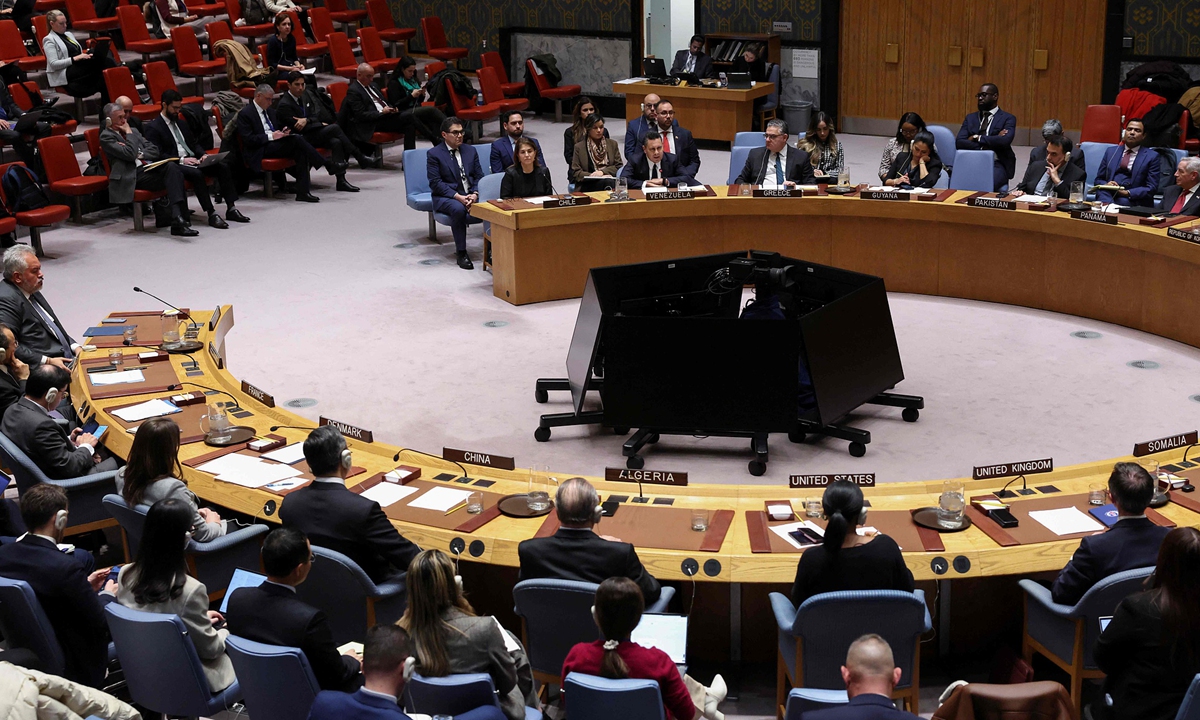
A United Nations Security Council meeting on US military actions against Venezuela is held at United Nations headquarters on December 23, 2025 in New York. Photo: VCG
Both Chinese and Russian envoys at the UN Security Council on Tuesday slammed the US over its military and economic pressure on Venezuela, as the US government is seeking to block third-party oil tankers from entering or leaving Venezuela.
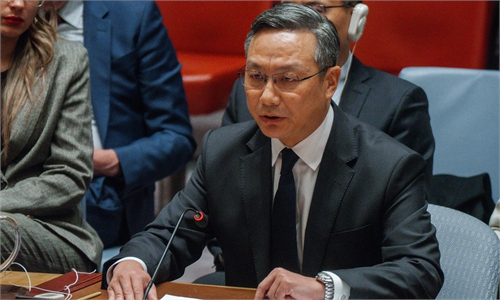
Speaking at an emergency meeting of the UN Security Council requested by Venezuela and backed by China and Russia, Sun Lei, deputy permanent representative of China to the UN, slammed the US infringe upon other countries' sovereignty, security, and legitimate rights and interests, seriously violate the UN Charter and international law, and threaten peace and security in Latin America and the Caribbean.
Russia also condemns the seizure of oil tankers off the coast of Venezuela by the US military, with Moscow's envoy to the UN Vassily Nebenzia slammed the blockage behavior as "cowboy behavior," RT wrote in a report on Tuesday.
According to a readout from UN website, many speakers in the Security Council on Tuesday urged restraint over escalation. The representative of Sierra Leone said that the UN Charter's rules regarding the use of force are "central to international stability and are intended to prevent escalation, miscalculation and illegal wars of choice."
At the same meeting, US Ambassador Mike Waltz responded to the criticism by saying, "The US will do everything in its power to protect our hemisphere, our borders, and the American people," FRANCE 24 wrote.
The US has seized two oil tankers off Venezuela's coast and NBC News reported on Monday that the US Coast Guard "is in active pursuit" of a sanctioned vessel in international waters off Venezuela. If it is caught, it will be the third vessel the US has intercepted in the Caribbean.
The US rhetoric of "protecting our hemisphere" is a 21st-century reiteration of the "Monroe Doctrine," viewing Latin America and the Caribbean as its exclusive sphere of influence and asserting the right to intervene to safeguard US self-proclaimed interests, Cui Shoujun, a professor and director of the Institute of International Development Studies at the School of International Studies, Renmin University of China, told the Global Times on Wednesday.
The response from the US representative indicates that, when its national interests are perceived as threatened, the constraints of international law and multilateral institutions are secondary. This notion of "American exceptionalism" creates a logic of action that any means deemed "necessary" - including sanctions and military operations considered by other countries as illegal - can be employed, which violated the principles and spirit of the United Nations Charter, Cui added.
The US has used the so-called "war on drugs" to justify its escalating military presence in the region, The Guardian reported.
Venezuelan President Nicolas Maduro has sent a formal appeal to all 193 UN member states and Caribbean leaders, warning of an "escalation of extremely serious aggression" by the US, Venezuelan Foreign Minister Yvan Gil said Monday, Xinhua News Agency reported.
At the UN meeting on Tuesday, Sun said China attaches importance to President Maduro's recent open letter.
China opposes all acts of unilateralism and bullying, and supports all countries in defending their sovereignty and national dignity. China stands against any move that violates the purposes and principles of the UN Charter and infringes upon other countries' sovereignty and security, against the threat or use of force in international relations, against external interference in Venezuela's internal affairs under any pretext, and against illicit unilateral sanctions and long-arm jurisdiction that have no basis in international law or authorization by the Security Council.
Recent air and maritime restrictions amid rising tensions between the US and Venezuela risk further worsening the South American country's already "fragile" economy and deepening humanitarian suffering, Anadolu Agency reported citing a senior UN official Tuesday.
As the US military reinforces its deployments in the region and tit-for-tat interception operations become normalized, the risk of miscalculation or accidental incidents involving frontline personnel on both sides will rise sharply, Cui said.
RELATED ARTICLES