How to view the contradictory narrative in the Pentagon’s report: Global Times editorial
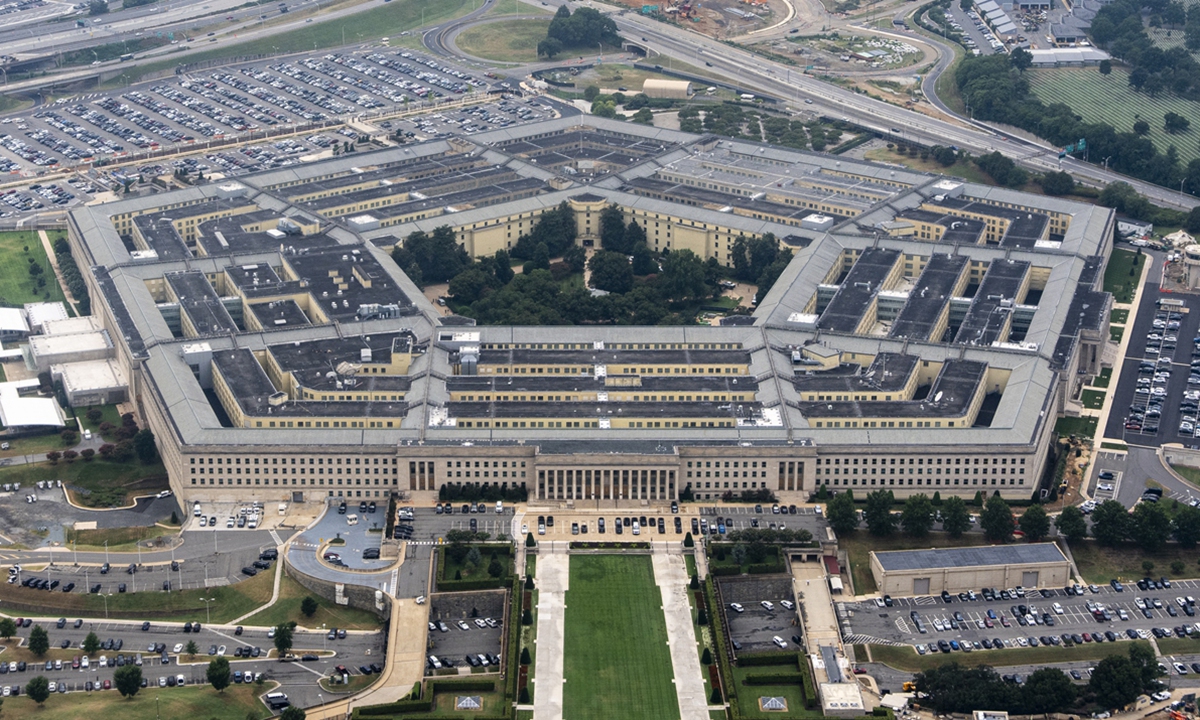
View of Pentagon Photo: VCG
The annual report on China's military and security developments released by the Pentagon on December 23 presents a seemingly contradictory narrative: On one hand, the report continues the misinterpretations and misconceptions of China's military power from the past few years, exaggerating China's "historic military buildup" and fueling anxieties about the "increasingly vulnerable" US homeland. In other words, the report still frames China as a "challenge" and "adversary" as its main theme. On the other hand, the report emphasizes that "Under President Trump's leadership, relations between the US and China are stronger than they have been in many years," and promises to open "a wider range of military-to-military communications with the PLA." The duality of the report provides a window into understanding the complex realities of current US-China relations.Hyping the "Chinese military threat" theory has become an "annual routine" for the Pentagon. This report is the first since the new US administration took office. It continues to adopt previous double standards, insisting on US military intervention in the Asia-Pacific region while simultaneously portraying China's military development as "able to directly threaten Americans' security." China's development of its normal defense capabilities is a legitimate measure to safeguard the security of over 1.4 billion people and every inch of its territorial sovereignty.
External forces have no right to make irresponsible remarks on this matter. China's military expenditure has remained below 1.5 percent of its GDP for many years, which is lower than the world average. It can be seen from the report that the failure to properly understand China remains a major obstacle for the US to develop a correct understanding of China. However, it is not difficult for the Pentagon to properly assess China's military strength, because China's purpose of building necessary defense capabilities has been transparent and consistent, which is to resolutely safeguard its legitimate rights and interests and preserve peace.
As a country with a long land boundary and vast maritime territory that has endured tremendous war sufferings, China cherishes peace and security more than anything else. China's defense policy is defensive in nature. It is the legitimate right and inevitable requirement of a sovereign state to strengthen national defense and military modernization, a necessity to address complex security challenges and fulfill China's international responsibility as a major country, and a foundation to safeguard national unity and dignity.
This does not mean that China is seeking hegemony or challenging any other country. As China has repeatedly made it clear, no matter how developed it becomes, China will never seek hegemony, expansion or spheres of influence. The development of the Chinese military is designed to meet the requirements of winning a defensive war and deterring conflict. Its military growth matches the country's comprehensive national power and its security obligations and international responsibilities. It is not aimed at "benchmarking" against a certain major power.
The healthy and stable development of China-US relations is important not only bilaterally but also for the future and destiny of the world. The Pentagon report has highlighted the current US president's emphasis on stabilizing China-US relations and his strategic framing in this regard, which is a positive signal worthy of attention. History over the past several decades has repeatedly shown that both countries stand to gain from cooperation and lose from confrontation. At a time when the world is undergoing profound changes unseen in a century, the special responsibilities jointly borne by China and the US have not diminished but grown even heavier. Steering bilateral relations toward a path characterized by coordination, cooperation, and stability, and avoiding a slide into confrontational conflict and the "Thucydides Trap," would not only serve the interests of both peoples but also meet the broad expectations of the international community. For both the two countries and their militaries, dialogue and cooperation are the only correct choice, and building a stable framework of relations based on mutual respect and equality and mutual benefit should be an unwavering goal for both sides.
A peaceful and stable world serves the fundamental interests of all countries, and China's development and growth advance in positive tandem with efforts to safeguard global peace and stability. As the second-largest contributor to the UN peacekeeping budget, China has dispatched over 50,000 peacekeepers cumulatively, maintains the most comprehensive range and the largest number of standby forces, and has demonstrated major-country responsibility through missions such as escort operations in the Gulf of Aden, Y-20 aircraft delivering emergency assistance, and medical services provided by the Peace Ark hospital ship. China remains committed to the path of peaceful development, actively participates in global security governance, and advocates a vision of common, comprehensive, cooperative, and sustainable security. The development of China's military capabilities is a proactive effort to provide global public security goods, and by no means the "threat" portrayed in the Pentagon report.
It is crucial for China and the US to accurately understand each other's strategic intentions through dialogue. However, for the US, it is even more important to move beyond the confines of Cold War thinking, build mutual trust through concrete actions, and jointly shape a constructive China-US relationship that is mutually beneficial and win-win. China has consistently honored its commitment to peace and has never sought to build its own security at the expense of others. The world's peace and prosperity cannot be achieved without common development and mutual reinforcement between China and the US. Only by staying on the right path of dialogue and cooperation and rejecting the misguided road of prejudice and confrontation can China-US relations cut through the fog and move forward in a healthy, stable, and sustainable direction that benefits both countries and the world.
RELATED ARTICLES