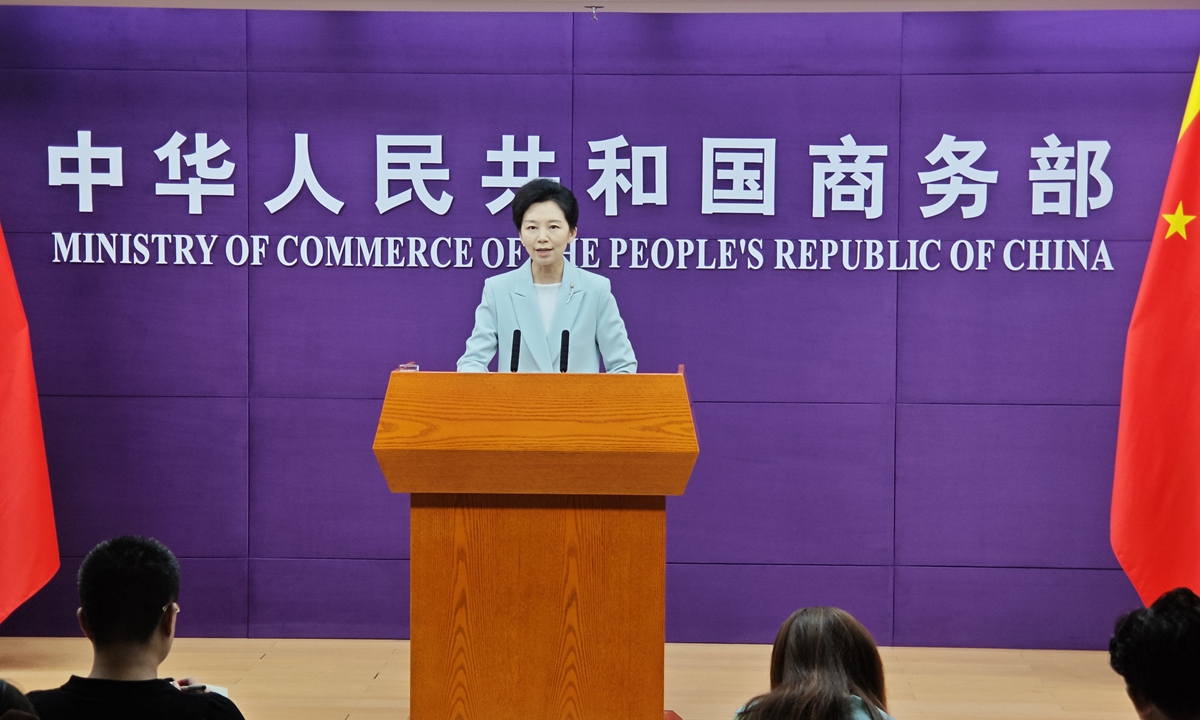
China's Ministry of Commerce spokesperson He Yongqian Photo: Yin Yeping/GT
China hopes that relevant companies can reach solutions on the TikTok issue that comply with Chinese laws and regulations and reflect a balanced consideration of interests, a spokesperson for the Ministry of Commerce (MOFCOM) said on Thursday, urging the US to provide a fair, open, transparent and non-discriminatory business environment for Chinese companies.
MOFCOM spokesperson He Yongqian made the remarks at a regular press briefing in response to reports that TikTok has signed a deal with three investors and plans to establish a joint venture in the US to ensure its continued operations there.
In order to implement the important consensus reached during the phone call between the two heads of state, the economic and trade teams of the two sides previously reached a basic framework consensus on properly resolving issues such as TikTok through cooperation, based on mutual respect and equal consultation, according to He.
The spokesperson expressed the hope that the US side will work with China in the same direction, earnestly fulfill its relevant commitments, provide a fair, open, transparent and non-discriminatory business environment for Chinese companies to maintain stable operations in the US, and promote the steady, sound and sustainable development of China-US economic and trade relations.
According to Reuters and other foreign media, TikTok CEO Shou Zi Chew said in an internal letter to employees last week that ByteDance and TikTok have reached agreements with Oracle, Silver Lake and MGX, with plans to set up a US-based joint venture. The deal is expected to close on January 22, according to The Associated Press.
Foreign Ministry Spokesperson Guo Jiakun reiterated on Friday that China's position on the TikTok issue remains clear and consistent, in response to media inquiries on whether China has approved a joint venture agreement. The spokesperson also said in September that "The Chinese government respects the wishes of the company in question, and would be happy to see productive commercial negotiations in keeping with market rules lead to a solution that complies with China's laws and regulations and takes into account the interests of both sides."
Gao Lingyun, a researcher at the Chinese Academy of Social Sciences, said that it would be premature to draw conclusions before a final agreement and concrete arrangements are officially announced. However, based on current media reports, the proposed plan is clearly an arrangement made by the company in light of its own business structure, he said.
"Regardless of when a final agreement may be reached, its core prerequisite must be full compliance with Chinese laws, while effectively safeguarding the legitimate rights and long-term development interests of Chinese companies," Gao told the Global Times on Thursday.
According to Reuters, Chew told employees in the letter the joint venture would "operate as an independent entity with authority over US data protection, algorithm security, content moderation and software assurance." US entities of ByteDance-controlled TikTok "will manage global product interoperability and certain commercial activities, including e-commerce, advertising, and marketing" separately from the joint venture.
Gao said that any concrete arrangement must strictly adhere to the red lines clearly defined by the Chinese side, adding that "Respecting these principles is the fundamental basis for any eventual agreement."
On September 14 and 15 local time, Chinese and US delegations held talks in Madrid, Spain, where the two sides reached a basic framework consensus on resolving issues related to TikTok through cooperation, reducing investment barriers and promoting relevant economic and trade cooperation.
Regarding the TikTok issue, China has always opposed politicization, instrumentalization and weaponization of technology as well as economic and trade matters and will never seek to reach any agreement at the expense of principles, interests of companies, or international fairness and justice, according to MOFCOM previously.
RELATED ARTICLES