New International Land-Sea Trade Corridor to receive financial policy boost
Move highlights China’s determination for further opening-up
By Published: Dec 25, 2025 10:09 PM

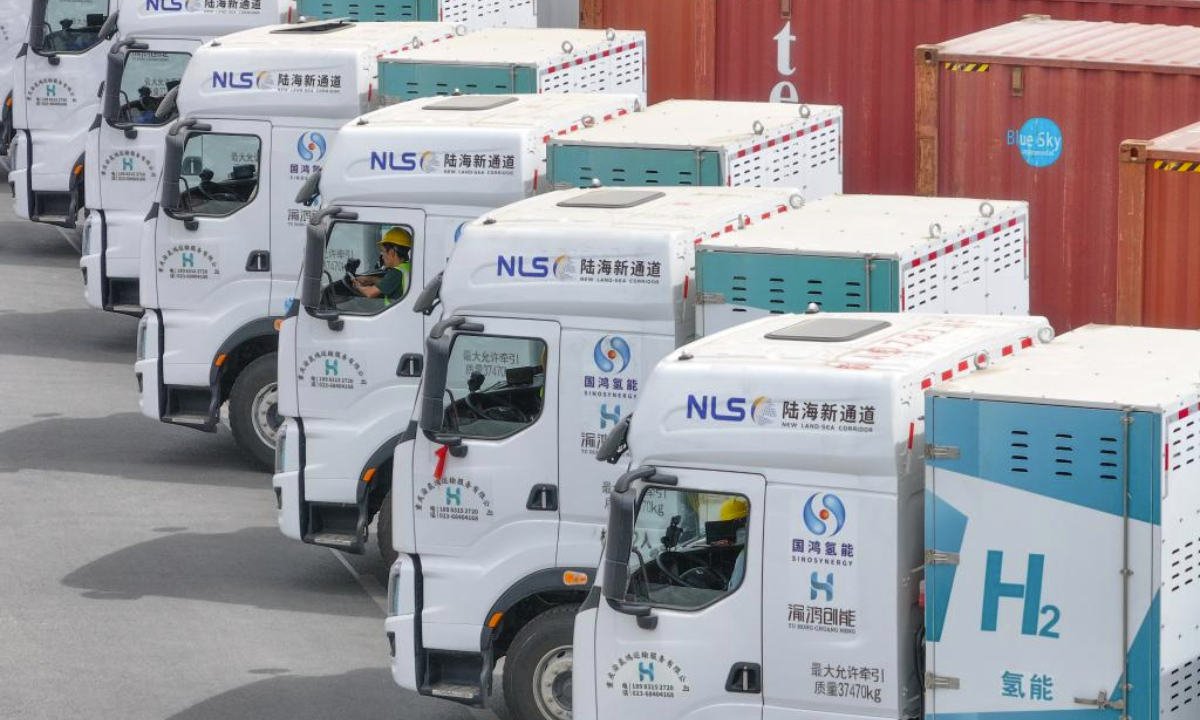
An aerial drone photo taken on April 14, 2025 shows hydrogen-powered heavy-duty trucks awaiting departure from the dry port of the New International Land-Sea Trade Corridor in Chongqing, Southwest China. The route, now operational for regular freight services via hydrogen-powered heavy-duty trucks, spans 1,150 kilometers from Southwest China's Chongqing Municipality to Qinzhou Port in south China's Guangxi Zhuang Autonomous Region, passing through southwestern Guizhou Province. Photo: Xinhua
New measures supporting financial sector development of the New International Land-Sea Trade Corridor, a key logistics network connecting China's western regions to global markets, demonstrate China's determination to "open its doors wider and wider" in the next phase of development and will inject positivity in boosting dual circulation, a deputy governor of the People's Bank of China (PBC), China's central bank, said on Thursday.
On Wednesday, the PBC, the National Development and Reform Commission and six other departments, jointly issued a document, proposing 21 specific supportive measures, focusing on giving full play to the core functions of financing and settlement in a move to provide financial support for the high-quality development of the New International Land-Sea Trade Corridor.
At a press conference on Thursday, Lu Lei, deputy governor of the PBC, said that in the next stage, the PBC will work with relevant departments to advance the implementation of the measures outlined in the document, diligently enhance financial services, comprehensively elevate the capacity and quality of financial services for the corridor, and contribute to the formation of a new pattern of opening-up characterized by the "linked development of inland and coastal areas, and two-way support between eastern and western regions," according to a post on the PBC website.
Lu noted that the release of the document is of great significance and positive influence for fostering smooth and interconnected domestic and international dual circulation.
Elevating the level of financial institutional opening-up in central and western regions will help create a favorable landscape where financial openness drives high-quality financial, economic, and trade development in the regions along the corridor, the central bank official said.
From January to October, total trade via the corridor reached 1.35 trillion yuan ($192.08 billion), up 17.9 percent year-on-year. Trade shipped via Southwest China's Chongqing Municipality, an important node along the corridor, totaled 48.96 billion yuan in the first 11 months, a 1.7-fold increase year-on-year, the city government announced on Wednesday.
The introduction of the document is another move by China to promote high-level and institutional opening-up following the recent launch of the island-wide special customs operations in the Hainan Free Trade Port, a Chinese analyst said on Thursday.
"The document is a blueprint of infrastructure design for financial opening-up in western regions, covering a full-chain financial support system to address issues such as financing bottlenecks, high financing costs, cumbersome settlement procedures, and inadequate cross-border financial services in corridor construction," Wan Zhe, a professor at Beijing Normal University, told the Global Times.
Targeted support for infrastructure, industrial development, the development of industrial clusters, and expanding the use of cross-border yuan settlements are expected to accelerate development in related areas, Wan said.
Lu of the PBC noted the document's focus on breaking down regional barriers, emphasizing enhanced coordination between finance and the real economy within provinces and regions, cross-regional linkages of financial systems among provinces, and cross-border financial cooperation between countries along the corridor and ASEAN nations, among others, according to thepaper.cn.
These three levels of coordinated efforts will promote integrated financial development, collectively contributing to the formation of a new development paradigm with domestic circulation as the mainstay and domestic and international circulations reinforcing each other, Lu said.
The New International Land-Sea Trade Corridor connects the Silk Road Economic Belt in the north with the 21st Century Maritime Silk Road in the south, coordinating with the Yangtze River Economic Belt and playing a crucial role in China's coordinated regional development strategy. Since its pilot run in 2017, it has evolved into a strategic route linking China's inland regions with the markets of ASEAN countries and other parts of the world, according to the Xinhua News Agency.
The Corridor currently covers 157 nodes in 73 cities across 18 provinces, regions and municipalities in China, and reaches 583 ports in 127 countries and regions worldwide, according to Xinhua.
In the first three quarters of this year, China's western regions recorded 611.5 billion yuan in imports and exports via the corridor, an increase of 19.3 percent year-on-year. The corridor also drove up the overall foreign trade growth of western regions by 3.4 percentage points, according to Xinhua.
RELATED ARTICLES