Japan has become a troublemaker in international community: Global Times editorial
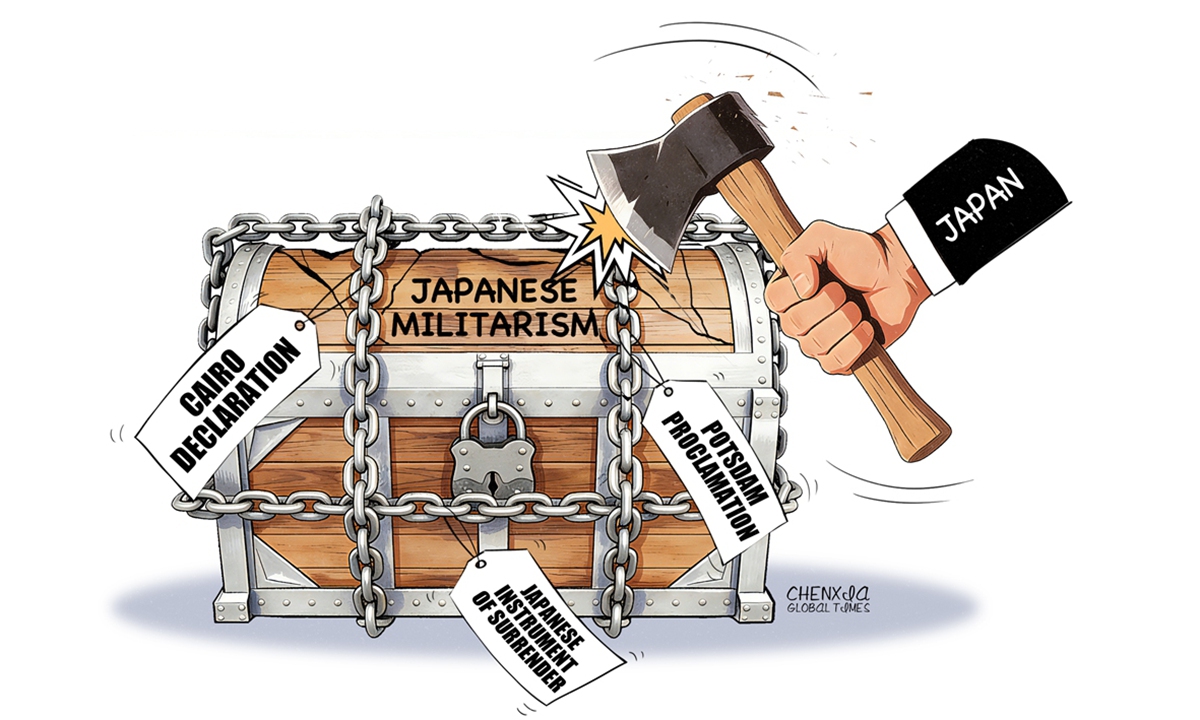
Illustration: Chen Xia/GT
The Japanese government has been sending out dangerous signals one after another. Japanese Prime Minister Sanae Takaichi has publicly stated that Japan will not rule out the possibility of introducing nuclear submarines and is preparing to push forward the revisions of the three documents on security and defense to "be prepared for possible long military conflict." Her close associate, Koichi Hagiuda, led a group of Japanese lawmakers who visited the Taiwan region and met with Lai Ching-te. Japanese media also revealed that Takaichi's another close associate, Oue Sadamasa, was the one who previously made statements in favor of Japan possessing nuclear weapons. This series of words and actions is by no means accidental or isolated incidents. Japan is transforming from a constrained nation in the post-war international order into a "troublemaker" for peace and stability in the Asia-Pacific region and even the world.
The root cause of Japan's role as a "troublemaker" lies in its persistent failure to thoroughly liquidate militarism, which poses a direct challenge to the international order established on the fruits of victory in World War II. This year marks the 80th anniversary of the victory of World War II, a time when Japan should have deeply reflected on its history. However, the Takaichi administration has instead moved against the tide. Its cabinet members had repeatedly visited the Yasukuni Shrine, glorified the history of aggression as a "war of self-defense," and referred to Class-A war criminals as "heroic spirits," constituting an insult and harm to the people of nations that suffered from Japanese colonial aggression. More dangerously, this misguided view of history has transformed into specific policies: the Takaichi administration has attempted to revise the "Three Non-Nuclear Principles," promoted the loosening of military restrictions, and even openly questioned the validity of international legal documents such as the Cairo Declaration and the Potsdam Proclamation. The Japanese Instrument of Surrender pledges to "carry out the provisions of the Potsdam Declaration in good faith." However, the actions of the Takaichi administration today represent an attempt to overturn the political foundation of Japan's surrender and constitute an open betrayal of international justice.
The shift from historical revisionism to military adventurism is an extension of Japan's path as a "troublemaker," which is primarily manifested in the systematic loosening of its nuclear policy. After assuming office, Takaichi swiftly increased defense spending to over 2 percent of GDP and continuously relaxed restrictions on arms exports. From deploying long-range missiles on the Southwest Islands to hinting at the intention to acquire nuclear weapons, Japan's so-called "counterattack capability" exhibits clear preemptive and offensive characteristics. It has also been revealed that Japan's Liberal Democratic Party has reached internal agreement on revising the "Three Principles on Defense Equipment Transfers," aiming to fully liberalize the export of lethal weapons. On the nuclear issue, Tokyo's blatant disregard for the Treaty on the Non-Proliferation of Nuclear Weapons (NPT) is becoming the greatest threat to nuclear security in East Asia and even globally.
Japan's role as a "troublemaker" is also reflected in its deceptive, two-faced diplomacy. While the Takaichi government claims to be "open to dialogue" with China, it has repeatedly provoked tensions on the Taiwan question. From late December to early January 2026, nearly 30 Japanese lawmakers are expected to visit Taiwan, and Iwasaki Shigeru, the former chief of the Joint Staff of Self-Defense Forces of Japan, has taken up the post of a "political consultant" for the Taiwan authorities, crossing the red line of governmental exchanges. This pattern of saying one thing and doing another mirrors the deceptive tactics Japan employed before launching wars in history. For decades after World War II, Japan cultivated an international image as a "peaceful nation" and a benevolent contributor, leading some countries even today to regard it as a "successful example of democratic transformation by the West." The Takaichi administration is now trying to portray itself internationally as a "victim" and to hype a false narrative of "Chinese bullying," with the real aim of using deception to conceal its expansionist nature.
Japan's provocations go far beyond self-armament. They are also evident in its deliberate undermining of regional unity and its role as a frontline proxy for external forces seeking to intervene in the region. The Takaichi government has repeatedly stirred up trouble, provoking neighboring countries on issues such as Dokdo and the Southern Kuril Islands. South Korean political commentator Hanjin Lew wrote in Asia Times that in just two months since taking office, Sanae Takaichi's hawkishness has accelerated regional crisis situation while isolating her own country. By manufacturing and amplifying divisions, Japan seeks to pursue its geopolitical interests amid turmoil and revive old dreams of regional dominance. Such practices seriously poison the atmosphere for resolving disputes through dialogue and cooperation among regional countries, turning Japan into an obstacle to peace and cooperation in the Asia-Pacific.
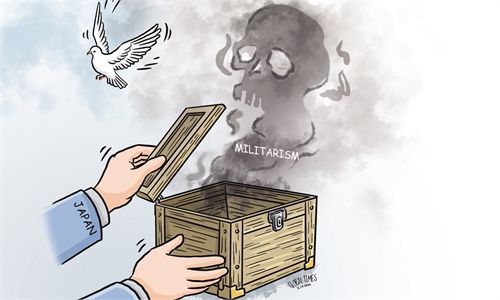
History shows that once the specter of militarism returns, it brings grave disaster to the region and the world. By backtracking on historical issues, racing down the path of military expansion, and sowing division among regional countries, Japan's authorities are cementing their role as an "international troublemaker."
The Japanese government should recognize the trend of the times, immediately stop all dangerous actions that undermine regional peace and stability, sincerely reflect on its history of aggression, uphold the spirit of the "pacifist constitution" and its "Three Non-Nuclear Principles," and build trust with its Asian neighbors and the international community through concrete actions. Peace and development in the Asia-Pacific must not be undermined, and any attempt to overturn the postwar order or revive militarism will be firmly opposed and jointly resisted by all peace-loving countries and peoples.
RELATED ARTICLES