Illustration: Xia Qing/GT
Editor's Note:
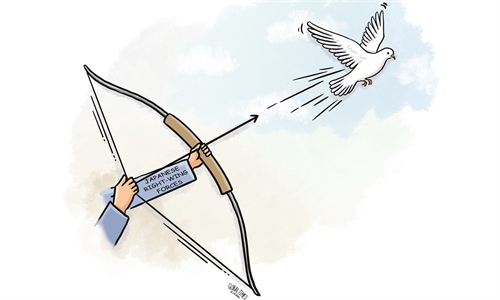
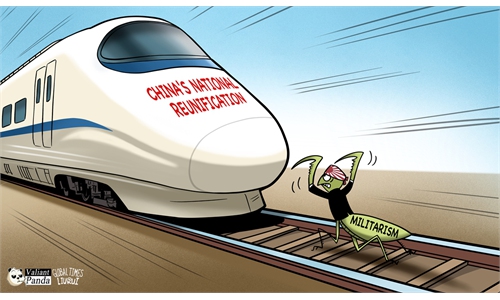
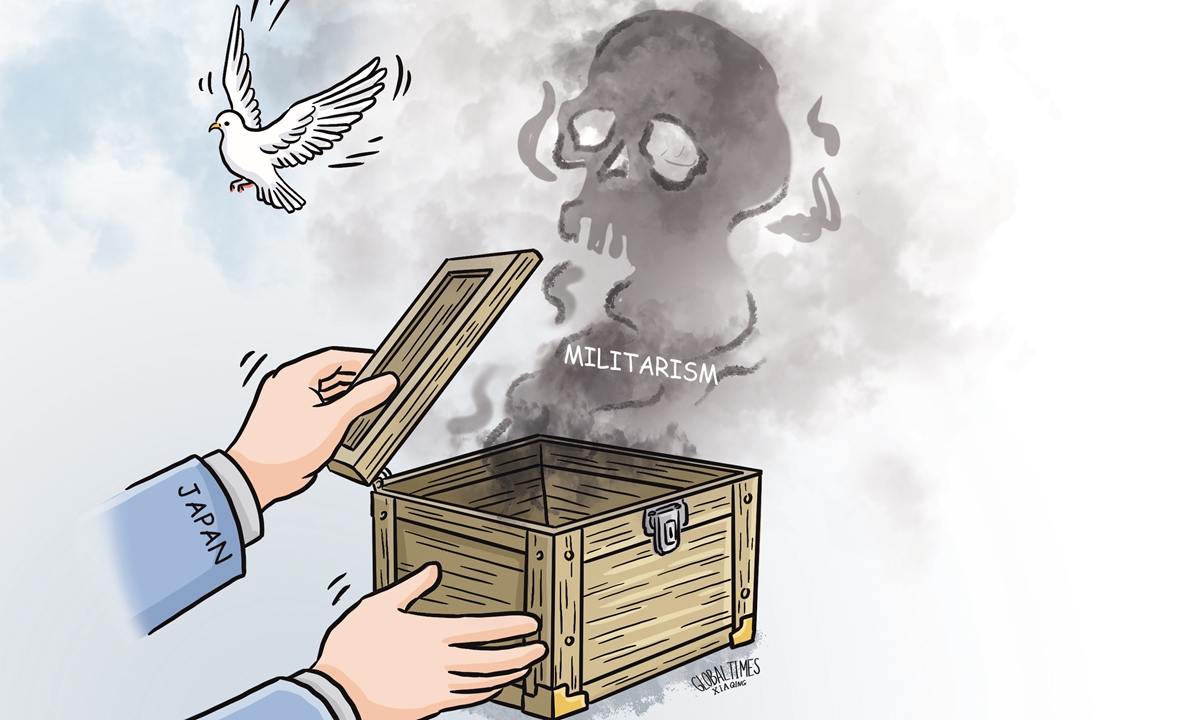
More than two weeks have passed since Japanese Prime Minister Sanae Takaichi made her erroneous remarks on the Taiwan question. Yet neither Takaichi nor Japanese diplomats have committed to retracting those erroneous statements. Japanese right-wing forces are attempting to press for a reinterpretation of the pacifist constitution, lift the ban on collective self-defense, revise the "Three Non-Nuclear Principles" and pursue an ambition to become a "military powerhouse." What do these actions portend for the region? The Global Times has invited three international scholars to offer their insights.
Peter T C Chang, research associate at China-Malaysia Friendship Association, and former deputy director at Institute of China Studies, University Malaya
From the vantage point of Southeast Asia, Japan's recent moves to reinterpret collective self-defense, amend its pacifist constitution and debate the "Three Non-Nuclear Principles" are viewed with profound apprehension. For Malaysia and the broader ASEAN community, these actions are not merely a matter of Japanese domestic policy. They represent a pivotal shift in the regional security architecture - one that carries significant risks and threatens to unravel the delicate balance that has underpinned regional stability for decades.
The primary danger lies in the acceleration of an arms race and the solidification of a confrontational bipolar structure in Asia. Japan's post-war pacifist constitution, while a product of its historical context, has functioned as a crucial confidence-building measure. It reassured neighbors who suffered under Japanese wartime aggression that Tokyo's power would be channeled through economic and diplomatic means. Dismantling this cornerstone fundamentally alters this perception.
Furthermore, any erosion of the "Three Non-Nuclear Principles" would cross a critical red line, potentially trigger a catastrophic regional nuclear arms race and shatter the nuclear non-proliferation regime in Asia. The international community, and ASEAN in particular, cannot afford to bear these consequences.
The region's unprecedented peace and economic prosperity over the past 40 years have been predicated on a stable great-power dynamic and a focus on economic integration. A remilitarized Japan, perceived as aligning squarely with US strategic containment attempt against China, would shatter this foundation.
For ASEAN, the cost would be existential. It would render ASEAN-led platforms like the East Asia Summit and the ASEAN Regional Forum ineffective, as mutual suspicion would override dialogue.
The vision of the ASEAN Outlook on the Indo-Pacific, which emphasizes inclusivity and cooperation rather than containment and rivalry, would be stillborn. The ensuing instability would deter foreign investment, disrupt critical sea lanes like the South China Sea and jeopardize the economic future of over 600 million people.
Warwick Powell, an adjunct professor at the Queensland University of Technology and former policy advisor to Kevin Rudd
As the world marks the 80th anniversary of victory in the World Anti-Fascist War in 2025, one might have hoped that the lessons of the mid-20th century had been irrevocably learned. Yet, what was once described without hesitation as neo-fascism has, to a degree, been recast as "patriotism," "national security assertion," or "self-defense." This process of ideological laundering is what makes the resurgence so dangerous.
Among these developments, Japan's political trajectory stands out for its implications in Asia, where memories of Japan's wartime militarism remain raw. The country's accelerated shift to the right has involved a deliberate attempt to reinterpret, weaken or transcend the post-war constraints that were designed to prevent the re-emergence of militarism.
The lifting of the ban on "collective self-defense," the ongoing attempts to revise Article 9 of the pacifist constitution and now the watering down of Japan's long-held "Three Non-Nuclear Principles" represent not isolated procedural debates, but a cumulative re-engineering of national identity.
These moves have not come from the social margins. They are reflected at the highest levels of Japanese leadership. The new prime minister is in political lineage and conviction aligned with revisionist historical narratives, having a record of visiting the controversial shrine and downplaying the horrors inflicted by the Imperial Japanese Army between 1931 and 1945, particularly in China.
The symbolic power of such gestures is profound: to re-interpret history is to redefine the moral limits of the present. And once the moral memory of aggression is softened, the restraints that prevented its resurgence weaken as well.
Japan's turn is also part of a global pattern in which far-right movements regain legitimacy not by winning overwhelming majorities, but by creating enough political space that their ideas can once again be articulated without shame. Fascism does not return first through tanks; it returns when public culture begins to treat it as reasonable, defensible, perhaps even inevitable.
In this regard, Japan's militarized turn should alarm the region. The danger is not only the possibility of future conflict, but the deeper erosion of the normative firewall that was built out of the catastrophe of the last great war. Once that firewall falls in one major country, others may follow.
Josef Gregory Mahoney, a professor of politics and international relations and director of the Center for Ecological Civilization at East China Normal University in Shanghai, and senior research fellow with the Institute for the Development of Socialism with Chinese Characteristics at Southeast University in Nanjing
If Tokyo is truly interested in collective security rather than insecurity, then it should do the following.
First, Japan must adhere to international norms and respect the one-China principle. Tokyo has no legal right to conduct bilateral relations with Taiwan treating the region as an independent nation. Taiwan is a province of China. This historical fact concerns Chinese sovereignty and is widely recognized in the international community.
Second, Japan should immediately relinquish all claims to the Diaoyu Islands and refrain from contesting Chinese sovereignty over Taiwan and other Chinese territories. In accordance with international law and the provisions of the Potsdam Proclamation, Japan was required to return all occupied Chinese territories to China, including the Diaoyu Islands.
Third, Japan should not act as a forward operating base of American containment strategies. While Japan should be supported in developing the defense capabilities necessary to extricate itself from the security trap inherent in its dependence on the US, it should not do so through appeals to Japanese militarism or "Taiwan independence."
Rather, it should do so through security consultations with China, North Korea and South Korea, and with an eye on establishing a clear horizon for terminating the continued occupation of US forces on Japanese soil. To do otherwise will produce an arms race and increased risks for military conflicts.
Fourth, Japan must learn and teach the correct lessons of history. It should study carefully the trial of Japan's wartime prime minister and Class-A war criminal Tojo Hideki, whose remains, along with other war criminals guilty of committing genocide against China and other nations, are in the Yasukuni Shrine, a site often visited by Japanese leaders in misguided appeals to Japanese nationalism.
Fifth, Japan should forge stronger economic and cultural ties with its neighbors, including China. Many of the problems Japan faces today are systemically similar to those in other countries where political polarization and stagnant economies stem from self-limiting counterproductive relations with Washington. Consequently, Japan should draw closer to its Asian neighbors, including seeking a possible trilateral trade agreement with China and South Korea, and deepen its civilizational links and shared values with China to help address both immediate and long-term security concerns. This is how a true collective security and a shared future are achieved.
RELATED ARTICLES