China’s high-speed rail network tops 50,000 km, surpassing rest of world combined
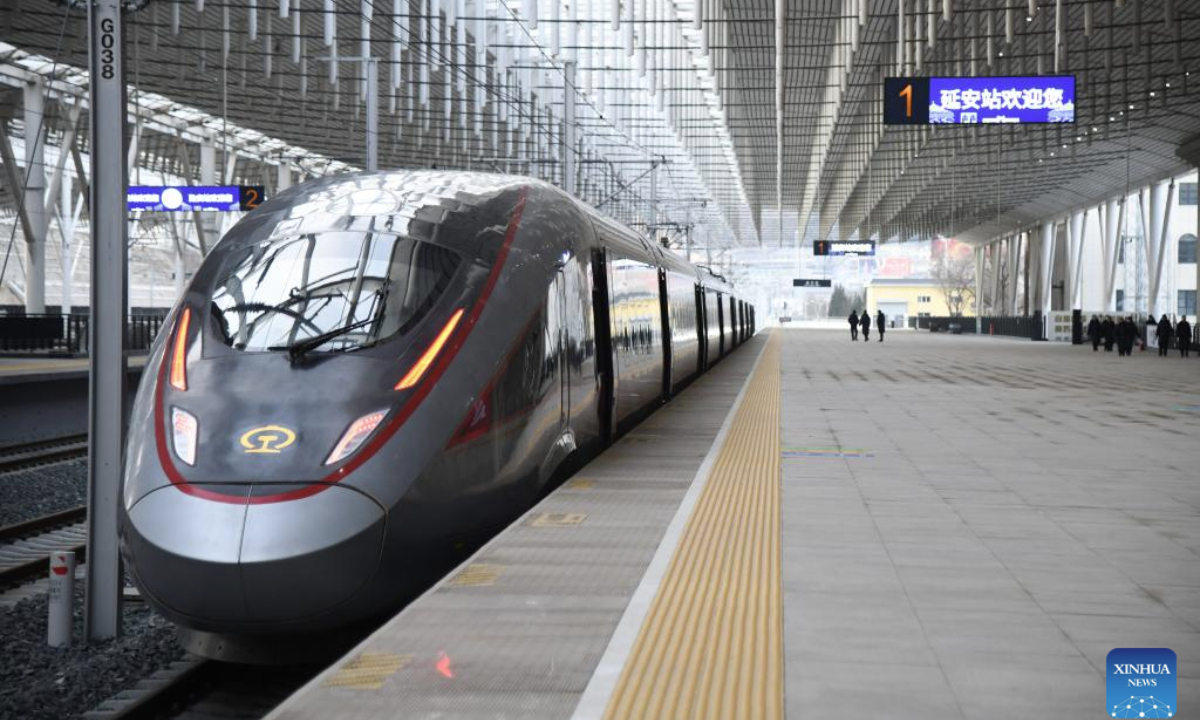
A "Fuxing" bullet train is pictured at Yan'an Station of the new Xi'an-Yan'an high-speed railway in northwest China's Shaanxi Province, on Dec. 26, 2025. (Xinhua/Zhang Bowen)
With the launch of the Xi'an-Yan'an high-speed railway (HSR) on Friday, China's high-speed rail network has surpassed 50,000 kilometers in operation, a landmark achievement in the country's railway transportation network, Global Times learned from China Railway.China's high-speed rail services now cover 97 percent of cities with an urban population of more than 500,000, according to a news release sent by the company.
The country ranks first globally in terms of HSR operating mileage, not only exceeding the combined total of all other countries, but also leads the world in commercial operating speeds for high-speed rail.
As a result, the country has built the world's largest and most advanced high-speed rail network.
Within a 500-kilometer radius, China's major urban clusters have largely formed one- to two-hour travel circles. Cross-regional city trips of around 1,000 kilometers can generally be completed within four hours, while journeys of about 2,000 kilometers increasingly allow for same-day round trips.
At peak capacity, China's high-speed rail network can transport up to 16 million passengers in a single day — equivalent to the population of a megacity moving through the system, according to the company.
The Xi'an-Yan'an high-speed railway starts in Xi'an, capital of Northwest China's Shaanxi Province, passes through Weinan and Tongchuan and terminates at Yan'an station in Shaanxi. The line spans 299 kilometers with a designed maximum speed of 350 kilometers per hour, China Central Television reported on Friday.
During the initial stage of operation of the Xi'an-Yan'an HSR, up to 38 EMU trains will run daily. With a total of 10 stations to be put into service, the fastest travel time between the two cities will be reduced to 68 minutes, 62 minutes shorter than conventional rail services.
Since the start of the 14th Five-Year Plan period (2021-25), China has built and put into operation about 12,000 kilometers of HSR, with total operating mileage rising by roughly 32 percent from the end of 2020 and extending HSR access to 128 counties nationwide.
High-speed rail has strengthened the flow of people, information and capital between cities, facilitating resource integration and complementary advantages. It has helped form multiple economic corridors linked by high-speed rail lines, analysts said.
Meanwhile, China has achieved a world-leading level in HSR technology, supported by a comprehensive system covering engineering construction, equipment manufacturing and operational management.
At the end of 2024, the country unveiled the prototype of the CR450 EMU, whose key performance indicators, including operating speed, energy efficiency, interior noise levels and braking distance, are internationally leading.
During testing, the train set a new record with a relative passing speed of 896 kilometers per hour between two EMUs, marking the world's first establishment of a top-level technical benchmark system for 400-kilometers-per-hour-class-high-speed trains, according to the company.
Global Times
RELATED ARTICLES