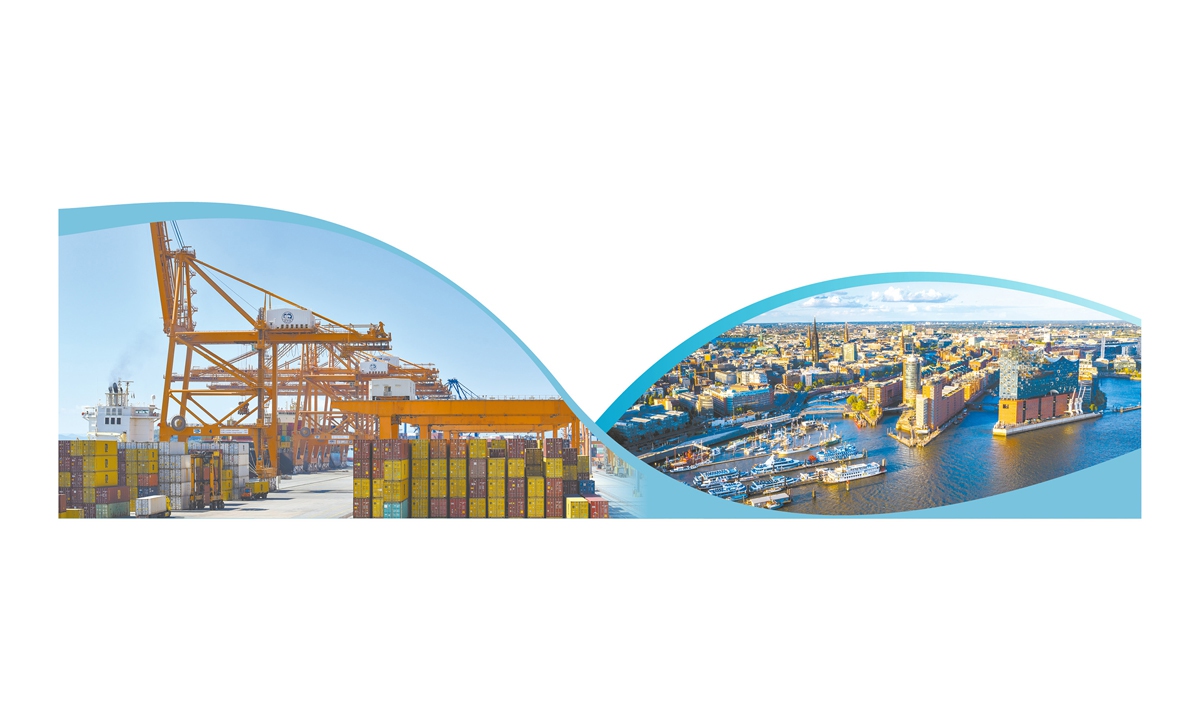
Views of the Port of Piraeus in Greece (left) and the Port of Hamburg in Germany Photos: VCG
Editor's Note:
This year marks the 50th anniversary of the establishment of diplomatic relations between China and the EU. President Xi Jinping noted that over the past 50 years, China and the EU have achieved fruitful outcomes in exchanges and cooperation, delivering mutual success and worldwide benefits. An important understanding and insight is that the two sides should respect each other, seek commonality while reserving differences, uphold openness and cooperation, and pursue mutual benefit. To explore the future trajectory of China-EU relations, the Global Times is launching a column titled "China-Europe Resonance." In the third article, we invite scholars from both China and Europe to review how the Port of Hamburg in Germany and the Port of Piraeus in Greece cooperate with China, demonstrating the tenacity of China-Europe cooperation.
The Port of Hamburg witnesses the continuous deepening of China-Europe economic and trade relations
Sun Yanhong (a senior research fellow at the Institute of European Studies at the Chinese Academy of Social Sciences): Since the commencement of trade with China in 1731, the Port of Hamburg has consistently served as a crucial hub for China-Europe economic and trade exchanges. The interaction between the Port of Hamburg and China has evolved through several stages. This entire process has witnessed the continuous evolution and deepening of bilateral economic and trade relations.
In the 21st century, the opening of the China-Europe Railway Express has further strengthened Hamburg's position in the sea-rail intermodal transport system, making it a comprehensive hub connecting Chinese manufacturing with the European market. Today, the interaction between the Port of Hamburg and China has gone beyond traditional trade, extending to areas such as investment, port management, logistics and green shipping.
Zheng Chunrong (director of the German Studies Centre at Tongji University): China is the largest and most important source of containers for the Port of Hamburg. While the port's trade volume remains high, two-way investment between China and Hamburg is also increasing, with Hamburg becoming a bridgehead for Chinese companies to enter the German and European markets.
Currently, there are over 500 Chinese companies in Hamburg. Meanwhile, people-to-people exchanges are strengthening as well; Hamburg boasts Germany's largest Chinese community, with over 10,000 Chinese people studying, working and living there.
Helga Zepp-LaRouche (founder of Germany-based political and economic think tank, the Schiller Institute): The fascinating success story of the relationship between Hamburg and China has inspired German society's interest in China's history, language and culture. The Department of Chinese Language and Culture at Hamburg University has become the cradle for Sinology in Germany, and has since developed a significant network with the Sinology departments of various universities in China.
Direct container trade between Hamburg and China accounted for about 2.2 million twenty-foot equivalent units (TEUs) in 2024, underscoring its role as the city's most important trading partner. As a result, the port and city authorities have been pragmatic and self-assured, withstanding any pressures put on Germany to "de-risk," because the appreciation for the mutual benefit of the trade with China has become part of the genes of the people from Hamburg. Therefore, the overall relations between the Hamburg city and China can serve as a role model and a microcosm for relations between Germany and China.
Successful transformation of the Port of Piraeus provides a replicable experience for practical cooperation between China, Europe
Zheng Chunrong: Today, the Port of Piraeus is no longer the small, near-bankrupt port it once was. Under Chinese operation, it has maintained its position as the largest port in the Mediterranean and one of the top five ports in Europe, with an annual container throughput exceeding 5 million TEUs. Most importantly, COSCO has resolved the long-standing problem of insufficient rail connectivity at the Port of Piraeus by launching the "China-Europe Land-Sea Express Line." This is a sea-rail intermodal transport corridor with the Port of Piraeus as its hub. It not only provides an efficient route for Far Eastern goods to enter the hinterland of Central and Eastern Europe, but is also crucial for building the Port of Piraeus' distribution system and consolidating its position as the gateway to Southern Europe. In recent years, the Port of Piraeus' core business units have performed strongly, with both revenue and profits reaching record highs.
Sun Yanhong: The successful transformation of the Port of Piraeus provides replicable experience for pragmatic cooperation between China and Europe. First, it effectively combined capital investment with governance reform. Second, infrastructure upgrades and port operational efficiency improvements occur simultaneously. Third, regional supply chains and multimodal transport networks are integrated. Fourth, port upgrades effectively boost local economic growth and employment, truly solidifying the common economic interests of China and Europe.
Helga Zepp-LaRouche: While successive Greek governments from different political parties supported the expansion of the port due to its obvious benefits to the Greek economy, criticism from the European Commission and the German and French governments was entirely motivated by geopolitics. It was first the US that demanded "decoupling" from China, which the EU then watered down into "de-risking," with both concepts based on flawed economic thinking.
Now, against the backdrop of the US launching a tariff war against Europe, Europe should recognize that blind acquiescence to Washington has brought it no real benefits, and that China is, in fact, a more reliable partner for cooperation.
As Gottfried Wilhelm Leibniz said, the China-EU cooperation is a 'singular plan of the fates'
Zheng Chunrong: Although the ports of Hamburg and Piraeus started cooperation with China at different times, they wrote brilliant chapters of win-win cooperation between China and Germany, and between China and Greece, respectively. The cooperation has benefited both sides and the world, providing important experience and insights for current China-Europe relations.
First, we must adhere to openness, cooperation and mutual benefit. Second, promoting industrial synergy and land-sea intermodal transport is essential. Third, we should strengthen trust and promote people-to-people exchanges.
Sun Yanhong: Currently, the world is undergoing rapid changes, with escalating geopolitical competition and a complex interplay of great power rivalry and cooperation, leading to a profound restructuring of global supply chains. Given the respective economic weight of China and Europe, the importance of economic and trade cooperation has become even more prominent. China-Europe economic and trade cooperation is gradually upgrading from the flow of goods to industrial linkages. The practices of the two ports demonstrate that China and Europe not only possess vast potential for mutual benefit and win-win outcomes, but can also work together to make significant contributions to stabilizing global supply chains.
Helga Zepp-LaRouche: In both cases, in Hamburg and Piraeus, the success of these ports and their home cities is largely due to their trade relations with China.
Nowadays, the international order is undergoing profound changes, which makes it all the more important to establish a new global security and development order which indeed takes into account the security and development interests of all countries on the planet into account.
The most comprehensive proposal in this respect comes from the Global Governance Initiative. Within that framework, the specific relationship between China and Europe can have a prominent function.
As the German philosopher Gottfried Wilhelm Leibniz already discussed in 1697 in his Novissima Sinica, the cooperation between China and Europe is "a singular plan of the fates."
Let us therefore cooperate to realize Leibniz's vision.
RELATED ARTICLES