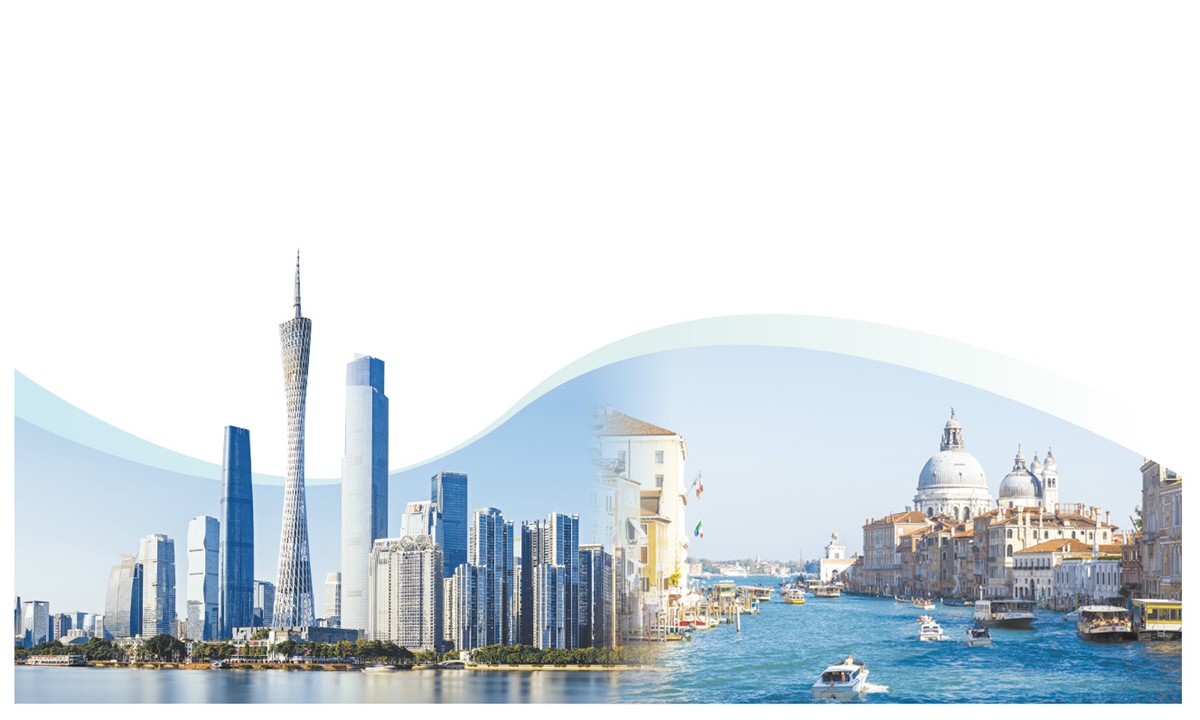
Views of Guangzhou, China, and the architectural landscape of Venice, Italy. Photos: VCG
Editor's Note:
This year marks the 50th anniversary of the establishment of diplomatic relations between China and the EU. President Xi Jinping noted that over the past 50 years, China and the EU have achieved fruitful outcomes in exchanges and cooperation, delivering mutual success and worldwide benefits. An important understanding and insight is that the two sides should respect each other, seek commonality while reserving differences, uphold openness and cooperation, and pursue mutual benefit. To explore the future trajectory of China-EU relations, the Global Times is launching a column titled "China-Europe Resonance." In the inaugural article, we invite scholars from both China and Europe to share their insights on why "new-era Marco Polos" are needed to further strengthen ties.
Civilizational dialogue runs through China-Europe relations
Zhang Jian (vice president of the China Institutes of Contemporary International Relations):
China and Europe sit at opposite ends of the Eurasian continent, both rich in splendid histories and civilizations. In the early days, the vast geographical distance meant that mutual understanding between the two sides relied largely on imagination. Later, with the formation and expansion of the Silk Road, ancient China's four Great Inventions and its achievements in agriculture, sericulture and ceramics spread to other parts of the world, including Europe.
Civilizational exchange and mutual learning have enhanced understanding between China and Europe and promoted their respective developments. This year marks the 50th anniversary of China-EU diplomatic relations. Over the past five decades, cooperation between China and the EU has continued to expand across a wide range of fields - including education, tourism, economy, science and technology, and climate change. The breadth and depth of China-EU cooperation are now unprecedented.
Jian Junbo (deputy director of the Center for China-Europe Relations, Fudan University, and under-secretary general of Shanghai Institute for European Studies):
2,000 years ago, Emperor Wu of the Han Dynasty twice dispatched Zhang Qian to the western regions, opening up land routes between China and Central Asia, West Asia, South Asia and even Europe. Silk was the main commodity exchanged, thus initiating trade between China and these regions, including Europe. German geographer Ferdinand von Richthofen named this route the "Silk Road," a term that has remained in use ever since. These historical facts serve as a testament to the early exchanges and mutual learning between Chinese and European civilizations.
In modern times, as China opened its door to the world and sought self-reliance and self-improvement, Western academic thought, science and technology, and institutional civilization continuously spread to East Asia, especially to China.
For both sides, exchanges and mutual learning have greatly enriched the depth and expanded the connotation of their respective civilizations, laying the foundation for enhancing political mutual trust and strengthening cooperation in other fields such as the economy, and science and technology.
Yorgos Moraitis (adjunct lecturer in the Department of Political Science at the University of Crete):
The history of relations between China and Europe is, in essence, a story of encounter, curiosity and exchange. From the early silk routes to the maritime explorations of the Renaissance, these two great civilizations have long been fascinated by each other - not only for their material wealth, but for their cultural depth and intellectual traditions.
Despite differences in geography, language and worldviews, China and Europe share a common belief that civilization advances through openness and dialogue. Today, in an era marked by uncertainty and transformation, the spirit of "harmony in diversity" offers both sides a philosophical foundation for building a more balanced and cooperative world. This spirit of mutual learning remains relevant today.
'The Marco Polo spirit' needed in the new era
Zhang Jian: The story of Marco Polo, who traveled to China along the ancient Silk Road as a cultural messenger more than 700 years ago, continues to offer inspiration for today's and tomorrow's exchanges: to approach one another with genuine curiosity, openness and a willingness to learn; to see each other through an objective and respectful lens, upholding equality and inclusiveness; and to recognize the vital role that individuals play in connecting civilizations.
Mutual respect, sincere engagement and the shared pursuit of common progress - these are the spiritual legacies Marco Polo left for China-Europe relations. By inheriting and carrying forward this spirit, both sides should work together to nurture more "new-era Marco Polos."
Yorgos Moraitis: Marco Polo's real legacy lies in the attitude he embodied: curiosity without prejudice, observation without arrogance and the courage to cross not just physical but cultural boundaries.
Today, as we speak of building a "new-era Marco Polo," this legacy should guide our approach to global engagement. The new "Silk Roads" - through trade, education, technology and culture - should not merely replicate economic connectivity, but foster empathy and shared learning. Their success depends on how well they promote mutual respect, co-creation and the flow of knowledge.
"New-era Marco Polos" are not limited to merchants or explorers - they are students, artists, scientists and entrepreneurs who navigate between cultures. Encouraging such exchanges means creating open platforms for joint research, educational partnerships and artistic collaboration. When people experience each other's societies firsthand, stereotypes give way to understanding, and mutual trust takes root.
Jian Junbo: One of the lessons Marco Polo offers to the world is the need for nations to maintain a strong curiosity and interest in diverse civilizations and cultures. Only by adopting an open attitude toward other civilizations and engaging in mutual understanding and contact based on principles of equality, mutual learning, dialogue and inclusiveness can we avoid falling into the traps of "civilizational superiority" or even "clash of civilizations."
Against the backdrop of current international turmoil and the prevailing geopolitical thinking, some areas - such as economics, science and technology, and cultural exchanges - are facing interference from politicization and securitization. The more this occurs, the more all relevant parties, including China and Europe, should overcome these difficulties and steadfastly promote mutual learning among civilizations in the spirit of Marco Polo in this new era.
Achieving shared prosperity through 'harmony in diversity'
Chloe Balla (professor of ancient philosophy at the University of Crete and the president of the Steering Committee of the Center of Chinese and Greek Ancient Civilizations):
The dialogue between China and Europe has lasted for centuries, surviving wars, revolutions and ideological divides. Its endurance shows that civilizations, unlike empires, do not rise and fall in isolation - they evolve through learning from one another. The task before us now is to renew that dialogue in a world more interconnected than ever before, yet still divided by misunderstanding.
To do so requires humility: the willingness to listen, translate and learn. It also requires imagination: to envision new forms of cooperation that combine material progress with moral and cultural depth. If China and Europe can rediscover the spirit of mutual curiosity that animated figures like Marco Polo and Matteo Ricci, a Italian missionary, they will not only strengthen their own partnership but also contribute to sending a much-needed message to the world that civilizations can flourish together without erasing their differences.
Jian Junbo:The world today is rife with cultural disputes and value conflicts, which are impacting and eroding the consensus on civilizational values.
Against this backdrop, in March 2023, President Xi Jinping proposed the Global Civilization Initiative (GCI). Over the past two years, the initiative has gradually transformed from a concept into practice, playing a vital role in promoting the inclusive coexistence and mutual learning among different civilizations, contributing Chinese wisdom to the flourishing of the world's diverse civilizations, and advancing exchanges and mutual learning among civilizations as well as the progress of human civilization.
From this perspective, the differences in history, culture, development paths, systems and stages of development between China and Europe should not be used as an excuse to hinder exchanges. As long as both sides respect and learn from each other, continuously deepen exchanges between civilizations, enhance friendship between peoples, and solidify the foundation for cooperation, they can jointly create a beautiful picture of mutual learning and exchange among different civilizations.
Zhang Jian: The world today is undergoing changes unseen in a century. The historical trend toward peace, development, cooperation and mutual benefit is unstoppable. Yet at the same time, local conflicts occur frequently; anti-globalization sentiments are rising; and hegemonism, unilateralism and protectionism are rampant.
In this context, it becomes increasingly important to respect the diversity of world civilizations, enhance mutual understanding and friendship among peoples, and jointly promote the progress of human civilization. The GCI provides both direction and guidance for advancing China-Europe civilizational exchange and mutual learning.
Looking to the future, the two sides should collaborate across a broader range of areas to meet the demands of the times. In this process, civilizational exchange and mutual learning form one of the fundamental logics underpinning cooperation. This will not only help China and Europe build a lasting, stable, healthy and sustainable partnership, but it will also hold profound significance for the world at large.
RELATED ARTICLES