China’s first footage of wild Siberian tigress with five cubs captured in Northeast China
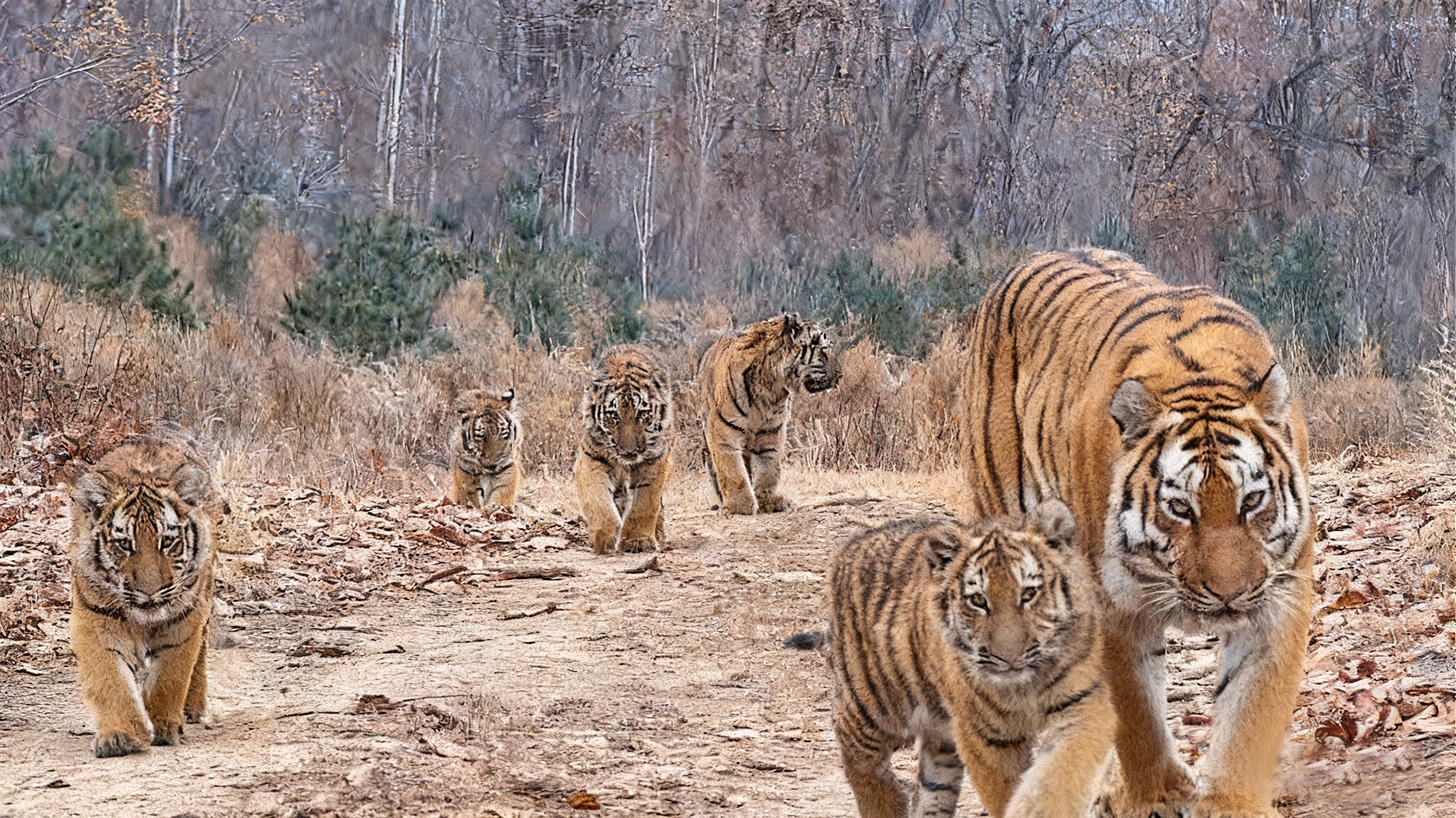
The six-tiger family captured by cameras in the Northeas China Tiger and Leopard National Park in November. Photo: Courtesy of the Northeast China Tiger and Leopard National Park
In a groundbreaking moment for wildlife conservation, camera traps in the Northeast China Tiger and Leopard National Park (NCTLNP) captured the China's first footage of a wild Siberian tigress with five cubs in November, the Global Times learned from the World Wide Fund of Nature (WWF) on Friday.
Wild Siberian tigers typically give birth to one to four cubs, making five cubs an exceptionally rare occurrence even in regions with abundant prey. Experts note that five cubs surviving to this age in a landscape where prey availability is still recovering is nothing short of extraordinary. This footage provides invaluable insight into tiger reproduction and signals positive progress for the species' recovery in Northeast China, according to a statement WWF sent to the Global Times.
The Siberian tigress, estimated to be nine years old, was recorded alongside her cubs, each about six to eight months old. This family is distinct from another recently recorded tigress with four cubs. The continuous recording of multiple tiger families breeding in the national park underscored the success of ongoing conservation efforts in the region, WWF said in the statement.
"This extraordinary footage literally took my breath away. It is rare worldwide to film a mother tiger with five cubs and is definitely a first in China. China's commitment to tiger conservation is delivering incredible results and creating a bright future for these magnificent cats," Stuart Chapman, leader of WWF's global tiger program Tigers Alive, told the Global Times.
The footage of the six-tiger family being captured within the Northeast China Tiger and Leopard National Park further illustrates the significance of building the park to enhance its conservation capacity in Siberian tiger and Siberian leopard population recovery, as well as maintaining the authenticity, integrity, and connectivity of the ecosystems, Chapman said.
"The China's first footage of 'six wild tigers in one frame' recorded in China reflects that the country's conservation actions have been effective and sustained; it also showcases China's contribution to global tiger conservation," Zhou Fei, chief program officer of WWF-China, told the Global Times.
"Years of conservation efforts show that saving tigers is possible. Amid the current global acceleration of nature loss, 'save the roar' brings hope and strength for the restoration and nature conservation of other endangered species and their habitats,"Zhou said.
Siberian tigers, also known as Amur tigers, mainly live in Russia's Far East and Northeast China. The NCTLNP is the world's largest tiger reserve and a critical habitat for the endangered species. Approximately 70 wild Siberian tigers are now living in the park while there were only 12 to 16 in 1998, the Xinhua News Agency reported.
Tigers' survival depends on large, connected habitats and healthy prey populations. The appearance of a tigress with five cubs is not just a local success, it's a beacon of hope for tiger conservation worldwide. It demonstrates that with sustained investment, science-based strategies, and community engagement, even the most endangered species can recover, WWF said in the above mentioned statement.
As the global community accelerates efforts to halt biodiversity loss, this rare glimpse of a thriving tiger family serves as a reminder that collaboration and persistence can turn the tide for endangered species, according to WWF.
RELATED ARTICLES