China issues guidelines to boost employment, calls for enhanced financial support for key groups’ entrepreneurship
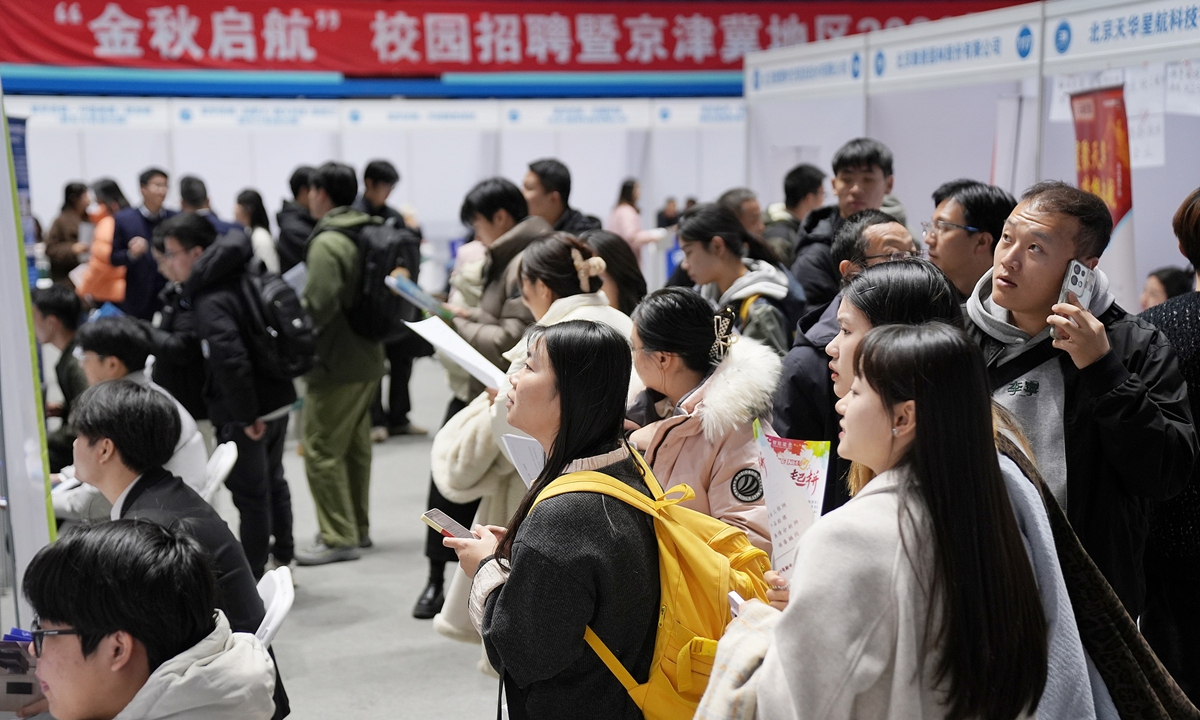
Participants attend a large job fair for 2026 college graduates in the Beijing-Tianjin-Hebei Region on November 19, 2025, at Beijing University of Technology. More than 200 employers from the region are offering over 4,000 job vacancies. Photo: VCG
China's Ministry of Finance and three other departments jointly released a guideline on Friday, calling for enhanced efforts to tap into job creation potential, expand employment capacity, and bolster support for entrepreneurship among demographic key groups, according to the ministry's official website.
Notably, the guidelines placed particular emphasis on strengthening financing guarantees for private firms to expand production, reinforcing a mutually supportive relationship between business growth and job expansion.
This marks the nation's latest move to reaffirm its commitment to employment as a fundamental livelihood priority, by guiding more financial resources to precisely support job creation and entrepreneurship.
The notice, which was issued together with the Ministry of Human Resources and Social Security, the People's Bank of China and the National Financial Regulatory Administration, outlines five key areas aimed at further leveraging the government-backed financing guarantee system to strengthen support for employment and entrepreneurship.
The guideline stresses the implementation of the employment-first strategy and closer coordination between fiscal, financial and employment policies. It calls for intensified efforts to expand job opportunities, support entrepreneurship among priority groups, and enhance the job-creation impact of financial resources, in a bid to promote development while improving public wellbeing.
It also emphasizes integrating support for the real economy with employment promotion. Government-backed financing guarantees should remain focused on serving small businesses and agriculture, while increasing support for micro and small enterprises with strong job-creation capacity and labor-intensive characteristics, helping firms stabilize and expand employment as they scale up production and investment, and fostering a virtuous cycle between high-quality development and job growth.
Chinese experts and industry observers noted that by prioritizing labor-intensive firms with strong job-creation capacity, the policy helps ease financing constraints and stabilize business expectations, enabling companies to expand production and investment while creating more jobs. Aligning financial support for the real economy with employment goals also strengthens the employment elasticity of growth, fostering a virtuous cycle between high-quality development and job expansion, they mentioned.
The document underscores a more integrated, system-wide approach to employment stabilization, marked by closer coordination across fiscal, labor and financial policy tools, said Wang Yiwei, a professor of the School of International Studies at the Renmin University of China. He told the Global Times on Friday that unlike the traditional model led primarily by employment agencies, it places greater emphasis on the combined use of fiscal and financial instruments to step up support for private firms and micro and small enterprises, helping to stabilize business expectations.
The guideline also highlighted the need to better align policy guidance with market-based operations. It calls for strengthening the policy transmission and system-leading role of the National Financing Guarantee Fund, optimizing resource allocation and enhancing the effectiveness of policies aimed at stabilizing employment and encouraging entrepreneurship. Financial institutions are encouraged to select service recipients independently under market-oriented and commercially sustainable principles, while ensuring compliance with laws and regulations.
Meanwhile, the document underscores the importance of balancing innovation with risk prevention. Government-backed financing guarantee institutions and banks are encouraged to innovate financial products and service models, strengthen the use of technology, and develop more convenient online inclusive finance products for micro and small enterprises, while maintaining prudent risk management standards throughout the entire business process.
In recent years, the nation has repeatedly underscored the role of the private sector in supporting urban employment and tax revenues.
According to a recent report by the National Development and Reform Commission, private businesses, as the main channel for absorbing employment, account for more than 90 percent of newly created urban jobs nationwide.
Wang said private firms and micro and small enterprises remain the main source of job creation, and stronger financial support can help stabilize production and spur innovation, while also anchoring workers' employment expectations and supporting a virtuous cycle between jobs, consumption and economic growth. He added that this integrated approach — linking employment stabilization, expectation management and consumption support — aligns closely with the emphasis in the 15th Five-Year Plan (2026-30) on investing in both people and productive capacity.
From a medium- to long-term perspective, Wang said the core challenge lies not in boosting short-term job numbers, but in improving job quality and sustainability.
He pointed to persistent issues such as hidden unemployment, short-term or unstable jobs, and structural mismatches between skills and demand, alongside elevated job-switching rates. Only by aligning employment policies with industrial upgrading and structural adjustment — coordinating future industries, emerging sectors and the transformation of traditional industries — can more resilient, high-quality employment be achieved, rather than temporary or superficial job gains.
The country's economic work in 2025 called for the implementation of measures to stabilize jobs, expand employment, and improve job quality, according to Xinhua News Agency.
China created 12.1 million urban jobs in the first 11 months of 2025, meeting its full-year target of over 12 million a month ahead of schedule, according to Xinhua's another report. The report noted over the same period, the average surveyed urban unemployment rate was 5.2 percent, better than the annual target of about 5.5 percent, citing data from the Ministry of Human Resources and Social Security.
China's urban unemployment rate among the 16-24 age group (excluding students) — widely regarded as the core job-seeking cohort, including recent graduates — stood at 16.9 percent in November, down 0.4 percentage points from October, marking a third consecutive monthly decline and the lowest level in five months, according to the National Bureau of Statistics.
In the first three quarters, the nation created 10.57 million new urban jobs, achieving 88 percent of the full-year target, Xinhua reported.
RELATED ARTICLES