China’s decarbonization is one of defining economic experiments of the time
Pursuing green development
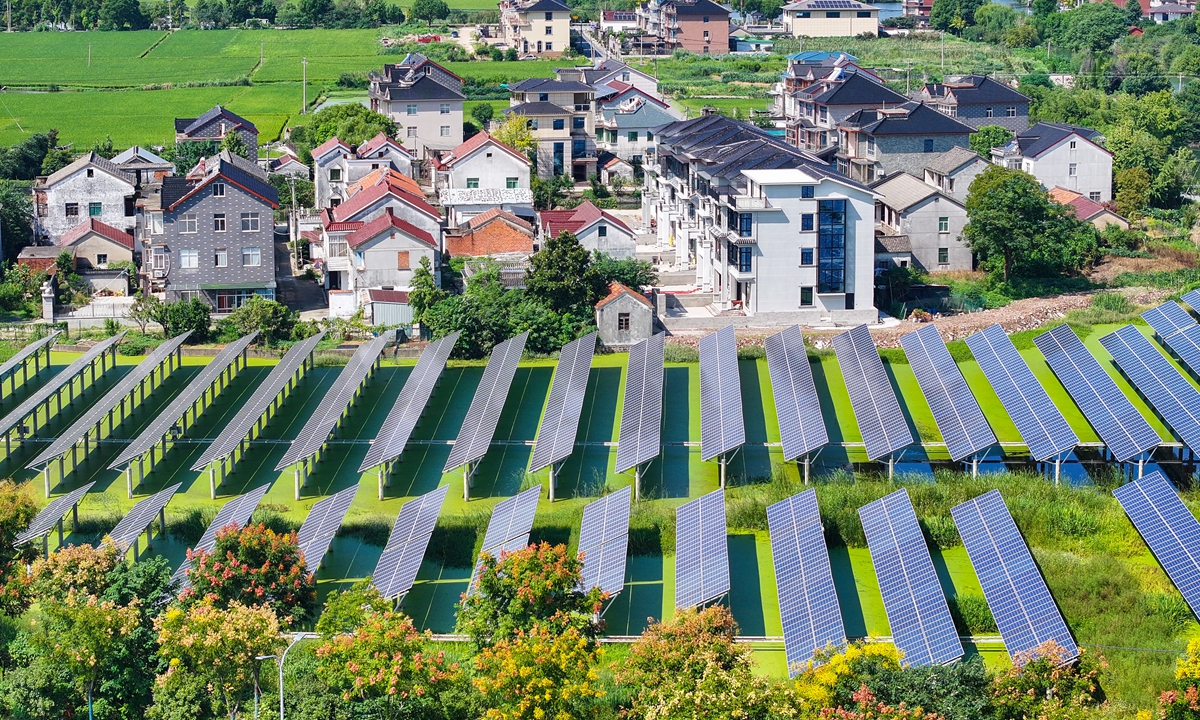
Solar panels are installed above a rural fish pond in Huzhou, East China's Zhejiang Province, on September 22, 2025. Photo: VCG
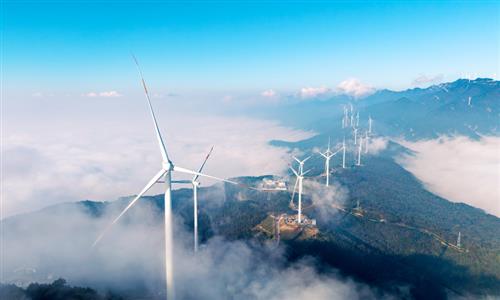
During the 14th Five-Year Plan period (2021-25), China made notable progress in advancing a low-carbon transition while sustaining economic growth. These achievements suggest that decarbonization is not been treated as a trade-off, but increasingly as part of a broader process of economic modernization. What stands out is a shift from incremental efficiency gains toward a more systemic reshaping of the energy system, integrating renewable energy, grid upgrades, energy storage and digital technologies.
This approach is reflected in China's progress in electric vehicles (EVs), battery technology and high-speed rail. Meanwhile, growing attention to transparency along supply chains points to a more data-driven and accountable green transition. At events like the China International Supply Chain Expo, we have seen first-hand how Chinese innovations are scaling domestically while beginning to shape greener supply chains globally.
The proposals for the 15th Five-Year Plan (2026-30) call for accelerating the green transition across the board and building a beautiful China. The annual Central Economic Work Conference urged efforts to promote a comprehensive green transformation. China's confidence in advancing green development stems from its proven ability to execute complex systemic transitions, evident in its world-leading deployment of renewables, EVs and grid infrastructure.
The 15th Five-Year Plan signals an evolution from pilots to economy-wide transformation, embedding green transition into industrialization, urbanization and consumption patterns. We have witnessed this dynamic in forums such as the WBCSD co-hosted "Two Lakes Dialogue," where Central China's Hubei Province is spearheading low-carbon industrial clusters that integrate carbon market mechanisms with green technology incubation.
Deepening cooperation
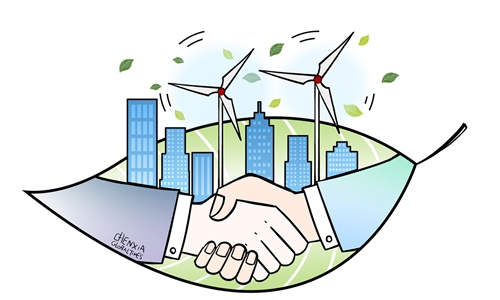
For European companies, China's green transition is creating room for deeper cooperation that is no longer limited to selling products or sourcing components. As climate-related trade rules become more prominent, many companies are facing similar questions about how to calculate, present and verify the carbon footprint of what they produce.
Greater alignment in this area can make cooperation smoother and reduce friction in cross-border trade. European companies bring experience in data verification and reporting, while working with Chinese partners helps turn complex green requirements into practical, workable supply chains.
Cooperation is also expanding into areas that are traditionally harder to decarbonize, including industries such as steel, cement and chemicals. Progress in these sectors depends on combining Europe's experience in industrial processes with China's ability to apply new technologies at scale, allowing ideas to move more quickly from testing to real-world use. A stronger policy focus on a circular economy is expected to expand cooperation by linking how products are designed, used and restored, creating new value chains where European expertise can work alongside China's strengths in manufacturing and large-scale implementation.
The 15th Five-Year Plan places greater emphasis on building self-reliance and strength in science and technology, making clear that green development is a defining feature of Chinese modernization. By putting technology at the heart of decarbonization, this reflects a view that climate goals and economic growth can advance together, with future technological progress playing a key role in reshaping China's energy system and supporting sustainable development.
A smarter and more resilient power system sits at the heart of this shift. The focus is moving beyond simply adding renewable capacity toward building grids that are more flexible and digitally managed, able to handle clean power together with energy storage and EV charging. Improvements in long-distance transmission and grid management may also offer useful lessons for other countries, particularly emerging economies.
At the same time, changes in how materials are produced and reused are helping bring costs down. Supported by its manufacturing scale, China is well placed to make these solutions more affordable and widely available, much as it did with solar power.

Peter Bakker Photo: Courtesy of WBCSD
Climate responsibility
China's decision to submit its 2035 Nationally Determined Contributions ahead of COP30 highlights its active role in global climate efforts. By covering the entire economy and all major greenhouse gases, and by setting absolute emissions-reduction targets for the first time, the move signals continued engagement with multilateral climate cooperation. As the first major economy to pursue modernization based explicitly on non-fossil energy, China is exploring a development path with broad international relevance.
This transition is neither simple nor linear. It involves reshaping how industries operate, how cities function, how capital is allocated, and how energy is consumed, all while seeking to reduce reliance on fossil fuels without undermining economic growth.
Beyond its national targets, China's role in South-South cooperation is pivotal. Through platforms like the Belt and Road Initiative, China offers more than technology transfer; it provides a replicable model of development-coupled decarbonization. By sharing integrated solutions, China enables other developing nations to leapfrog the high-carbon intermediate stage that historically accompanied industrialization.
If paired with open collaboration and harmonized standards, these advances can strengthen global climate governance and accelerate the Paris trajectory.
We are at a decisive moment for global climate action, when multilateral cooperation remains our strongest lever. China's Five-Year Plans represent one of the few remaining examples of long-term strategic economic governance. It is particularly significant because it frames sustainability as the core engine of next-generation competitiveness, aligning industrial upgrades, energy security and climate responsibility into a single coherent vision.
By embedding long-term goals such as carbon neutrality by 2060 into medium-term action plans, China provides investors and global businesses with greater predictability about where capital, innovation and policy will flow. As geopolitics increasingly hampers climate progress, China's commitment to a planned transition can help steady global decarbonization if paired with openness, shared lessons and joint investment in global solutions.
China's pursuit of a green modernization pathway is among the most significant economic experiments of our time. Its outcomes will influence not only China's future, but also the prospects for a globally just transition. From WBCSD's perspective, companies most likely to thrive are those that contribute to building the systems required for a net-zero, nature-positive and equitable economy as this transition unfolds.
The author is president and CEO of the World Business Council for Sustainable Development (WBCSD).
RELATED ARTICLES