China urges Japan to avoid compounding wrongdoing, slams its defense budget hike
Continuous rise in defense spending reflects a major shift in Japan’s national security strategy, undermines Japan’s pacifist constitution: experts
Chinese Foreign Ministry
China urged Japan on Friday to face squarely and deeply reflect on Japan's history of aggression, take concrete actions to show remorse for the crimes committed by Japanese militarists and respect to the victims, and not further compound the wrongdoing while slamming Tokyo's plan to significantly increase its defense budget as further exposing the sinister intent of Japanese right-wing forces to push for remilitarization and attempt a revival of militarism.
Spokesperson Lin Jian made the remarks at Friday's press conference when asked for comments on Russian Foreign Ministry Spokesperson Maria Zakharova's remarks at a briefing responding to a question about Japanese leader's possible visit to Yasukuni Shrine, in which Zakharova condemned Japan's attempts to whitewash its history of militarist aggression and war crimes, and said Japan should construct a memorial hall dedicated to the victims of Japanese militarism as a way to atone for the crimes it has committed.
Lin said the Yasukuni Shrine is a spiritual tool and symbol of Japanese militarists' war of aggression, and that it enshrines 14 Class-A war criminals responsible for Japan's aggression in the 1930s and 40s.
China stands ready to work with the international community, including Russia, to firmly defend the outcomes of the WWII victory and the post-war international order, strictly prevent the resurgence of Japanese militarism and jointly safeguard world peace and stability, Lin noted.
Also on Friday, the Japanese government approved the fiscal 2026 budget, according to multiple Japanese media reports, with defense spending exceeding 9 trillion yen (about $57.56 billion) for the first time, setting a new record high.
The budget plan aims to strengthen defense capabilities and coastal defense, deploying cruise missiles and unmanned weapons to respond to escalating regional tensions, according to media reports.
Lin said despite recent international criticism over latest military and security developments in Japan, the Japanese side has shown no inclination to mend its conduct, and instead plans to again hike defense budget, further revealing Japanese right-wing forces' motive to remilitarize Japan and resurrect militarism.
Since the new Japanese government took office, it has been notably accelerating military buildup. From Prime Minister Takaichi's erroneous remarks on Taiwan that threatens the use of force against China, to the remarks of a senior official of the Japanese Prime Minister's office calling for Japan's possession of nuclear weapons, and to the proposed revision of the three national security documents and the idea of altering the three non-nuclear principles, Japan is deviating further and further away from the path of peaceful development and moving in a dangerous direction, Lin warned.
Dangerous path
The continuous rise in defense spending reflects a major shift in Japan's national security strategy over the years, from a defensive posture to an offensive one, a Chinese expert said.
It exposes Japan's ambition to break free from the constraints of the postwar international order, represents a complete departure from the principle of exclusively defensive defense, and undermines the provisions of Japan's pacifist constitution, Xiang Haoyu, a distinguished research fellow at the China Institute of International Studies, told the Global Times on Friday, noting the move poses great risks to regional security.
In fiscal year 2025, Japan's per capita defense spending is three times that of China's, and the per capita cost for defense personnel is more than twice that of China's, the Chinese Embassy in Japan said in an X post on Thursday.
Japan's defense budget has increased for 13 consecutive years, surging by about 60 percent over the past five years. At the same time, Japan has loosened restrictions on collective self-defense, vigorously developed the so-called "enemy base strike capability", significantly relaxed arms export controls, and has even sought to undermine the "Three Non-Nuclear Principles", deviating from the obligations of a defeated country as stipulated in the Cairo Declaration and Potsdam Proclamation, and abandoning the peace commitments enshrined in its own constitution, the Chinese embassy said.
Commenting on Japan's plan to increase its defense spending, Russian Kremlin spokesman Dmitry Peskov said on Friday that any increase in military spending must be carried out carefully so as not to lead to escalation, per a report from Russian media Izvestia.
Tokyo's push for defense spending hikes has also raised concern within Japan.
Commenting on the potential increase in the military budget to approximately 9 trillion yen, Japanese Communist Party (JCP) lawmaker and House of Councilors member Taku Yamazoe criticized the plan, writing on X on December 13 that under the pretext of a "severe security environment" and "enhancing deterrence", the Japanese government is "single-mindedly pursuing budget expansion… Such actions, which trample on the Constitution and accelerate integration with a US military that employs preemptive strike strategies, are impermissible," Yamazoe wrote.
He continued: "In reality, Prime Minister Takaichi's diplomatic blunders are contributing to the deterioration of relations. What Japan lacks now is not military spending, but sound diplomacy."
In an article titled "Will the increase in defense spending impose a burden on the citizens?", Tokyo Shimbun commented that "If defense spending were to be raised to around 3.5 percent of GDP - a target set by NATO members at the behest of the US - a simple calculation shows it would increase the burden on each citizen by approximately 70,000 yen per year."
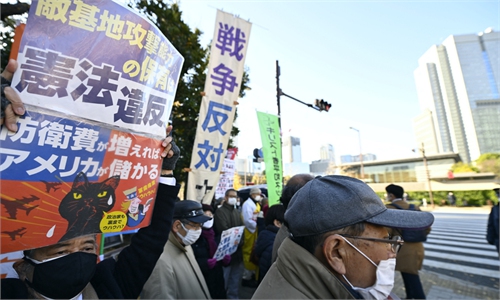
The Japanese people are also victims of militarism. Rallies have been held across Japan in strong protest of the Japanese government's military expansion. Some scholars also note that the defense budget hike will weigh heavily on Japan's economy and eventually be borne by the ordinary people in Japan, spokesperson Lin said.
Japan's substantial increase in defense spending serves three purposes: first, to break through the constraints of its exclusively defensive posture and pursue the status of a "military power"; second, to meet US demands for greater defense responsibility, with a significant portion of the increased spending used to procure offensive weapons from the US; and third, to contain China, which has been the main direction of Japan's policy since the adoption of the new three documents on security and defense in 2022, Zhuo Hua, an international affairs expert at the School of International Relations and Diplomacy at Beijing Foreign Studies University, told the Global Times on Friday.
Previously, Japan focused on building an operational capability system combining both offense and defense. In fact, its high military budget is gradually breaking the conceptual boundaries of the "self-defense forces", pushing Japan toward becoming a "defense army" or a "national military", which itself constitutes a significant breach of the pacifist constitution, Song Zhongping, a military affairs expert, told the Global Times on Friday. "The Japanese government has already begun substantially crossing the traditional red line of the national military concept," Song said.
Hyping so-called 'military threat'
Following the unveiled new record high fiscal 2026 defense budget, Japanese Defense Minister Shinjiro Koizumi continued hyping up so-called Chinese military strength on Friday, citing a report from the US Department of Defense on military and security developments involving China in 2025.
Koizumi claimed during a press conference on Friday that China is continuously strengthening its military capabilities with a focus on enhancing its long-range operational capacity.
Japan, under the banner of the so-called Japan-US alliance, has been simultaneously hyping up the so-called Chinese military threat while claiming it wants to consult with the US on how to respond, Song said.
"However, US officials previously made it clear that while the US continues its firm alliance with Japan, it is seeking to find productive ways to work together with China," Song said, noting that under the US government's agenda, maintaining stable China-US economic and trade relations was prioritized above Japan's interests.
Therefore, the Japanese defense minister's high-profile posturing and constant theatrics, to some extent, reveal a lack of clear judgment about the current situation and an inability to fully grasp the reality of the circumstances, Song said.
RELATED ARTICLES