China’s high-speed rail network tops 50,000 km, cementing global lead
Milestone expansion strengthens regional connectivity and highlights innovation-driven growth: experts
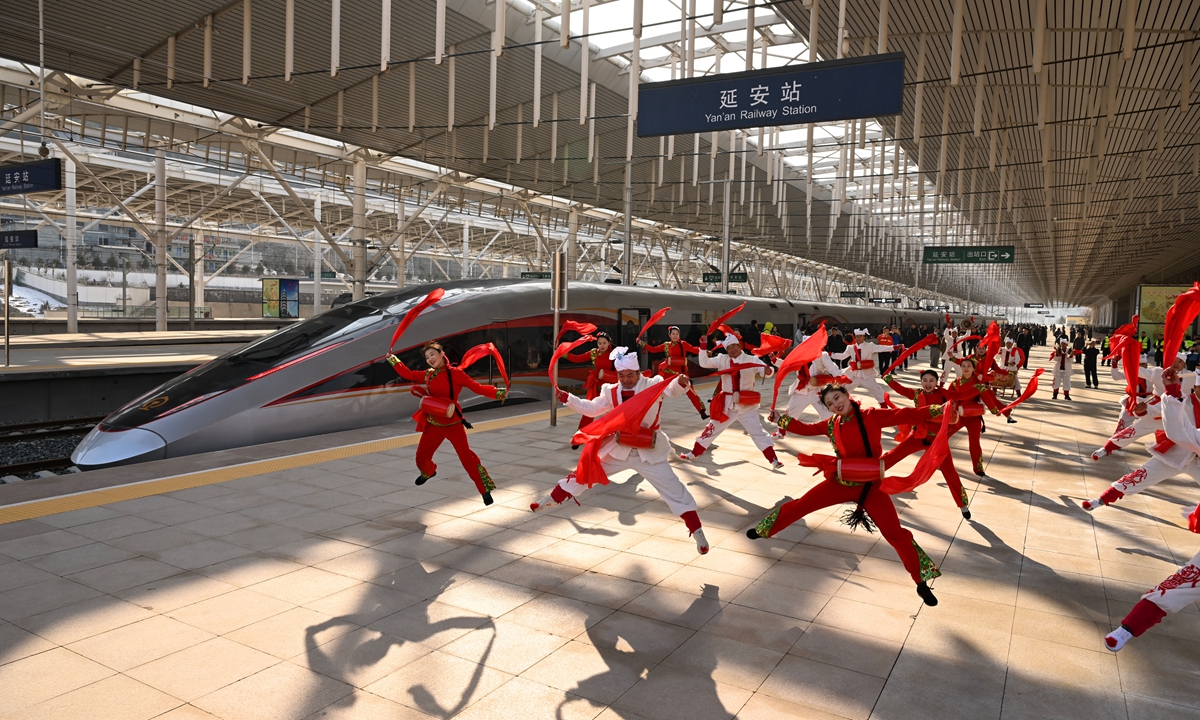
Residents put on an Ansai waist-drum performance, a traditional drum dance, in front of the C9312, the first train of the Xi'an-Yan'an high-speed railway at Yan'an Station in Northwest China's Shaanxi Province, on December 26, 2025. Photo: VCG
With the opening of the Xi'an-Yan'an line on Friday, China's high-speed rail (HSR) network has surpassed 50,000 kilometers in operating mileage, Global Times learned from China Railway. The milestone marks a new phase in China's railway development and highlights the country's sustained push to improve infrastructure connectivity and advance coordinated regional growth, analysts said.
This progress further consolidates China position as the world's largest and most advanced HSR system. The country now ranks first globally in terms of operating mileage, exceeding the combined total of all other countries, according to a statement the operator sent to the Global Times.
The landmark achievement comes as China, during the 14th Five-Year Plan period (2021-25), saw marked improvements in the scale, quality and modernization of its rail network, while the outline of the 15th Five-Year Plan (2026-30) calls for accelerating the development of a modernized infrastructure system.
Chinese experts said the milestone goes beyond a simple expansion in mileage. By making long-distance travel faster and more convenient, the high-speed rail network is increasingly shaping how regions connect, work together and grow, and is expected to support more balanced regional development and create new momentum for the economy.
Boosting connectivity
The newly opened Xi'an-Yan'an high-speed railway runs from Xi'an, capital of Northwest China's Shaanxi Province, through the cities of Weinan and Tongchuan, and terminates in Yan'an. Stretching 299 kilometers, the line is designed for a maximum speed of 350 kilometers per hour, China Central Television reported on Friday.
During the initial stage of operation, up to 38 electric multiple unit (EMU) trains will run daily. With a total of 10 stations to be put into service, the fastest travel time between the two cities will be 68 minutes, which are 62 minutes shorter than current conventional rail services.
The launch of the line will significantly improve travel for residents along the route and is expected to support rural revitalization in the northern province, boost high-quality regional economic and social development, and contribute to a new phase of China's western development drive, the report said.
With the opening of the line, China has built the world's largest and most advanced high-speed rail network. Within a 500-kilometer radius, China's major urban clusters have largely formed one- to two-hour travel circles. Cross-regional city trips of around 1,000 kilometers can generally be completed within four hours, while journeys of about 2,000 kilometers increasingly allow for same-day round trips.
Also on Friday, another major rail project came on-stream as the Wuhan-Yichang section of the Shanghai-Chongqing-Chengdu high-speed railway entered operation, cutting the fastest travel time between Wuhan and Yichang to just 69 minutes, according to Xinhua News Agency. The project will provide a faster passenger link between central and western parts of Hubei province, strengthen rail connectivity along the Yangtze River corridor, and support regional economic and social development, analysts said.
Sun Zhang, a rail transit expert and professor at Shanghai's Tongji University, told the Global Times on Friday that surpassing 50,000 kilometers is a milestone for China's high-speed rail buildout. He said the achievement reflects the growing maturity of China's rail system and its expanding role in supporting national development and regional connectivity.
The achievement marks the basic formation of the country's backbone railway network, said Pan Helin, a member of the expert committee of the Ministry of Industry and Information Technology. It not only consolidates China's global lead in HSR technology, construction standards and operating scale, but also highlights the tangible progress of the strategy to build a strong transportation system, he said.
"The cluster of high-speed rail projects coming into operation toward the end of the year reflects that China is not only building infrastructure faster, but also focusing on the high-quality development of its infrastructure system and the entire economy," Pan told the Global Times on Friday.
China revised its Medium- and Long-Term Railway Network Plan in July 2016, expanding the vision to an "eight vertical lines and eight horizontal lines" network. Since then, the country's high-speed rail development has shifted toward a more integrated network, greater technological self-reliance, higher safety and quality standards, and more market-oriented, high-quality growth, according to analysts.
Since the start of the 14th Five-Year Plan period (2021-25), the country has built and put into operation about 12,000 kilometers of HSR, with total operating mileage rising by roughly 32 percent from the end of 2020 and extending HSR access to 128 counties nationwide, per China Railway.
"Major transport projects coming into service often serve as catalysts for regional integration. By cutting travel times for passengers and goods, they speed up the flow of people and logistics, helping foster new growth engines such as corridor economies and transport hub-based development," Pan noted.
Innovation momentum
China has also reached a world-leading level in high-speed rail technology, supported by a comprehensive system spanning engineering construction, equipment manufacturing and operational management, according to China Railway.
China's technological advances in the rail sector deserve particular attention, particularly breakthroughs in some internationally cutting-edge areas such as CR450 EMU and heavy-haul freight railway technologies, Sun noted.
Before the Wuhan-Yichang section of the Shanghai-Chongqing-Chengdu high-speed railway entered service on Friday, the CR450 EMU - often dubbed the world's fastest high-speed train - was tested on the line, where it set records with a single-train speed of 453 km/h and a relative passing speed of 896 km/h.
It marks the world's first establishment of a top-level technical benchmark system for 400-kilometers-per-hour-class high-speed trains, according to the operator.
At the end of 2024, China Railway unveiled the prototype of the CR450 EMU, whose key performance indicators, including operating speed, energy efficiency, interior noise levels and braking distance are internationally leading.
The rail innovation now extends well beyond passenger services. On December 8, China achieved a major breakthrough by successfully testing the world's first group operation of a 35,000-ton heavy-haul train. The trial represents a significant advance in heavy-haul rail technology and could reshape existing rail transport systems, with the potential to bring transformative changes to railways worldwide.
China is integrating autonomous-driving concepts with high-speed rail control technologies to make rail transport safer, more efficient and better suited to large-scale use, Sun said. "Railway infrastructure and high-end manufacturing will boost industry growth and help new technologies' applications, continuing to serve as an important pillar supporting China's growth," he added.
RELATED ARTICLES