China adopts revised Foreign Trade Law, to promote cross-border financial services, mutual recognition of digital certificates
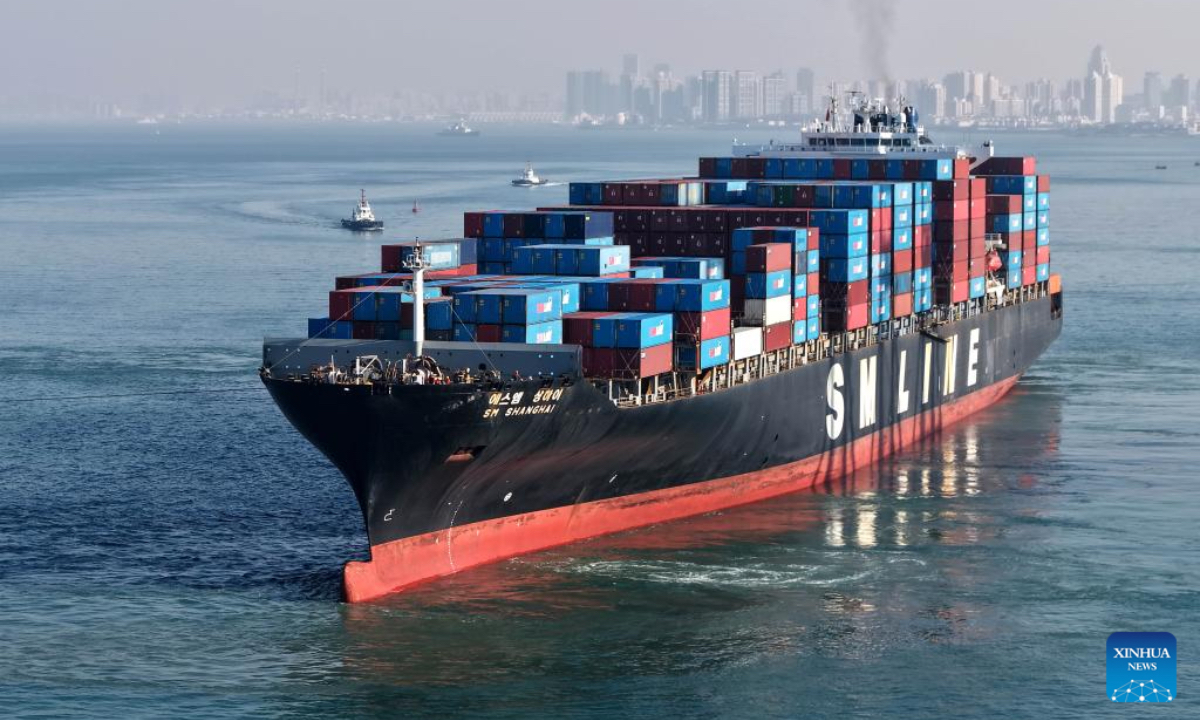
A drone photo taken on Dec. 4, 2025 shows a cargo ship loaded with containers departing from the Qianwan Container Terminal of Qingdao Port in east China's Shandong Province. With nearly 240 foreign trade routes, Qingdao Port connects over 700 ports in more than 180 countries and regions worldwide. (Xinhua/Li Ziheng)
A revised version Foreign Trade Law was passed at a session of the National People's Congress Standing Committee on Saturday and will take effect on March 1, 2026, the Xinhua News Agency reported on Saturday.At a press conference on December 19, Huang Haihua, spokesperson for the Legislative Affairs Commission of the National People's Congress (NPC) Standing Committee, the nation's legislature, said key revisions include adding provisions to promote the building of a strong trading nation, safeguard a fair and just international economic and trade order, encourage international trade in services through various models, and support trade promotion platforms in enhancing their functions and service capacity.
The revision also strengthens provisions related to trade facilitation, including measures to promote the development of a cross-border financial services system, advance international mutual recognition of digital certificates and electronic signatures, improve trade facilitation, develop product standards, certification and labeling systems related to green trade, and support the development of a skilled foreign trade talent pool, the spokesperson noted.
China's Foreign Trade Law took effect in 1994, and was revised for the first time in 2004. The newly revised law now consists of 11 chapters, according to Xinhua.
Revisions related to the cross-border financial services system are expected to enhance enterprises' ability to withstand risks in an increasingly complex and volatile global trade environment by improving mechanisms such as cross-border settlement and payment services, Li Yong, an executive council member at the China Society for WTO Studies, told the Global Times on Saturday.
Meanwhile, strengthening the foreign trade talent pool is seen as a major highlight, helping transform China's advantages in digital technologies and green industries into stronger trade competitiveness and better support the development of digital and green trade, Li said.
Data released by the General Administration of Customs (GAC) on December 8 showed that China's total goods trade reached 41.21 trillion yuan ($5.83 trillion) in the first 11 months of this year, up 3.6 percent year on year, with the growth rate unchanged from that of the first 10 months. In November alone, trade growth rebounded to 4.1 percent year on year, marking 10 consecutive months of expansion since February.
Lü Daliang, spokesperson for the GAC, said China remains committed to openness, cooperation and mutual benefit and continues to expand two-way trade cooperation with its partners to promote shared development. In the first 11 months, China recorded both export and import growth with more than 110 countries and regions worldwide, an increase of more than 20 from the same period last year.
"The revision of the Foreign Trade Law not only aims to stabilize foreign trade in the short term, but also lays a solid long-term foundation for high-quality and sustainable trade development," said Li, stressing that it is fully aligned with the Recommendations of the Central Committee of the Communist Party of China for Formulating the 15th Five-Year Plan for National Economic and Social Development, stating that China should enhance both quality and performance in foreign trade and work faster to turn China into a strong trading nation.
RELATED ARTICLES