World's first 6-ton-class tiltrotor aircraft, independently developed by Chinese company, completes maiden flight
By and Fan Wei Published: Dec 28, 2025 05:14 PM

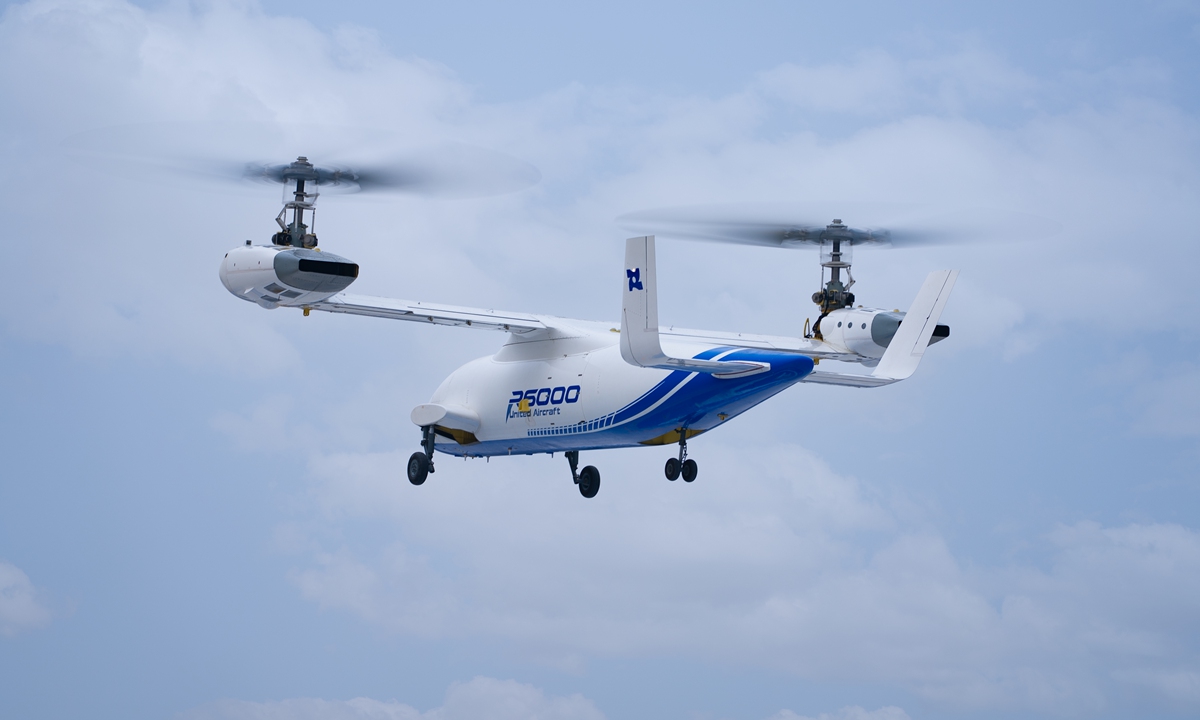
The Lanying R6000, independently developed by Chinese company United Aircraft successfully completes its maiden flight in Sichuan Province on December 28, 2025. Photo: Courtesy of United Aircraft
A 6-ton-class tiltrotor aircraft—the world's first of its kind—named the Lanying R6000 and independently developed by a Chinese company, successfully completed its maiden flight on Sunday in Southwest China's Sichuan Province, the Global Times learned from the company.
The tiltrotor aircraft is believed to serve point-to-point air commuting, in cities, across sea routes, and mountainous areas, reducing time and space distances and helping to build cross-regional "door-to-door transport networks, according to a release sent to the Global Times by United Aircraft.
The emergence of the R6000 indicates that China has reached the forefront of the world in the cutting-edge aviation field of tiltrotor, breaking the long-standing technological monopoly, Zhao Fengming, the project manager, told the Global Times.
The R6000 is equipped with the AES100 engine independently developed by AERO Engine Corporation of China, Zhao said.
The Lanying R6000 features unique tiltrotor design technology. It is able to transit smoothly between vertical takeoff and landing (VTOL) mode and high-speed horizontal flight mode. This design merges the vertical takeoff, landing, and precise hovering capabilities of traditional helicopters with the long range, high payload capacity, and high-speed cruise advantages of fixed-wing aircraft, creating a unique dual-mode flight performance platform, according to the company.
As the largest tiltrotor aircraft successfully completing its maiden flight in China to date, the LanYing R6000 adopts an advanced tilting rotor shaft design rather than a fully rotating engine nacelle configuration, achieving significant breakthroughs in flight control and power system design.
This configuration avoids the high-temperature airflow generated by engine exhaust during takeoff and landing phases, thereby preventing potential harm to personnel moving around the aircraft near its fuselage. Additionally, it eliminates the risk of high-temperature ablation damage to surfaces of maritime moving platforms lacking ablation-resistant coatings, which will facilitate the future landing and takeoff of this aircraft on ordinary maritime platforms, according to the company.
In fixed-wing flight mode, the Lanying R6000 achieves a cruising speed of 550 kilometers per hour—about twice that of traditional helicopters.
It also boasts a maximum commercial payload of 2,000 kilograms, far exceeding that of helicopters in the same weight class. With a maximum range of 4,000 kilometers—four times that of traditional helicopters—and a service ceiling of 7,620 meters, twice that of traditional helicopters.
Meanwhile, the aircraft features wing tandem-folding and blade retraction technologies, reducing its footprint during parking and overcoming the deployment and storage bottlenecks of traditional fixed-wing aircraft in confined spaces.
The company said the successful maiden flight of the Lanying R6000 marks a series of independent breakthroughs in core key technologies in the tiltrotor aircraft field in China. The aircraft is equipped with an intelligent tilt and flight control system that possesses fully independent intellectual property rights, ensuring ultimate safety and stability throughout the entire flight process. In terms of power and rotor systems, the use of high-performance turboshaft engines and advanced composite rotor blades achieves balance between power, efficiency, and quietness.
The entire transmission system meets the most stringent aviation safety standards, laying a solid foundation for the large-scale application of the aircraft.
The low-altitude economy is steadily integrating into people's daily lives. The Xinhua News Agency reported that drones now are able to transform into food delivery couriers, taking off effortlessly as a freshly brewed cup of coffee travels between buildings, accurately reaching the customer's hands just minutes later. For those seeking more than conventional tourism, taking a helicopter to soak in panoramic views of mountains and rivers unlocks a fresh aerial perspective.
Apart from serving air commuting, the Lanying R6000 is also expected to play a role in medical emergencies, fire rescue, police patrols, and large-scale disaster relief operations, enabling rapid and precise deployment of personnel and suppliesIt also opens up new possibilities for high-end private travel and aerial sightseeing tourism, according to the company.
According to forecasts by the Civil Aviation Administration of China, the market size of China's low-altitude economy is expected to reach 1.5 trillion yuan by 2025, with the potential to exceed 3.5 trillion yuan by 2035. Below the 1,000-meter altitude, opportunities are boundless, Xinhua reported.
RELATED ARTICLES