ARTS / CULTURE & LEISURE
Musk remarks put China’s fast-evolving humanoid ‘cerebellum’ in spotlight
Dancing with robots
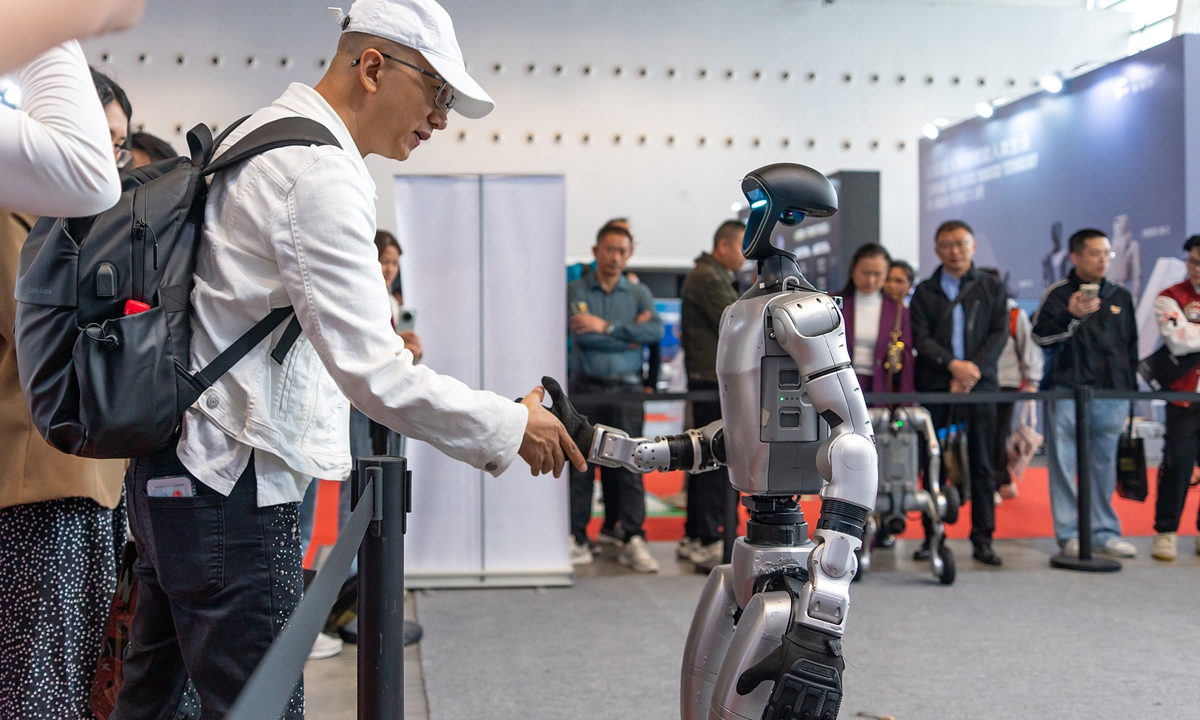
A humanoid robot shakes hands with an attendee at an event in Guangzhou, South China's Guangdong Province on October 22, 2025. Photo: VCG
A concert, six humanoid robots, and one flawless somersault. Together, they ignited not only the cheers of a crowd of more than 100,000 viewers, but also triggered a surge of wows in the cyberspace.On Saturday, the chief engineer of Tesla's Cybertruck reposted a video showing Chinese company Unitree Robotics' Unitree G1 humanoid robot conducting synchronized combat-movement tests alongside a human engineer. The robot mirrored the engineer's fighting motions with impressive precision until the final moment, when it delivered what viewers jokingly described as a "vicious" kick toward its human counterpart. Tesla CEO Elon Musk responded with a laughing-crying emoji.
This marked the second time in a month that Musk had commented on Chinese-made humanoid robots. The first occasion, however, did not take place in a laboratory or factory, but on a concert stage.
On the evening of December 18, at singer Wang Leehom's concert in Chengdu, Southwest China's Sichuan Province, six humanoid robots executed synchronized Webster flips on stage, moving in precise synergy. Following the performance, Wang's studio described it as "the world's first robot concert performance." The video caught Musk's attention. He reposted the clip, adding a single word - "Impressive" - triggering widespread discussion across global technology circles.
Unitree Robotics CEO Wang Xingxing responded to Musk's endorsement, saying that public enthusiasm for his firm's robots exceeded expectations. "Being liked by so many people is truly exciting," he said, adding that the attention was beneficial not only for Unitree, but for the broader robotics industry.
From standing stiffly on the Spring Festival Gala stage while tossing a handkerchief to performing backflips, why have humanoid robots' performances suddenly generated such an immense response in the world?
Three humanoid robots from Unitree Robotics perform at a concert on December 18. Photo: Courtesy of Unitree Robotics
'Kungfu' robots"These shows allow the public, perhaps for the first time, to intuitively grasp how far humanoid robots have come in dynamic control, and how those capabilities can be packaged in controlled environments into highly shareable outcomes," Li Qingdu, executive dean of the Institute of Machine Intelligence at the University of Shanghai for Science and Technology, told the Global Times.
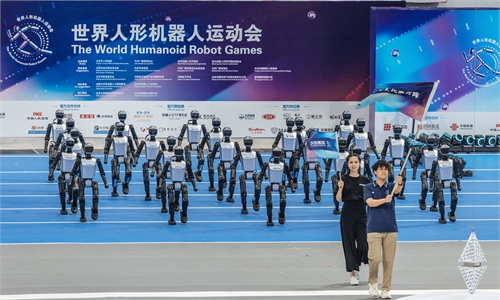
Commenting beneath the concert video, many viewers expressed amazement that robots could now perform movements humans cannot. The contrast was stark; just months earlier, at the first World's Humanoid Robot Games (WHRG) in Beijing, some robots struggled to complete a 400-meter run without veering off course or falling.
"At its core, it's about robots becoming more human-like in agility," Li said. "That's what triggered such a strong reaction."
A Unitree Robotics representative surnamed Huang told the Global Times that since the WHRG, the G1's motion-control system has undergone continuous upgrades. By October, it had reached version 6.0, the same version used in the concert performance. The eye-catching somersaults, he explained, were the direct result of these latest motion-control improvements.
The G1 robot that took the stage stands approximately 1.32 meters tall and weighs 35 kilograms, yet it packs formidable capabilities. Equipped with between 23 and 43 joint motors, it delivers a maximum joint torque of up to 120 newton-meters, enough to support complex, high-difficulty movements.
Even more critical is its enhanced group coordination capability. The millisecond-level synchronization of six robots was made possible by a distributed control system supported by 5G and edge computing. Amid intense lighting, smoke, and close interaction with human dancers, the robots relied on multimodal perception systems, integrating vision, inertial sensing, and force feedback to maintain stable performance.
Better motion imitation
"This performance may only be a starting point," Li said. "It signals the accelerated arrival of a new era of humanoid robots, driven by precision hardware, advanced algorithms, diverse application scenarios, and capital."
Li's view is far from speculative. In fact, several Chinese robotics firms, including Unitree, EngineAI, and DroidUp, have achieved synchronized multi-robot stage performances using multi-agent control technologies. Li's own team at DroidUp Robotics collaborated with human performers earlier this year at a Peking Opera performance. The robot's human-like facial expressions to replicate traditional opera footwork and physical bearing sparked widespread discussion.
Also in December, a teaser for a unique "boxing" competition captured global attention. Shot with dim lighting and cinematic editing, the video showed EngineAI's T80 humanoid robot unleashing fluid punch combinations and kicking through a wooden door with explosive force.
The robot also demonstrated basic environmental perception, enabling it to avoid collision risks under complex lighting conditions and in densely populated settings. CEO Zhao Tongyang personally participated in a test, being kicked by the robot on stage. A 75-kilogram adult was knocked to the ground by a single strike.
That kick bore more than a passing resemblance to the one seen in Unitree's video on Saturday. A EngineAI Robotics representative surnamed Wu told the Global Times that while the test appeared playful, it was designed as a direct or extreme way to evaluate the robot's strength and control.
"At this point, robots' large-scale motion capabilities are highly mature and can be widely applied in performance settings," Li said. "This indicates that the 'engineering of the cerebellum,' the systems governing movement control, is growing increasingly sophisticated."
Humanoid robots, he added, are moving beyond demonstrations of basic walking and jumping toward more demanding goals: stable locomotion in unstructured environments, dexterous manipulation, and effective human-robot collaboration.
Awaiting a stronger brain
As robots' physical capabilities continue to advance, concerns arise over whether they can truly be controlled, and whether they can be meaningfully deployed in practical applications.
The China Electronics Society predicted that, by 2030, China's humanoid robot market could reach approximately 870 billion yuan. Meanwhile, a report from China's Development Research Centre of the State Council estimated that the embodied intelligence market may top 400 billion yuan by 2030 and surpass 1 trillion yuan by 2035.
Behind the rapid maturation of motion control lies the fundamental engineering tension --computational division of labor. The "brain" handles perception and planning, while the "cerebellum" translates high-level intent into high-frequency, real-time joint control signals, managing dynamics, balance, and disturbances, and addressing what engineers call "the last centimeter" between algorithms and the physical world.
"What companies like EngineAI and Unitree are demonstrating is precisely this 'engineering of the cerebellum,' extracting motion-control capabilities from bespoke projects, manual tuning, and tightly coupled code, and turning them into reusable, deliverable, and measurable system assets," Li said. "When robots can complete 80 percent of tasks in 80 percent of unfamiliar environments using only voice commands, that's when the brain will have caught up, and embodied intelligence will reach a true inflection point."
The challenge now, he noted, is how the brain can keep pace with the rapidly advancing cerebellum.
Wang said in June that Unitree's ultimate goal is to make robots truly useful for work. The "ChatGPT moment" for embodied intelligence, he predicted, could arrive within the next one to two years.
From the Spring Festival Gala stage to stadium concerts, from laboratories to production lines, China's robotics industry is expected to complete a dazzling somersault, landing steadily at the center of the global AI push.
RELATED ARTICLES