ARTS / CULTURE & LEISURE
Nationwide passion for reading revitalizes culture
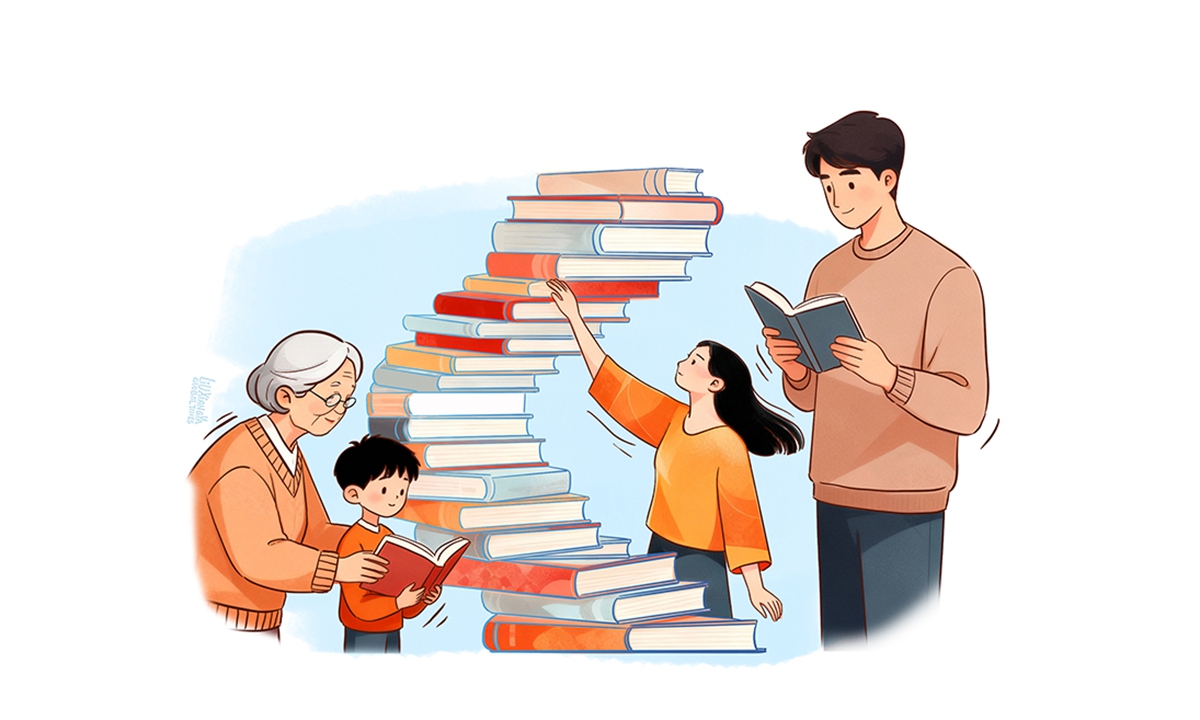
Illustration: Liu Xiangya/GT
The encouragement of learning and reading lies at the heart of traditional Chinese culture. China's ancient classic The Analects of Confucius begins with the sentence: "Is it not a pleasure, having learned something, to try it out at due intervals?" This ethos is echoed in other masters' thoughts such as those of the Tang Dynasty (618-907) calligrapher Yan Zhenqing, who once wrote in a poem, "Only at old age will you regret not having studied earlier." Southern Song Dynasty (1127-1279) philosopher Zhu Xi also noted that to seek underlying principles, one must turn to books.Is reading essential for every individual? Should the entire nation commit to reading? The answer is an absolute yes. As Confucius observed: "You will not be able to express yourself properly, if you do not study The Book of Songs; You will have no ground to stand on without learning the rites."
From the 20th to the 21st century, China traversed an era of war and revolution, experienced the periods of socialist construction and reform and opening-up, and has now embarked on a new journey to build China into a great modern socialist country in all respects.
Advancing from a semi-colonial and semi-feudal society to a new era of socialism with Chinese characteristics, and progressing from poverty to standing up, growing prosperous, and becoming strong, this victory is the triumph of the Communist Party of China (CPC) and the Chinese people through over a century of tenacious endeavors.
Since the 18th National Congress of the CPC held in 2012, in the face of rapid scientific and technological development and various new challenges both domestic and international, the CPC Central Committee stood at the forefront, continuously learning, and leading the Chinese people with foresight and vision to seize development opportunities and create a brand-new chapter in history.
Today, the CPC Central Committee has elevated nationwide reading to a national strategy, and regulations to promote public reading have been officially issued. This is truly a commendable initiative. We look forward to, with the guarantee of national institutions and legislation, the country ushering in a great vision of a nation embracing the culture of books!
Someone might say, "I read a lot online every day." But you may only be skimming through fragments, mixed with unreliable information. Fragmented reading prevents you from truly understanding the context of matters or systematically grasping knowledge to draw conclusions; scrolling through texts encourages skimming dozens of lines at a glance, leaving no room for reflection or insight, nor for deep memorization to internalize knowledge.
Thus, it often happens that you read, you spend time, yet you cannot remember, articulate, or clarify. Research indicates that printed books are better than e-books in terms of memory retention and reading depth. Of course, we do not deny the convenience brought by the internet and AI in summarizing and searching information. Ultimately, however, knowledge should reside in our minds, not merely in the storage of media.
Someone might also say, "I'm always busy, so I have no time to read." But the truth is, bits and pieces of time are perfectly suited for reading. As Chinese literary giant Lu Xun observed, "Time is like water in a sponge. There will always be some if you are willing to squeeze it." While riding the subway, traveling, or between household chores, these moments can add up to meaningful reading.
Modern life offers immense conveniences as we are not living in times of turmoil, nor do we have to handle every task personally. The ease of transport, food delivery, and express services have saved us countless hours, and it truly comes down to whether one has the will to read.
In ancient times, those who were too poor to afford lamp oil still read by the light of fireflies or the reflection of snow. Therefore, today, with comfortable desks, chairs, and bright lights everywhere, if we still find excuses not to read, are we letting down our predecessors? Even from a purely personal development perspective, without enriching and improving oneself, how can one keep up with the times or make the meaningful contributions one is capable of in this life?
It can be said that throughout Chinese history, those who have left us a precious spiritual legacy were mostly individuals with great ambitions, and at the same time, they were diligent learners deeply versed in literature. Now, in the 21st century, we of this generation should not waste vast amount of time on entertaining and gossipy browsing in the face of the convenience and overwhelming information of new media. Nor should we abandon serious, intellectually substantial paper book reading for the sake of hearsay, sensationalism, pretentious "criticizing," and mindless "hype," substituting them for genuine knowledge.
Now, from policy direction to legal safeguards and institutional design, everything is being optimized to foster nationwide reading. Yet we have even greater expectations. Cultural departments should recognize, award, and publicize individuals who love reading, read well, and read broadly.
Education departments should aim to cultivate reading habits among the young generation and inspire a passion for reading, placing more emphasis on the selection of teaching materials and reading content.
Meanwhile, we must also nurture small, intimate reading spaces. And we must never forget the unity of "family." It is the starting point and ultimate destination for everyone. It is at home that many people develop their reading habits. Whether family members read and discuss books together or each scrolls through their phones alone at home will have a completely opposite impact on a child's lifelong development.
Let's read since we are living in a great era! Reading better, learning better, and putting knowledge into practice will directly strengthen our confidence, drive, sense of fulfillment, and happiness.
The writer of the article is the former minister of China's Ministry of Culture, honorary vice chairman of the China Writers Association and a Chinese contemporary writer and scholar. The article was first published in Chinese by the People's Daily on Sunday.
RELATED ARTICLES