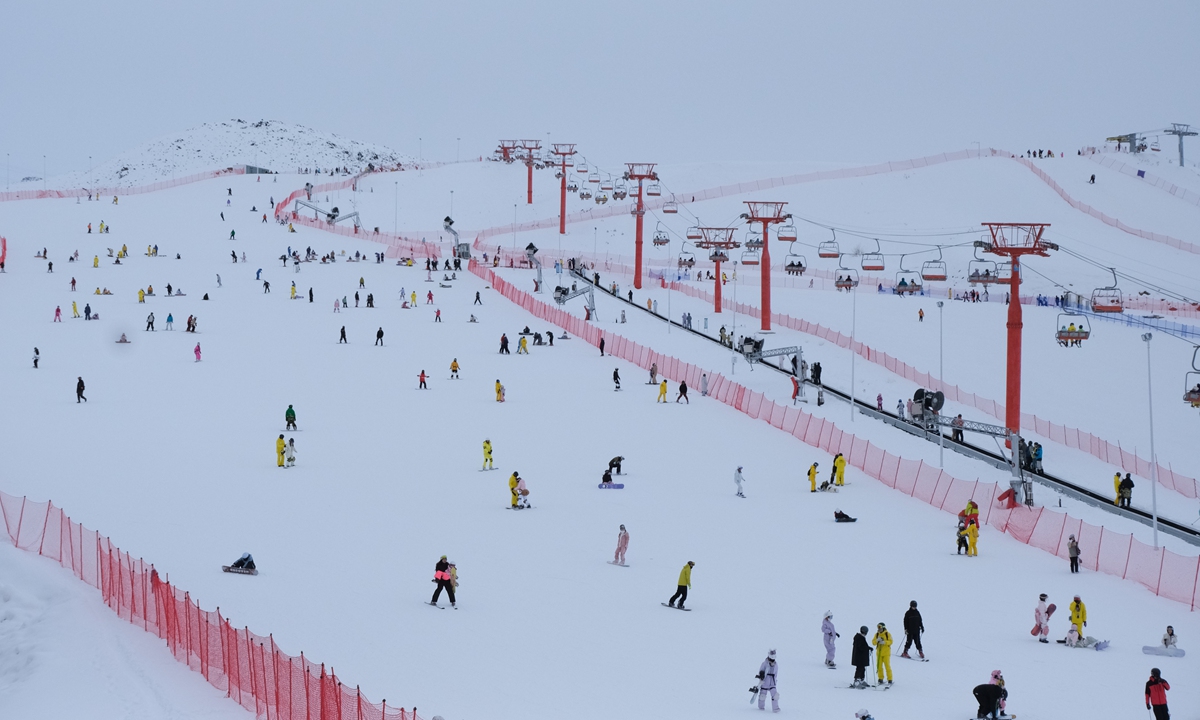
The Jiangjunshan Mountain International Ski Resort in Altay, Northwest China's Xinjiang Uygur Autonomous Region Photo: Li Yawei/GT
Experiencing wolf culture, learning to craft traditional ski tools, enjoying the sunset and music at a mountaintop ski resort... These are examples of how Altay, a popular ski destination in Northwest China's Xinjiang Uygur Autonomous Region, blends ice and snow with new scenarios, providing diverse experiences to invigorate winter tourism.
Since the start of this year's snow season, Altay has welcomed more than 6 million tourists, generating nearly 4.8 billion yuan ($685 million) in total spending, an official surnamed Guo from the local culture and tourism authority told the Global Times.
Qinghe county in Altay has integrated the wolf culture of the Kazak ethnic group with ice and snow tourism. Housing 200 wolves of various breeds, a local wolf park features four functional zones—a breeding center, a free-range area, a rescue station, and a wolf culture exhibition hall—offering wolf-themed tourism services.
Tourist can observe wolves closely to learn about wolf culture.
A tourist surnamed Gao from Northeast China's Heilongjiang Province told the Global Times that he visited the park after skiing. He described it as "a particularly novel and unforgettable experience."
Gao said that this close encounter with wolves helped him gain insight into the wolf culture of the Kazakh ethnic group. "After listening to the guide's introduction, I learned that wolves, with their unique wisdom, courage, unity, and fearlessness, are regarded as 'heroes' in traditional Kazak culture," he said.
During the visit, the Global Times reporter noticed that many staff members in the park are local ethnic minority residents. Bujinit Turdieli told the Global Times that her current monthly salary is 3,500 yuan, with additional commissions, while her previous income from farming was only a few hundred yuan per month; snow tourism has largely improved her living standards.
As of last week, Qinghe had received a total of 48,405 tourists this season, marking a nearly 4 percent increase compared to the previous season, an official from the local government told the Global Times on Sunday.
Lasite township in Altay attracts tourists by giving them the chance to experience making traditional fur skis, a local intangible cultural heritage. With support from local governments, Selambek, a local resident and a representative inheritor of this autonomous region-level intangible cultural heritage, has transformed a corner of his courtyard into an exhibition hall for traditional horsehide skis.
The corner now integrates processing and production, cultural displays, and product sales. Skiing enthusiasts and tourists from all over the country can visit the workshop and, under guidance, try cutting the board and installing the horsehide; they can also purchase fur skis and miniature ski handicrafts.
A pair of fur skis costs around 1,000 yuan, and the Selambek's family can produce about 50 pairs annually, earning an income of 50,000 to 80,000 yuan per year.
"This year, there are more tourists than before. So far, over 300 pairs of small skis have been sold, with sales revenue reaching about 130,000 yuan," he told the Global Times.
In addition, the Jiangjunshan Mountain International Ski Resort in Altay has specially introduced new experiences such as sunset parties and paragliding experiences and training programs, combining them with skiing.
A tourist from East China's Fujian Province told the Global Times that she came specifically to experience these new activities. "Besides skiing, I can also enjoy music while watching the sunset at the mountaintop, which is particularly novel."
As of Friday, the resort has already accommodated close to 400,000 visits this year, marking a 52 percent increase year-on-year, Zhang Qi, the marketing manager, told the Global Times.
RELATED ARTICLES