GT Voice: NEC’s 5G difficulties expose deeper problems in Japan’s telecom sector
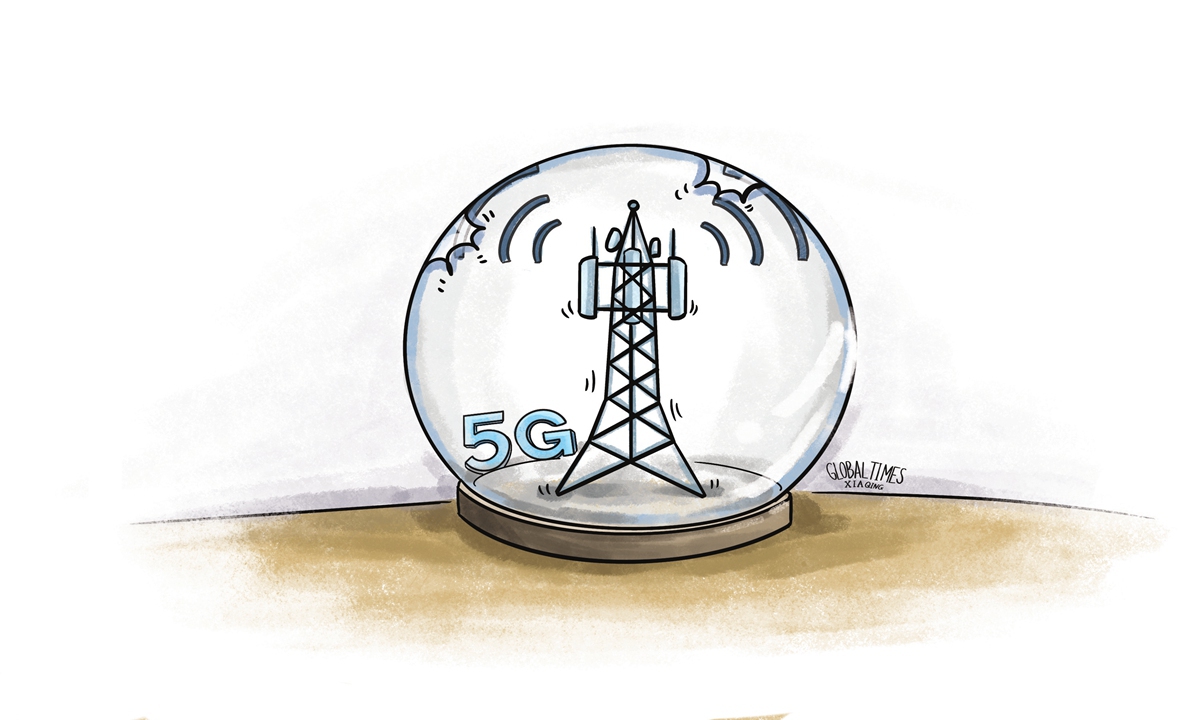
Illustration: Xia Qing/Global Times
Japanese telecom equipment maker NEC decided to halt development of wireless base stations for smartphones and other devices compatible with the 4G and 5G communications standards, representing "a retreat from a market dominated by Chinese and European players," the Nikkei Asia reported on Sunday.The decision by NEC, a key player in Japan's telecom equipment sector, is widely considered a natural outcome shaped by market forces against business models that lack economies of scale and sustainable market competitiveness. NEC's predicament is essentially a microcosm of the deep-seated development difficulties currently facing Japan's telecommunications equipment industry.
Modern telecom gear industry is marked by high globalization and intensive in capital expenditure, where economies of scale serve as the cornerstone of survival and development. Enormous sales volume is required to amortize costs and support technological iteration across a broad spectrum of research and development, wireless network manufacturing, and market promotion.
Currently, China's Huawei Technologies, Sweden's Ericsson and Finland's Nokia control nearly 80 percent of the global market for 4G and 5G base stations, while Japanese NEC and Fujitsu holding less than 2 percent of the global market share, the Nikkei Asia reported, citing data from research firm Omdia. The inability to gain sufficient market share has trapped NEC's related businesses in a quagmire of losses, ultimately forcing it to scale back production.
But Japan is unlikely to completely retreat from telecom gear market. Although NEC decided to call an end to 4G and 5G base station development, the company briefed media that it will continue development for the next-generation 6G wireless network standards. The move appears to epitomize Japan's efforts in recent years to promote 6G research and development, in order to walk out of the passive position it has been trapped in sluggish 4G and 5G development.
In 2020, Japan launched the Beyond 5G Promotion Strategy, a roadmap toward 6G that proposed the sequential establishment of key technologies starting from 2025 and the adoption of Beyond 5G communication services by 2030. However, the feasibility of such a strategy remains uncertain.
As reported by the Xinhua News Agency in April 2024, industry experts believe that Japan's insufficient development of 5G may affect its progress in 6G development. The ultra-high-frequency spectrums allocated to 6G can only travel in straight lines and over very short distances, necessitating a much denser deployment of base stations. And, compounding this challenge is Japan's inadequate 5G infrastructure.
More critically, there are significant shortcomings in Japan's technology reserves. Japan's 6G patent applications accounted for merely 9.9 percent of the global total, according to a survey conducted by Japanese media company Nikkei and Tokyo-based research company Cyber Creative Institute.
What is more noteworthy is that earlier this month, Japan, Australia, Canada, the UK and the US held a closed-door meeting of the international partnership known as the Global Coalition on Telecommunications (GCOT) in Tokyo. While the GCOT ostensibly focuses on cooperation in artificial intelligence and next-generation 6G standards, it is interpreted by media outlets like Nikkei Asia and Australia's Channel News as efforts to counter "China's grip on global telecoms."
Any attempt to shape a new high-speed telecom system based on geopolitical considerations is bound to face formidable challenges due to its dividing the global market, increasing technology development costs, and reducing network interoperability.
The past development experiences of 4G and 5G clearly demonstrate that truly viable and competitive technologies originate from widespread market demand, open cooperation, and sufficient market testing, rather than being arbitrarily shaped by geopolitical intentions. Japan's telecom gear industry faces constraints at the industrial level: it does not have a sufficiently large and unified internal market to incubate technologies and form economies of scale. Political alliances cannot compensate for its industrial shortcomings.
RELATED ARTICLES