Illustration: Xia Qing/GT
From a distance, changes in China's imports can be easy to overlook. Up close, in specific places and practices, the pattern comes into sharper focus. In 2025, a series of seemingly unrelated scenes - from Horgos on the border with Kazakhstan, to emerging trading models in Yiwu, and even tomato cultivation in Huaibei - together suggested how China's import landscape is being quietly reshaped.Horgos provides the first telling example. Widely regarded as one of the key hubs of China's westward opening, the port also illustrates how ongoing reforms are streamlining the mechanics of imports. Cargo throughput for both imports and exports at Horgos remained steady growth in the first 11 months of 2025, the Xinhua News Agency reported. Behind the headline number lies a concrete change: the introduction of a smart railway port and local fast customs clearance system has cut passage time for imported goods from two to three days to within 16 hours - an efficiency gain that is quietly transforming how trade moves across China's western border.
Horgos is just one concrete example of a broader trend. In 2025, China took measures to promote imports as part of its strategy to expand domestic demand and deepen high-standard opening-up. China implemented a tariff reduction measure effective January 1, 2025, under which provisional import tariffs on hundreds of products were lowered, facilitating greater access to high-quality foreign goods in the Chinese market.
Additionally, the General Administration of Customs implemented trade facilitation reforms such as the "two-step declaration" pilot program to streamline customs clearance for imported goods, reducing administrative burdens and improving efficiency for importers. These import-oriented reforms were part of broader policy efforts to support a more open economic structure in China.
As the year draws to a close, a second micro-level scene worth noting is Yiwu. Long regarded as a bellwether of China's exports, the city has also seen a notable rise in imports. According to a report from Yiwu Fabu, the city's official social media account, total imports in Yiwu reached 93.62 billion yuan ($13.36 billion) from January to November, a year-on-year increase of 30.1 percent.
This growth has been driven by multiple factors, including emerging business models and digital technologies such as cross-border e-commerce. According to the Xinhua News Agency, cross-border e-commerce import orders in Yiwu surpassed 100 million this year, setting a record. While digital platforms have facilitated faster and more efficient transactions, this surge also reflects the city's deeper integration into global supply chains and the diversification of imported goods.
Yiwu remains just one window into China's evolving import models and technologies. In 2025, China empowered its import processes through digitalization and advanced technologies such as artificial intelligence, big data, and smart systems, enhancing trade facilitation and operational efficiency.
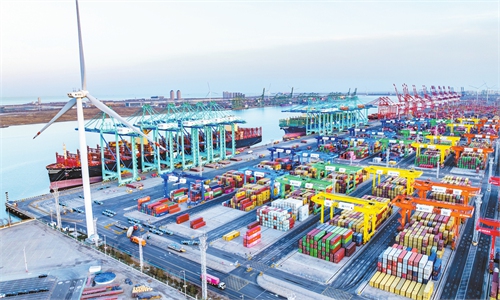
For example, the development of digital technologies continued to accelerate. In 2025, China expanded smart logistics, using advanced automation and digital technologies to improve cargo handling efficiency and strengthen global trade connectivity.
The third micro-level scene worth observing concerns domestic consumption. In Huaibei, East China's Anhui Province, tomato cultivation is nearing a bountiful harvest, with produce reaching the market in time for the upcoming holiday season, according to media reports.
As the New Year and Spring Festival holidays approach, the festive shopping season is already underway, underscoring the strength and potential of China's consumer market. This surge in demand creates significant opportunities for imports, yet it coincides with growing domestic competitiveness, as local producers supply high-quality goods that compete alongside imported products. In Huaibei, the rapid development of smart agriculture further enhances the competitiveness of Chinese agricultural output, illustrating how technological adoption is reshaping domestic consumption patterns.
China's domestic companies are steadily strengthening their competitiveness through innovation. While the country offers abundant market opportunities, capitalizing on them requires fair competition and a continual enhancement of capabilities.
As 2025 comes to a close, these micro-level scenes collectively underscore the ongoing development of China's import market. Contrary to claims in some foreign media outlets suggesting a softening in imports, the numbers and trends point to a vibrant market that is becoming structurally more optimized, with continuous improvements in quality and competitiveness. Taken together, they provide a clear picture of a super-large-scale market that is steadily expanding its openness and maturing in sophistication, reflecting the evolving dynamics of China's engagement with global trade.
The author is a reporter with the Global Times. bizopinion@globaltimes.com.cn
RELATED ARTICLES