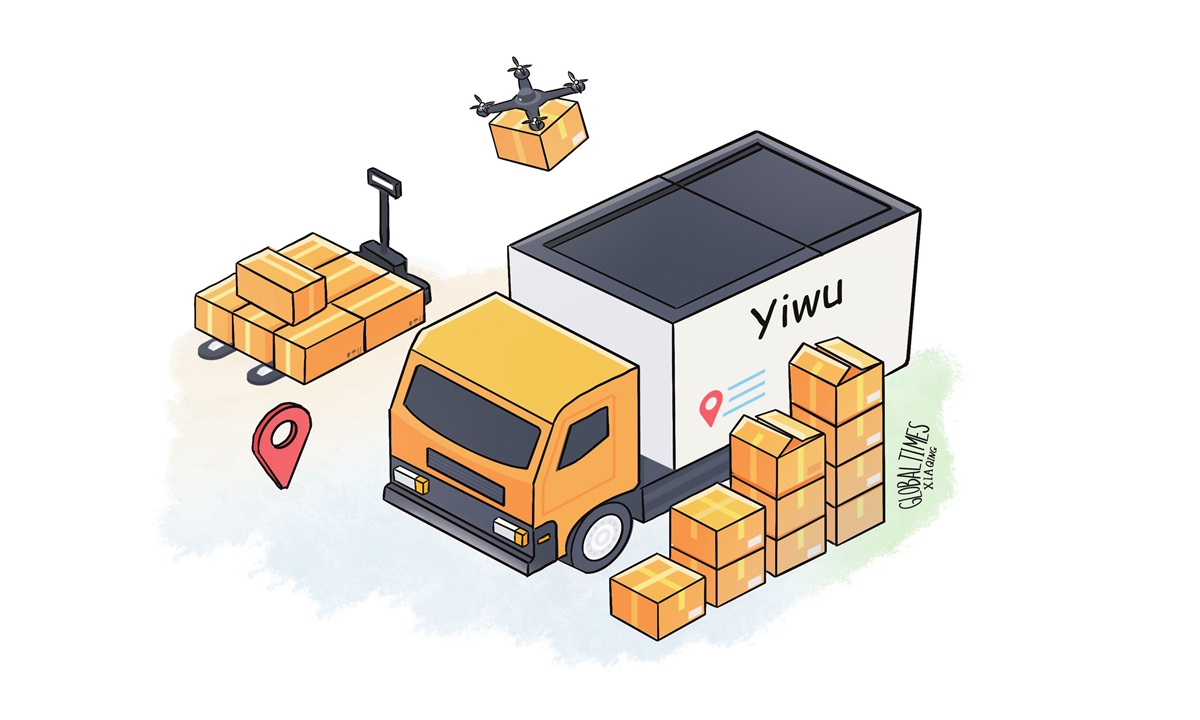
Illustration: Xia Qing/GT
Yiwu, the export-driven city in East China's Zhejiang Province, is seeing a noteworthy rise in activity from a different direction: imports. On Wednesday, Yiwu customs cleared a shipment of bonded cross-border e-commerce goods that lifted the city's full-year e-commerce import order count past 100 million for the first time, according to Yiwu Fabu. For a hub best known for its outward trade, the scale of inbound orders is notable - and signals a trend that warrants closer attention.A closer look at the mechanism behind these figures helps explain the surge. According to local media reports, one of the main models for cross-border e-commerce imports involves platforms purchasing goods in bulk from overseas sources based on market forecasts, and storing them in customs-supervised zones within China. Individual orders are then fulfilled directly from these bonded facilities. This approach can be understood as a "stock-in-advance" system and is intended to improve customs efficiency, maintain product quality, and, in many cases, offer more competitive pricing.
One factor supporting this growth is Yiwu's established role as a global hub for small commodities. The city offers a wide variety of products, a mature and diversified logistics network, and an efficient delivery system, all of which help facilitate the rapid expansion of cross-border e-commerce imports. Yiwu Fabu cited a supply-chain company executive who noted that average logistics costs per parcel in Yiwu are roughly 1.5 yuan ($0.21) lower than in other cities. While modest on a per-package basis, such savings can accumulate significantly across millions of shipments, providing a tangible advantage for businesses operating in the city.
According to Yiwu Fabu, Yiwu's cross-border e-commerce imports come from 74 countries and include more than 70,000 items, ranging from health supplements and cosmetics to toys. These goods can make use of the city's long-established distribution channels to reach consumers across China. Yiwu provides a noteworthy example of how imports can expand by relying on a complex logistics and distribution infrastructure, creating a dynamic in which inbound and outbound trade reinforce one another.
Yiwu is one of many examples illustrating emerging trends in China's import market. In advancing high-level opening-up, China has consistently emphasized the proactive expansion of imports, which is progressing along with domestic consumption upgrades and industrial upgrading amid the accelerating optimization of the economic structure, while meeting the growing demand for high-quality goods in the Chinese market.
China has introduced multiple measures, such as trade facilitation, and promoted the greater role of platforms such as cross-border e-commerce. Meanwhile, China has repeatedly sent clear signals about its commitment to expanding imports.
Cross-border e-commerce has shown relatively rapid growth, with the scale of import e-commerce transactions continuing to expand. In certain regions of China, cross-border e-commerce pilot zones and bonded warehouses have demonstrated strong performances in both order volume and transaction value. Meanwhile, changes in best-selling imported categories and evolving consumer preferences indicate that China's import consumption structure is steadily upgrading toward higher quality and greater personalization.
According to data from the General Administration of Customs, cross-border e-commerce imports reached about 425.54 billion yuan in the first three quarters of the year, up 5.9 percent. As a new business model in trade, cross-border e-commerce continues to grow, indicating that China's foreign trade structure is being optimized and upgraded, with high-quality development characteristics becoming increasingly prominent.
China's imports are increasingly developing alongside the country's established strengths in exports, distribution, and e-commerce. New business models and trade facilitation measures are emerging as key drivers of this growth, including initiatives to streamline customs and the rapid expansion of formats such as cross-border livestreaming. Companies and platforms are making use of these new channels and technologies to broaden import activity, while sectors such as health products, functional foods, smart devices, and environmentally friendly goods are becoming notable areas of expansion.
This does not mean that challenges are absent. Global trade remains subject to uncertainty. Yet the emerging opportunities in China's import sector merit attention.
Getting back to Yiwu, the city's export-oriented foundations and emerging import activity are not in conflict. On the contrary, the overlap between its export networks and its growing import operations allows the city to create additional space for cross-border commerce. Yiwu illustrates how China's long-standing commercial infrastructure can simultaneously support outbound shipments and facilitate inbound flows, generating tangible opportunities for trade in both directions.
The author is a reporter with the Global Times. bizopinion@globaltimes.com.cn
RELATED ARTICLES