China's polar research icebreaker Xuelong reaches Qinling Station, to unload cargo: media report
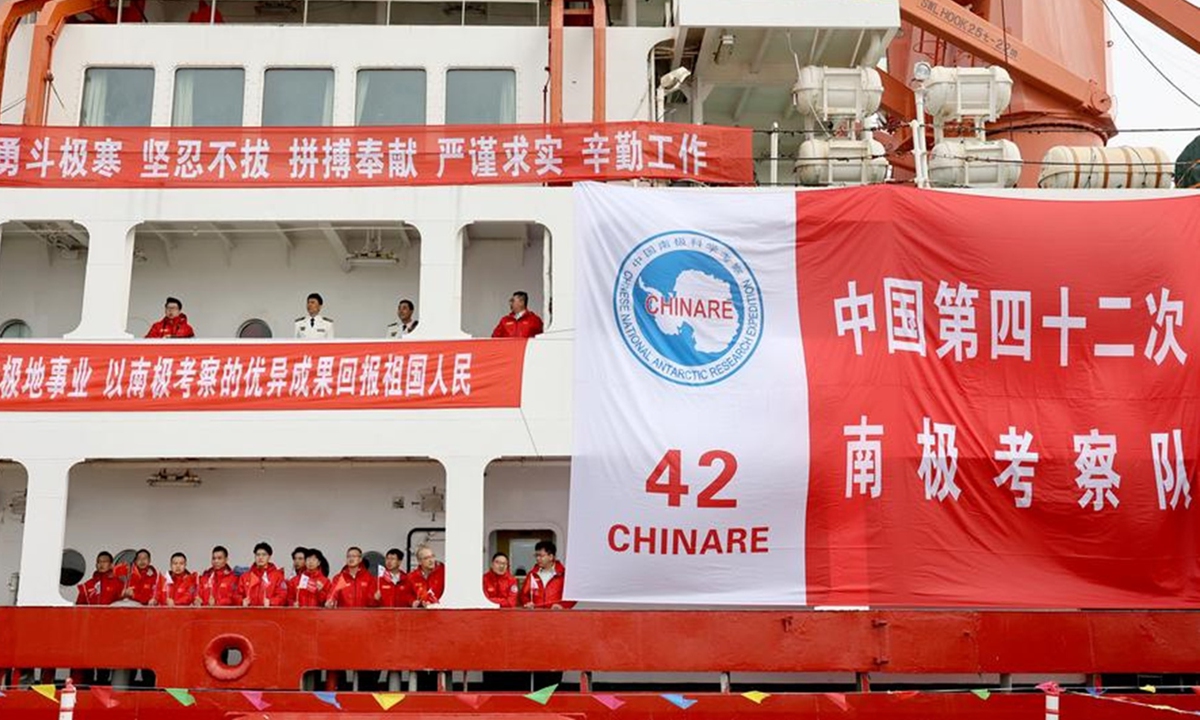
Members of the scientific expedition team bid farewell to their relatives, friends and colleagues on China's polar research icebreaker Xuelong, or Snow Dragon, in Shanghai, East China, Nov 1, 2025. Photo: Xinhua News Agency
The polar research icebreaker Xuelong carrying out China's 42nd Antarctic scientific expedition, successfully reached the waters near the Qinling Station on Monday Beijing time and commenced cargo unloading operations, Xinhua News Agency reported.
Wei Fuhai, the leader of the 42nd Antarctic expedition team, explained that this unloading operation involves approximately 1,400 tons of materials, including logistical support supplies, engineering materials, scientific research supplies, and fuel for the Qinling Station. The materials will be transported ashore via barges.
The unloading process is expected to last around five days, and depending on operational conditions, some materials and waste will be transported back to China. On-site engineering work is being carried out simultaneously with the unloading operations, per Xinhua.
The Qinling Station is China's fifth Antarctic research station. It commenced operations on February 7, 2024, filling a gap in China's scientific exploration in the Ross Sea region of Antarctica. According to Wang Tao, the station director, the Qinling Station has a total floor area of 5,244 square meters, making it the largest single building among China's existing research stations, with a capacity to accommodate 80 personnel.
It is reported that while the cargo unloading is underway at the Qinling Station, the expedition team will also utilize helicopters to conduct aerial photography of the surrounding areas and deploy the Xuelong for marine surveys and other scientific tasks, according to Xinhua.
The 42nd Antarctic expedition is organized by the Ministry of Natural Resources. A key aspect of this expedition is to continue improving supporting facilities such as the research building and communication network at the Qinling Station, further enhancing its operational support capabilities and scientific research potential.
Global Times
RELATED ARTICLES